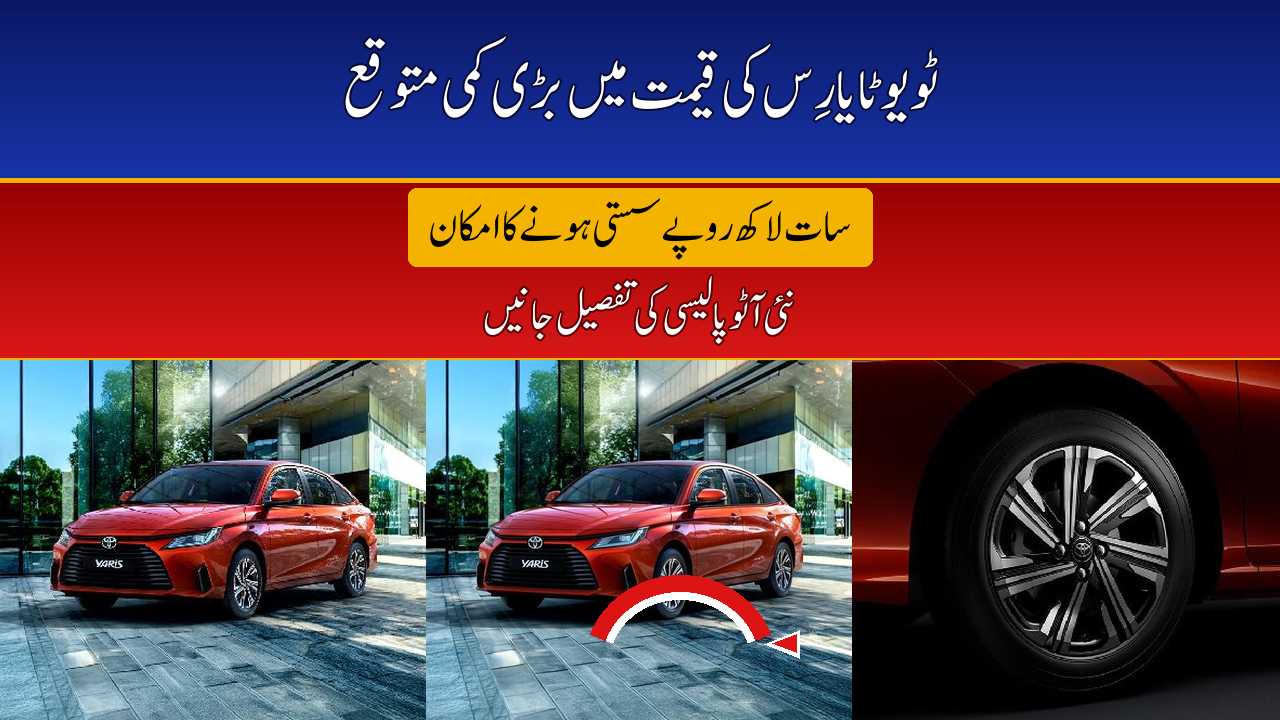
Toyota Yaris Price May Drop by Rs700,000 in Pakistan Under Proposed Auto Policy 2026–31
Toyota Yaris Price May Drop by Rs700,000 in Pakistan Under Proposed Auto Policy 2026–31 By Bilal Ahmed, Business Desk | Updated: October 21, 2026 Will the Toyota Yaris price drop in Pakistan? According to estimates published by The Express Tribune, yes — the 1,496cc Toyota Yaris, currently around Rs6 million, could cost roughly Rs5.3 million…
Toyota Yaris Price May Drop by Rs700,000 in Pakistan Under Proposed Auto Policy 2026–31
Will the Toyota Yaris price drop in Pakistan? According to estimates published by The Express Tribune, yes — the 1,496cc Toyota Yaris, currently around Rs6 million, could cost roughly Rs5.3 million in the first year of Pakistan’s proposed Automotive and Auto Parts Policy 2026–31, a potential reduction of Rs700,000. But read the fine print: this is an estimate, not an official announcement. Toyota Pakistan has not confirmed any price cut, and the policy still needs IMF, federal cabinet, and parliament approval before any of it becomes real.
What the Estimates Say: Rs6 Million to Rs5.3 Million
The Express Tribune’s estimates suggest the 1,496cc Toyota Yaris — the heart of Toyota’s small-sedan range and one of the most popular family cars on the road — could fall from about Rs6 million to approximately Rs5.3 million.
That is a cut of around Rs700,000, or roughly 11.7 percent. On a car in this segment, that is not pocket change: it is the difference between variants, between cash and a loan. For the middle-class buyers who walked out of showrooms this year when prices crossed Rs6 million, an 11.7 percent drop would reopen a door that had quietly shut.
But these figures are estimates based on the draft policy’s proposed tax changes. They assume the policy is approved roughly as drafted, that the cuts flow through to retail prices as calculated, and that nothing else — currency, dealer margins — moves against the buyer. Currency movement alone has wiped out announced price cuts in Pakistan’s auto industry before.
What Pakistan’s Auto Policy 2026–31 Actually Proposes
The proposal at the centre of all this is the Automotive and Auto Parts Policy 2026–31, the government’s five-year roadmap for how cars are taxed, built, and sold in Pakistan. Prime Minister Shehbaz Sharif approved the policy’s final draft on Tuesday, October 20, and it now goes to the IMF for approval before the federal cabinet and parliament.
Here is what the draft contains, in plain terms:
Conventional cars: customs duty down to 15% by 2031
For conventional internal combustion engine (ICE) cars and SUVs, the draft proposes bringing customs duty down to 15 percent by 2031 — with no additional or regulatory duty on top. That is the single biggest reason behind the Yaris estimates. Cut the duty wall, and the price floor of locally assembled and imported cars drops with it.
New energy vehicles get their own tax brackets
The draft divides new energy vehicles into three categories, each with a proposed sales tax rate:
- Battery Electric Vehicles (BEVs): 1 percent sales tax
- Range Extended Electric Vehicles (REEVs): 6 percent sales tax
- Plug-in Hybrid Electric Vehicles (PHEVs): 9 percent sales tax
These rates are subject to IMF approval, so read them as opening proposals rather than final numbers.
Hybrids treated equally with conventional cars
One detail worth noting: the draft proposes treating hybrid electric vehicles and conventional vehicles equally in terms of duties and taxes. That matters in Pakistan because the locally assembled hybrid market — led by Toyota’s own hybrid lineup — has been growing steadily. Equal treatment removes a policy grey area that has kept some manufacturers guessing.
Where the Policy Stands Right Now
This is the part that separates excitement from reality. Approving a final draft is step one of a long chain:
- PM approval (done): Prime Minister Shehbaz Sharif signed off on the final draft on October 20.
- IMF review (next): The government will submit the policy to the IMF, which must approve the tax and duty proposals.
- Federal cabinet: After the IMF, the policy needs federal cabinet approval.
- Parliament: The necessary bill must then be introduced and passed in parliament before anything takes effect.
Any one of these stages can change the numbers — the IMF in particular tends to have strong views about revenue-denting tax cuts. So the Rs700,000 figure is an estimate built on a draft. The final policy may look somewhat different, and the real price impact will depend on the final text.
What a Rs700,000 Cut Would Mean for Buyers
Let’s talk about what this would actually feel like in the market, because the Yaris occupies a very specific spot in Pakistani car culture. It is not a luxury car and it is not a cheap runabout — it is the default “first proper family sedan,” the car that competes with the Honda City for the same driveway.
A Rs700,000 reduction pulls the Yaris back into budgets many families had mentally closed off. It resets the competitive math — Honda and Suzuki price against the Yaris, and a cheaper Yaris forces everyone to recalculate. And if new prices fall, late-model used Yaris cars lose some of their current premium — good news for second-hand buyers, and worth remembering if you are selling right now.
There is a familiar pattern here: every time a credible policy signal hints at cheaper cars, showroom footfall slows as buyers wait — then, if the policy lands, pent-up demand releases at once. Recent car sales data shows the market already has momentum; a confirmed cut could amplify it substantially.
Should You Buy a Yaris Now or Wait?
This is the question actually sitting in people’s heads, and it deserves an honest answer: it depends on how urgently you need the car.
If you need a car right now — your old one is dying, you drive for work — the honest truth is that buying at today’s price gets you the car, and waiting on an unconfirmed estimate gets you a maybe. Nothing in the draft policy is law yet, and timelines in Pakistan can stretch.
If you can wait three to six months, hold your booking. You lose nothing by watching how the IMF review and cabinet stages play out, and if the policy survives them, you could realistically save Rs700,000 or more. Keep your financing lined up so you can move quickly the moment something becomes official.
One more practical note: do not pay any premium or “own money” on a Yaris booking right now. If new prices fall, early buyers of 2026 models take the depreciation hit.
Why Nothing Is Official Yet — and Why That Matters
It is worth saying one more time, plainly, because price news spreads fast on WhatsApp and the estimate quickly turns into “Toyota announced a price cut.” That is not what happened.
What happened is this: the government finished a draft policy with lower proposed duties; economists estimated what those cuts would mean for the Yaris’s price; The Express Tribune published those estimates; news outlets carried them. Toyota Pakistan has said nothing — no company notification, no revised price list, no dealer circular. Until Toyota issues one, every Rs5.3 million figure you see is a projection.
That distinction is your protection. Treat the first credible signal as an official government notification or a Toyota Pakistan price announcement — anything else is noise.
Frequently Asked Questions
It may, but nothing is confirmed. Estimates suggest the 1,496cc Yaris could fall from about Rs6 million to around Rs5.3 million. The policy still needs IMF approval, federal cabinet approval, and a parliament bill, and Toyota Pakistan has not announced any price cut.
According to estimates published by The Express Tribune, the reduction could be around Rs700,000 — roughly 11.7 percent off the current Rs6 million price. This is a first-year estimate and could change as the policy moves through approval.
No. Toyota Pakistan has not confirmed any price reduction. All figures currently circulating are estimates derived from the draft policy’s proposed tax and duty changes. Wait for an official company announcement or government notification before making purchasing decisions.
There is no fixed date yet. Prime Minister Shehbaz Sharif approved the final draft on October 20, 2026. It still has to clear the IMF, the federal cabinet, and parliament. The policy covers 2026–31, with the key customs duty target of 15 percent set for 2031.
The proposed duty cuts apply broadly to conventional cars and SUVs, not just the Yaris. If enacted, prices across several locally assembled models — from Suzuki, Honda, Kia, and Hyundai — could face downward pressure. The Yaris is highlighted because it is the most widely reported estimate, not the only car affected.
If you urgently need a car, buying at today’s prices is reasonable — nothing is official yet. If you can wait a few months, it is sensible to hold off and watch the approval stages. Either way, avoid paying premiums on bookings based on rumours, and check TimelyUps Business for updates as the story develops.