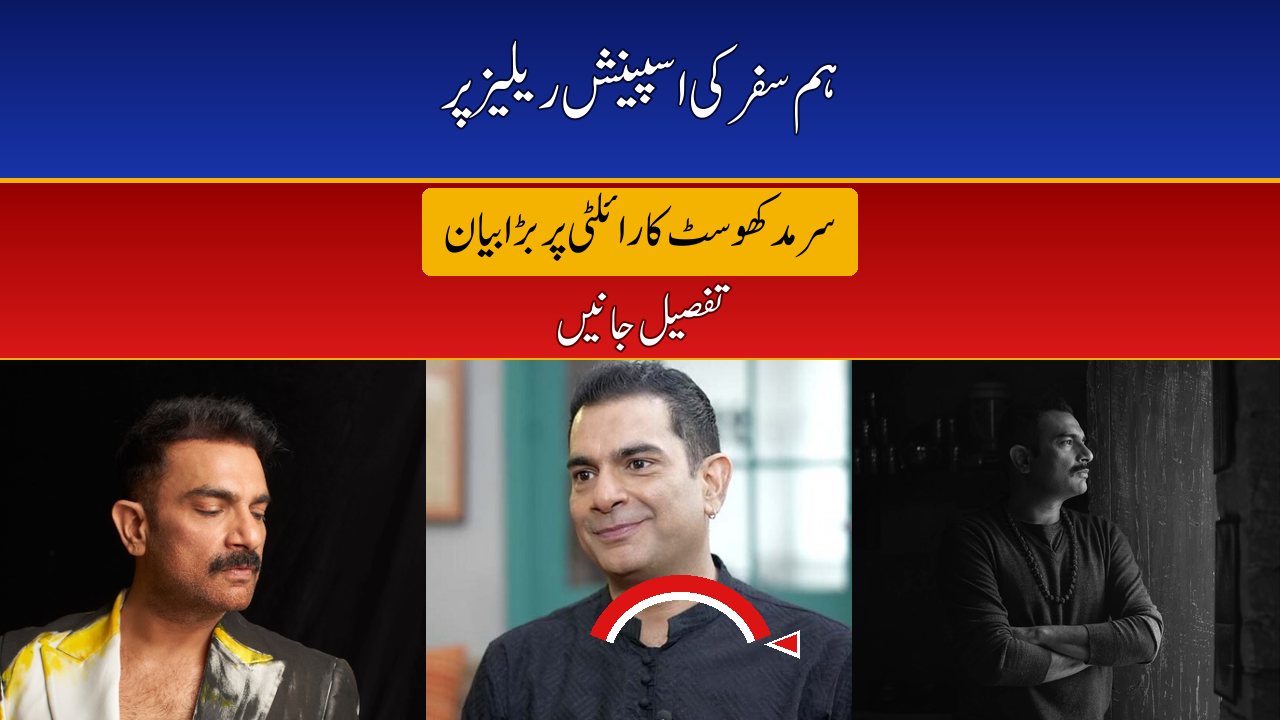
Sarmad Khoosat Reacts to Humsafar’s Spanish Release: “If Only There Were Royalties”
Sarmad Khoosat Reacts to Humsafar’s Spanish Release: “If Only There Were Royalties” By Hira Shahid, Entertainment Desk Updated: October 21, 2026 Director Sarmad Khoosat has reacted to the news that his blockbuster drama Humsafar is being dubbed and released in Spanish — and his one-line response has reopened Pakistan’s long-running debate over artist royalties. Sharing…
Sarmad Khoosat Reacts to Humsafar’s Spanish Release: “If Only There Were Royalties”
Updated: October 21, 2026
Director Sarmad Khoosat has reacted to the news that his blockbuster drama Humsafar is being dubbed and released in Spanish — and his one-line response has reopened Pakistan’s long-running debate over artist royalties. Sharing HUM TV‘s official announcement on his Instagram story on Tuesday, Khoosat wrote, “If only there were royalties,” alongside a blank-faced emoji. The remark — aimed at the fact that the show’s cast and crew earn nothing from its re-releases and foreign versions — struck a nerve with fans and fellow artists, turning a celebratory announcement into one of the week’s most talked-about entertainment stories.
The Instagram Story That Started It All
It was a simple, quiet post — the kind that slips past in a scroll. HUM TV announced that Humsafar, the 2011-12 phenomenon starring Mahira Khan and Fawad Khan, was getting a full Spanish-language dub for a new international audience. Sarmad Khoosat reposted it to his Instagram story. But instead of a celebratory caption, he added four words: “If only there were royalties.”
There was no anger in the post, no long thread, no tagging of channels — just that wry, tired line and a blank-faced emoji. And honestly, that is what made it land harder. Humsafar has been re-run, re-streamed, re-dubbed and re-monetized for well over a decade now, and the people who made it see none of that money beyond their original fees.
Within hours, fan pages and entertainment accounts picked up the story, and comment sections filled with the same question in different words: how is it fair that a drama still minting value in 2026 pays nothing to the people who created it?
Humsafar: The Drama That Refuses to Fade
For those who somehow missed it — Humsafar is not just another old drama. When it aired on Hum TV in the 2011-12 season, it became a genuine cultural event: Mahira Khan’s Khirad and Fawad Khan’s Ashar became household characters, and its dialogues and OST still circulate across Pakistani social media today. Directed by Sarmad Khoosat and written by Farhat Ishtiaq, it is widely credited with defining the modern era of Pakistani television romance.
The show’s afterlife is where the royalty question gets uncomfortable. Humsafar has been re-aired multiple times, picked up by streaming platforms, and now dubbed into Spanish for yet another market — each new release opening the drama to a fresh audience and, presumably, fresh revenue. The director’s post asks the question the industry has dodged for decades: why does none of that reach the artists?
Fans feel the imbalance. Browse any re-upload of Humsafar’s scenes and you will find thousands of comments about Khoosat’s direction and the cast’s performances — love that still generates millions of views. Stars like Urwa Hocane have spoken about Pakistani content’s place on platforms like Netflix, but the money conversation has lagged behind the prestige one.
What Are Royalties — and Why Don’t Pakistani Artists Get Them?
In most major television markets, royalties are standard practice: payments to actors, directors, producers and crew every time a programme is re-run, re-released, or licensed to a new market. The payments typically diminish over time until a minimum floor is reached. It is, in essence, a share in the long tail of a work’s success — exactly what Khoosat was pointing at.
The 1990s Deal That Changed Everything
Here is the part of the story that surprises many younger fans: Pakistan used to have a royalty system for television actors. It was scrapped in the 1990s, when the leading stars of that era agreed to trade royalty rights away in exchange for a pay raise from state broadcaster PTV. At the time, it must have looked like a good deal — more money up front. But the decision set a precedent that private channels have followed ever since, and many veterans of that era later said they regretted it. Speaking to DAWN in 2021, actors from that generation admitted that letting go of royalty rights was a mistake they had lived with for decades.
That trade cost the industry dearly: every re-run, every repeat, every international licensing deal since has flowed to broadcasters and platforms — not to the people on screen or behind the camera.
Mahira Khan and Naila Jaffery Raised the Alarm
Sarmad is far from the first major name to flag this. Earlier this year, Mahira Khan spoke about royalties during promotions for her film Aag Lagay Basti Main: big names like herself could survive without royalty income, but junior artists and technicians — the crew whose names scroll past in the credits — have no such cushion.
The issue first gained national attention in 2021, when veteran actor Naila Jaffery spoke openly about her financial struggles while battling cancer, noting that consistent royalty payments could have eased her medical expenses. Her testimony gave the debate a human face that statistics never could.
Why This Moment Hits Different
There is a reason Khoosat’s four words traveled further than a hundred previous op-eds. The Spanish release is not a local re-run — it is Pakistani content crossing a language barrier into an entirely new market, the dream every producer talks about. And the very moment of that triumph exposes the gap: the drama travels; the money does not.
It also lands as Pakistani entertainment enjoys a genuine international moment — from Oscar submissions to festival recognition. The industry is going global; its payment structures are stuck in the 1990s.
For fans, it is a reminder of something they have felt for years: the people who gave them their favourite characters and scenes are often one dry spell away from hardship. The royalty debate is not abstract industry talk — it is about whether the stars and crews of the future get to share in the success they create.
Sarmad Khoosat: The Filmmaker Behind the Remark
It is worth remembering who is speaking here. Sarmad Khoosat is one of the most respected directors of his generation — the man behind Humsafar, Shehr-e-Zaat and the critically acclaimed film Kamli, one of the few directors whose name alone signals quality to audiences.
[Reported, single source: outlets noted around three days ago that Kamli won him Best Director at the DC South Asian Film Festival.]
That is what makes his remark sting. This is not a struggling newcomer asking for a handout — it is one of the industry’s most decorated filmmakers, watching his most famous work open a new market while the system gives him nothing for it. If the system does not work for Sarmad Khoosat, who does it work for?
What Happens Next?
Realistically, one Instagram story will not rewrite industry contracts. Rebuilding a royalty framework would require channels, producers’ bodies and artists’ associations to agree — something the industry has failed to do repeatedly. But public pressure moves slow things. Mahira Khan’s comments in March, Naila Jaffery’s testimony in 2021, and now Khoosat’s viral remark are stacking into a narrative that is getting harder to ignore.
For now, fans can keep doing what they have always done: keep watching, and keep asking the question Sarmad Khoosat asked in four words. If only there were royalties — maybe, one day, there will be. Follow TimelyUps Entertainment for more on this story and everything happening in Pakistani showbiz.
Frequently Asked Questions
What did Sarmad Khoosat say about Humsafar’s Spanish release?
On his Instagram story, director Sarmad Khoosat shared HUM TV’s announcement that Humsafar would be dubbed and released in Spanish, and wrote “If only there were royalties” with a blank-faced emoji — pointing out that the show’s cast and crew earn nothing from its re-releases and foreign versions.
Is Humsafar really being released in Spanish?
Yes. HUM TV announced that the classic drama starring Mahira Khan and Fawad Khan is being dubbed into Spanish for a new international audience — which is exactly the announcement Sarmad Khoosat reacted to on October 20, 2026.
What are TV royalties and how do they work?
Royalties are payments made to actors, directors, producers and crew every time a show is re-run, re-released or licensed to a new market. They are standard practice internationally and usually diminish with each subsequent re-run until a minimum amount is reached.
Why don’t Pakistani actors get royalties?
Pakistan scrapped its TV royalty system in the 1990s, when leading actors traded royalty rights for a pay raise from PTV. Private channels followed that precedent, and many veterans later said they regretted the decision.
Has anyone else in the industry raised the royalty issue?
Yes. Mahira Khan spoke about royalties in March 2026 during promotions for Aag Lagay Basti Main, noting junior artists and technicians struggle without them. In 2021, veteran actor Naila Jaffery highlighted the issue while battling cancer, saying royalty payments could have eased her medical expenses.
Who directed Humsafar and who starred in it?
Humsafar was directed by Sarmad Khoosat and written by Farhat Ishtiaq. It starred Mahira Khan as Khirad and Fawad Khan as Ashar, and aired on Hum TV in the 2011-12 season, becoming one of Pakistan’s most iconic dramas.