Pakistan Now Dubai Airport’s 4th-Biggest Market: 800,000 Passengers in Q3 2026
Pakistan is now Dubai International Airport’s fourth-biggest international passenger market. In the third quarter of 2026, 800,000 passengers travelled between Dubai and Pakistan, putting Pakistan ahead of the United States (640,000) and Germany (480,000), according to figures released by Dubai Airports on Tuesday, 17 November 2026. For the millions of Pakistanis who live, work and…
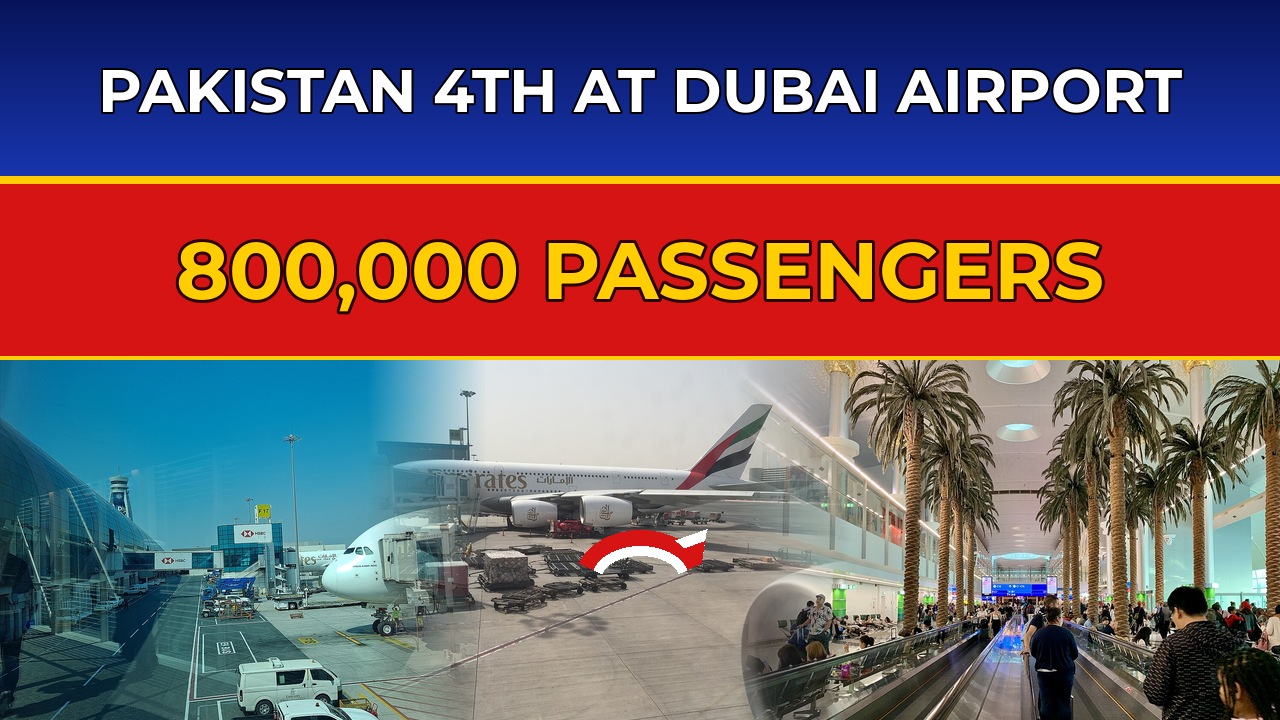
Pakistan is now Dubai International Airport’s fourth-biggest international passenger market. In the third quarter of 2026, 800,000 passengers travelled between Dubai and Pakistan, putting Pakistan ahead of the United States (640,000) and Germany (480,000), according to figures released by Dubai Airports on Tuesday, 17 November 2026. For the millions of Pakistanis who live, work and travel through the Gulf, the ranking confirms what every frequent flyer already knows: Dubai is Pakistan’s most important aviation hub.
By Bilal Ahmed | Published: 18 November 2026 | Updated: 18 November 2026
Key Facts: Pakistan and Dubai Airport in Q3 2026
| Fact | Detail |
|---|---|
| Pakistan’s rank among DXB country markets | 4th largest international passenger market |
| Passengers between Dubai and Pakistan (Q3 2026) | 800,000 |
| DXB total passengers, first nine months of 2026 | 50.4 million (down 28.1% year on year) |
| DXB passengers, Q3 2026 | 18.8 million (down 22.1% year on year) |
| Busiest month of Q3 | August 2026, with 6.6 million passengers |
| Full-year 2026 forecast | More than 70 million passengers |
| 100 million passengers a year | Expected in 2027, according to Dubai Airports CEO Paul Griffiths |
| Airlines serving DXB | 57 airlines |
| Destinations from DXB | 235 destinations in 101 countries |
| Figures released | Tuesday, 17 November 2026, by Dubai Airports |

Pakistan Ahead of the US and Germany
India remained DXB’s largest country market in the third quarter, with 2.6 million passengers. Saudi Arabia followed with 1.4 million and the United Kingdom with 1.3 million. Pakistan’s 800,000 passengers put it in fourth place, comfortably ahead of the United States at 640,000 and Germany at 480,000.
The gap is striking. Pakistan sent 25 percent more passengers through DXB than the United States in the quarter, even though the US is a far larger economy. The reason is simple: the Dubai-Pakistan corridor is one of the busiest labour and family routes in the world, with constant traffic in both directions.
| Rank | Country market | Q3 2026 passengers |
|---|---|---|
| 1 | India | 2,600,000 |
| 2 | Saudi Arabia | 1,400,000 |
| 3 | United Kingdom | 1,300,000 |
| 4 | Pakistan | 800,000 |
| 5 | United States | 640,000 |
| 6 | Germany | 480,000 |
London was the airport’s busiest single city destination in the quarter, with 784,000 passengers. Mumbai followed with 528,000, narrowly ahead of New Delhi at 525,000. Riyadh recorded 500,000 passengers and Jeddah 490,000.
| Rank | City destination | Q3 2026 passengers |
|---|---|---|
| 1 | London | 784,000 |
| 2 | Mumbai | 528,000 |
| 3 | New Delhi | 525,000 |
| 4 | Riyadh | 500,000 |
| 5 | Jeddah | 490,000 |
A Difficult Year, Then a Steady Recovery
The headline numbers come with important context. DXB’s 50.4 million passengers in the first nine months of 2026 were down 28.1 percent on the same period last year, after disruptions earlier in the year hit Middle East aviation. But the trend through the year has been steadily upward: the airport handled 13 million passengers in the second quarter, taking first-half traffic to 31.5 million, and then 18.8 million in the third quarter.
Monthly traffic tells the same story. It rose from 3.5 million passengers in April to 4.5 million in May and 5 million in June, before August became the busiest month of the year so far with 6.6 million. Traffic has not yet returned to pre-disruption levels, but the recovery is real and it is gathering pace.
| Period | Passengers | Year-on-year change |
|---|---|---|
| April 2026 | 3.5 million | — |
| May 2026 | 4.5 million | — |
| June 2026 | 5.0 million | — |
| Q2 2026 | 13.0 million | — |
| Q3 2026 | 18.8 million | Down 22.1% |
| August 2026 | 6.6 million | Busiest month of the year |
| First nine months of 2026 | 50.4 million | Down 28.1% |
Aircraft movements tell a similar story: 243,000 in the first nine months, down 27.6 percent year on year, including 92,800 in the third quarter. Cargo was also below last year’s levels at 1.215 million tonnes for the nine months, down 23.2 percent, with 464,000 tonnes in the third quarter. The average load factor stood at 74 percent, three percentage points lower than the same period in 2025.

Why This Ranking Matters for Pakistan
Dubai is not just another destination for Pakistani travellers. It is the main gateway for the country’s huge overseas workforce, the first stop for families visiting relatives, and the transit point for Pakistanis flying on to Europe, North America and beyond. When 800,000 people cross between the two countries in a single quarter, that is workers going home on leave, students heading to university, families reuniting, and businesses trading.
The traffic also underpins one of Pakistan’s most important economic lifelines: remittances from overseas Pakistanis. Pakistan recorded $3.9 billion in remittances in October 2026, and the Gulf, led by the UAE and Saudi Arabia, remains the biggest source of those inflows. Every seat on a Dubai-Karachi or Dubai-Lahore flight is, in a sense, part of that same story of Pakistanis working abroad and supporting families back home.
Pakistan’s air links are also widening on other fronts. Pakistan and Turkmenistan have moved towards direct flights and new trade corridors, opening another route for travel and commerce. And as travel demand grows, consular services are expanding too — Italy has opened a new embassy in Islamabad, easing visa and travel processes for Pakistanis heading to Europe.

What Happens Next at DXB
Dubai Airports expects to welcome more than 70 million passengers by the end of 2026. “We expect to welcome more than 70 million guests this year. As more airlines return to Dubai and our network strengthens, we are focused on continuing to accommodate future growth while making journeys simpler and more seamless,” said Paul Griffiths, chief executive of Dubai Airports.
Griffiths is optimistic the airport will reach the 100 million guest mark in 2027. The network is already rebuilding: DXB is currently served by 57 airlines connecting Dubai to 235 destinations across 101 countries, up from almost 50 airlines and 217 destinations in the first half of the year. British Airways resumed services earlier in November, joining returning carriers including Royal Air Maroc, SunExpress and Cebu Pacific, with more airlines expected to resume in the coming weeks.
In September, passengers travelling directly to and from Dubai accounted for 49 percent of traffic, while connecting passengers made up 51 percent. Direct traffic typically rises in the winter months, when Dubai’s tourism calendar and major events draw more international visitors. Some leisure routes are already growing strongly: Milan recorded a 20 percent increase in passenger numbers in the third quarter, followed by Phuket at 17 percent, Cape Town at 14 percent, Barcelona at 13 percent and Denpasar at 11 percent.
Dubai Airports is also investing in technology rather than just concrete. It is expanding artificial intelligence, predictive analytics and biometric processes to manage returning demand within the existing terminals. “Every process we simplify and every bottleneck we remove helps us use our existing facilities more efficiently,” Griffiths said. The airport is even working towards fully digital passports within five years. Looking further ahead, Al Maktoum International Airport is set to open by 2032, with capacity of up to 260 million passengers a year once fully open.

What Travellers Should Know
For Pakistanis planning a Dubai trip, the recovery has a practical side. Despite the disruption earlier in the year, service levels at DXB held up well in the third quarter: 99.9 percent of departing passengers waited less than 10 minutes at passport control, and the same share of arriving passengers cleared passport control in under 15 minutes. Security screening took under five minutes for 99.7 percent of passengers. The airport processed about 48 million bags in the first nine months, with 91 percent delivered within 45 minutes of arrival, and baggage accuracy stood at 99.73 percent.
Winter is traditionally the busiest season for direct Dubai travel, so travellers flying from Karachi, Lahore or Islamabad in December and January should book early and expect full flights, especially around the holidays. With airlines still rebuilding schedules, fares on the busiest Pakistan-Dubai routes can move quickly, so comparing options across carriers is worth the few minutes it takes.
Frequently Asked Questions
How many passengers travelled between Dubai and Pakistan in Q3 2026?
800,000 passengers travelled between Dubai and Pakistan in the third quarter of 2026 (July to September), according to figures released by Dubai Airports on 17 November 2026.
What is Pakistan’s ranking among Dubai Airport’s passenger markets?
Pakistan is the fourth-largest international passenger market for Dubai International Airport, behind India (2.6 million), Saudi Arabia (1.4 million) and the United Kingdom (1.3 million), and ahead of the United States (640,000) and Germany (480,000).
How many passengers did Dubai Airport handle in the first nine months of 2026?
Dubai International Airport handled 50.4 million passengers in the first nine months of 2026, down 28.1 percent year on year. The third quarter alone accounted for 18.8 million passengers, down 22.1 percent year on year.
What was the busiest month at Dubai Airport in 2026?
August 2026 was the busiest month, with 6.6 million passengers passing through Dubai International Airport.
How many passengers is Dubai Airport expecting in 2026?
Dubai Airports expects to welcome more than 70 million passengers in 2026. Its chief executive, Paul Griffiths, is optimistic the airport will reach the 100 million passenger mark in 2027.
Which airlines and destinations does Dubai Airport serve?
Dubai International Airport is currently served by 57 airlines connecting Dubai to 235 destinations across 101 countries. British Airways resumed services in early November 2026, joining returning carriers including Royal Air Maroc, SunExpress and Cebu Pacific.
Pakistan’s fourth-place ranking is more than a statistic. It is a measure of how deeply the lives of millions of Pakistanis are tied to Dubai — through work, family, trade and travel. As DXB rebuilds towards 70 million passengers this year and 100 million in 2027, that corridor will only get busier.