IMF Forecasts Pakistan Region Contraction in 2026, 6.6% Rebound in 2027
By Bilal Ahmed | Business Desk | Published: October 22, 2026 The International Monetary Fund has slashed its outlook for the region that includes Pakistan, forecasting a 1.3% contraction in economic output across the Middle East, North Africa and Pakistan in 2026, followed by a sharp rebound to 6.6% growth in 2027. The forecast, released…
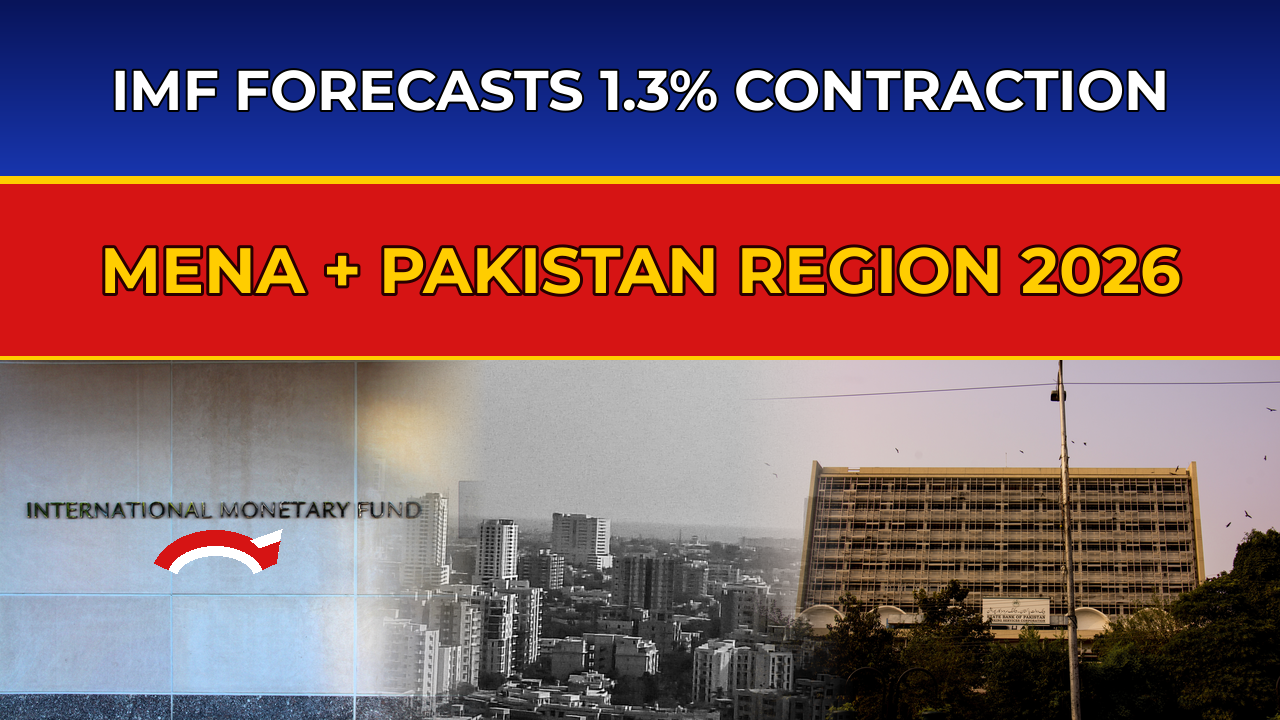
The International Monetary Fund has slashed its outlook for the region that includes Pakistan, forecasting a 1.3% contraction in economic output across the Middle East, North Africa and Pakistan in 2026, followed by a sharp rebound to 6.6% growth in 2027. The forecast, released Thursday in the IMF’s regional economic outlook in Dubai, blames the US-Israeli-led war against Iran — and the chaos it has inflicted on energy production, shipping, tourism, trade and investor confidence. Crucially, the 1.3% figure is the regional aggregate: the IMF groups Pakistan inside this region, it is not a Pakistan-only number.
IMF Regional Outlook (Released Oct 22, 2026, Dubai) — Quick Facts
| Region | Middle East, North Africa and Pakistan (grouped by the IMF as one region) |
| 2026 forecast | Output to contract 1.3% (was growth before the war) |
| 2027 forecast | Output to rebound to 6.6% growth |
| Catch-up position | Even with the rebound, output generally stays below pre-war projections |
| Driver | US-Israeli-led war against Iran — hits on energy production, shipping, tourism, trade and confidence |
| Hardest hit | Oil exporters; several Gulf oil exporters projected to face recession in 2026 |
| GCC in 2026 | Gulf Cooperation Council economies expected to contract, with Oman the exception; Bahrain, Kuwait, Qatar and non-GCC Iraq forecast double-digit GDP declines |
| Big two Gulf | Saudi Arabia and the UAE now also projected to experience recession in 2026 |
| Baseline assumption | Conflict abates in early 2027; trade gradually normalises during 2027 |
| Risk rating | Outlook clouded by “exceptionally high uncertainty” |
| IMF spokesperson | Jihad Azour, Director, IMF Middle East and Central Asia Department |
Why the IMF Slashed Its 2026 Forecast
The numbers are a direct reading of the war. The IMF says the region’s output will contract by 1.3% this year as a result of the war’s impact on energy production, shipping, tourism, trade and confidence — a five-channel hit that no economy in the region fully escapes.
The pain is, in the Fund’s words, “substantial, but uneven.” Oil-exporting economies directly affected by disruptions to energy production and shipping are taking the worst of it. Oil importers — a category that includes Pakistan — have proven more resilient, with domestic demand supported by remittances and tourism flows, favourable financial conditions, and prompt policy responses that shield consumers from higher commodity prices.
2027 brings relief on paper — a 6.6% growth rebound — but the IMF is explicit that this is a bounce from a depressed base, not a full recovery: output in these economies would generally stay below pre-war projections. If you are tracking the fallout for Pakistan’s fuel bills, our petrol price tracker shows how global energy shocks reach the pump, and the recent PSX’s 2,000-point crash as oil touched $112 shows how quickly regional conflict feeds into Pakistani markets.
The Gulf Takes the Worst Hit
This is where the downgrade concentrates. “This sharp downgrade is concentrated among the economies most directly affected by the conflict,” Jihad Azour, the IMF’s director for the Middle East and Central Asia, said at a press conference in Dubai, adding that “several Gulf oil exporters are projected to experience recession this year.”
The country-level picture is grim reading for the region’s energy giants:
- GCC economies are expected to contract in 2026 — with Oman as the lone exception.
- Bahrain, Kuwait, Qatar, and non-GCC member Iraq are forecast to post double-digit declines in GDP.
- Saudi Arabia and the United Arab Emirates — relatively less affected by the energy-trade disruptions — are now also projected to experience a recession in 2026.
For Pakistanis, this matters directly: millions of Pakistanis work across the Gulf, and these are the economies that pay their salaries. A recession-hit Gulf is a slower Gulf — and remittances, which the IMF itself flags as a cushion for oil-importing economies, are exactly the lifeline Pakistan leans on when domestic conditions tighten.
What It Means for Pakistan
Read the fine print and Pakistan sits on the more sheltered side of this storm — but sheltered is not the same as untouched.
Petrol and energy costs. The IMF’s central warning is that further disruption to energy production and trade routes could drive energy prices higher — and Pakistan imports nearly all of its oil. Every dollar added to the international crude price eventually shows up in Pakistan’s ex-depot fuel calculation. Pakistan’s daily fuel-pricing mechanism passes global movements through to consumers within days, so an extended conflict translates, with a short lag, into pressure on petrol and diesel prices at home.
Remittances cushion. On the other side of the ledger, the IMF notes that domestic demand in oil-importing economies is supported by remittances and tourism flows. Pakistan’s workers’ remittances — largely flowing from the same Gulf states the IMF expects to contract — have been the single most reliable stabiliser of the external account. That support matters more, not less, in a year like 2026.
Markets and inflation. The Fund also warns that external financial conditions could tighten if investors reassess AI-driven productivity gains and interest rates rise further amid heightened concerns about inflation and fiscal positions. For Pakistan’s markets, the linkage is already visible: regional escalation has repeatedly jolted the PSX, most recently when oil touched $112. Meanwhile, on the trade front, Pakistan is actively working to open new markets — the government is filing a fresh GSP+ application to the EU for 2027, exactly the kind of diversification that pays off when a region’s biggest buyers are in recession.
The Baseline: War Fades Early 2027, Trade Normalises
The entire forecast rests on one big assumption: that the conflict abates in early 2027 and trade gradually normalises during that year. The IMF is blunt about the fragility of that assumption — the outlook remains clouded by “exceptionally high uncertainty.”
“A more prolonged conflict remains the principal risk to the outlook,” Azour said. The ground reality gives that warning weight: the US State Department on Wednesday ordered some diplomats and family members to leave its missions in Saudi Arabia and plans to withdraw family members from other US missions in the region, following escalating missile strikes by Yemen’s Iran-aligned Houthis on the kingdom.
The other stated risk is financial. If investors reassess AI-driven productivity gains and interest rates rise further amid heightened concerns about inflation and fiscal positions, external financial conditions could tighten — a scenario that hits emerging markets with heavy debt and thin reserves hardest.
Beyond the Core Region
The IMF’s outlook also covers the Caucasus and Central Asia, where growth is moderating toward a more sustainable pace — 5.2% output growth forecast for 2026 and 5% in 2027 — far from the conflict’s epicentre and far from the downgrades.
The Fund closed with the same message it delivered at last week’s annual meetings, urging policymakers to prioritise maintaining price stability, while preserving fiscal sustainability, keeping central banks independent, and enacting structural reforms to boost productivity and create jobs. For a region entering a recession year with an uncertain ceasefire, that is easier prescribed than done.
Frequently Asked Questions
Is the 1.3% contraction Pakistan’s GDP forecast?
No. The 1.3% contraction is the IMF’s forecast for the regional aggregate — the Middle East, North Africa and Pakistan grouped together as one region. It is not a Pakistan-only figure, even though some headlines phrase it loosely. Pakistan’s individual country forecast comes from the IMF’s separate country outlooks, not this regional aggregate.
Why is the IMF forecasting a contraction in 2026?
The IMF blames the US-Israeli-led war against Iran, which is disrupting energy production, shipping through key trade routes, tourism, trade flows and investor confidence across the region. Oil-exporting economies hit by energy and shipping disruptions suffer most, while oil importers like Pakistan are more resilient.
Which Gulf countries face recession in 2026?
Several Gulf oil exporters are projected to experience recession, according to the IMF. GCC economies overall are expected to contract in 2026 with Oman the exception; Bahrain, Kuwait, Qatar and non-GCC Iraq are forecast to post double-digit GDP declines; and Saudi Arabia and the UAE are now also projected to face recession in 2026.
What does the 2027 rebound to 6.6% depend on?
The rebound assumes the conflict abates in early 2027 and trade gradually normalises during the year. Even then, output in the region’s economies would generally stay below pre-war projections — it is a recovery from a depressed base, not a full return to trend.
How does the IMF forecast affect petrol prices in Pakistan?
The IMF warns that further disruption to energy production and trade routes could drive energy prices higher. Pakistan imports most of its oil, and under the daily fuel-pricing mechanism, global crude movements pass through to Pakistani fuel prices within days — so an extended conflict means upward pressure on petrol and diesel at the pump.
What did the IMF say about oil-importing economies like Pakistan?
The IMF says oil importers have proven more resilient: domestic demand is supported by remittances and tourism flows, favourable financial conditions, and prompt policy responses that safeguard consumers from higher commodity prices. Workers’ remittances are exactly the cushion the IMF points to.
The bottom line for Pakistan: the IMF’s regional number puts the country inside a contracting neighbourhood, but on the more resilient side of it — an oil importer cushioned by remittances, exposed through the fuel pump. What happens next is almost entirely a function of one variable: how soon the war ends. The IMF’s baseline says early 2027. The Fund’s own “exceptionally high uncertainty” warning says: don’t bank on it.