World Bank: Pakistan Incomes Could Triple by 2050
Pakistan’s incomes could triple by 2050 if the country moves faster on structural reforms, the World Bank has said — lifting the average Pakistani to today’s income level of Vietnam and into the upper-middle-income world. The forecast comes from the Bank’s latest Pakistan Development Update, titled Attaining Escape Velocity, which argues that with macro-stabilisation achieved,…
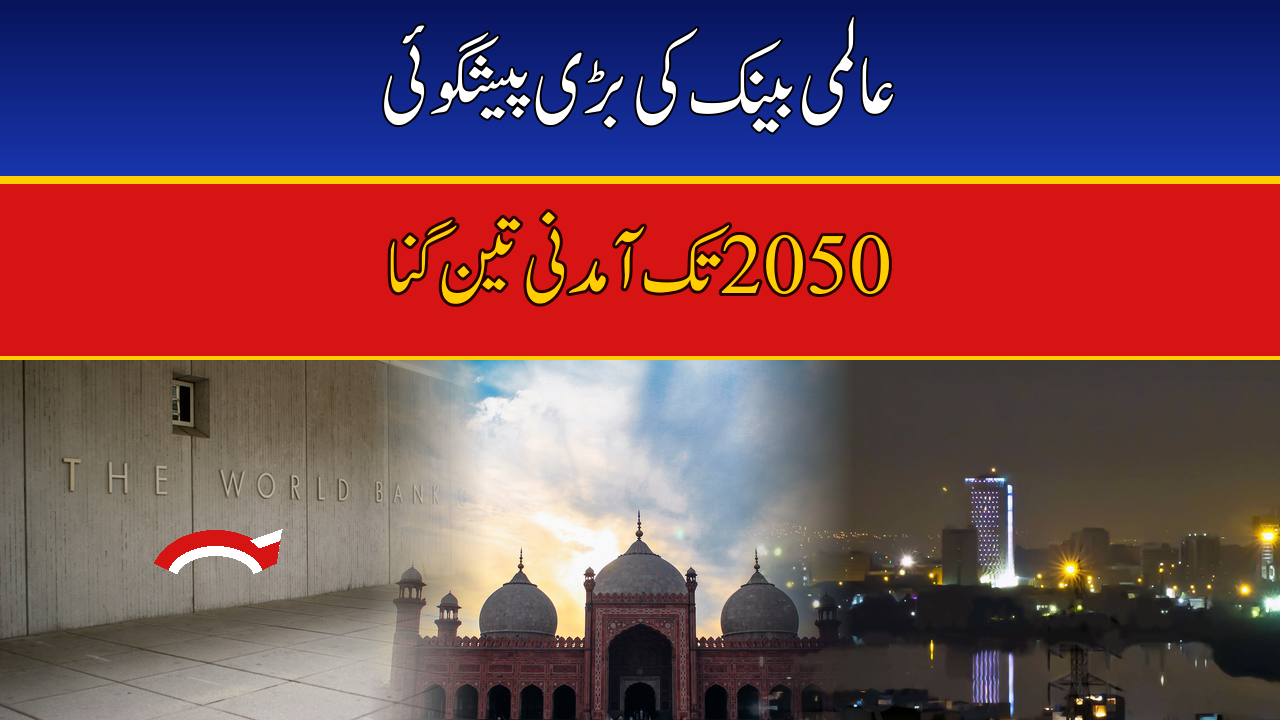
Pakistan’s incomes could triple by 2050 if the country moves faster on structural reforms, the World Bank has said — lifting the average Pakistani to today’s income level of Vietnam and into the upper-middle-income world. The forecast comes from the Bank’s latest Pakistan Development Update, titled Attaining Escape Velocity, which argues that with macro-stabilisation achieved, private-sector-led growth of 6.2 to 6.9 per cent a year is within reach — but only if stabilisation is turned into sustained reform.
| Detail | Confirmed information |
|---|---|
| Report | Pakistan Development Update: Attaining Escape Velocity (World Bank Group) |
| Headline projection | Incomes could triple by 2050 with faster reform implementation |
| Required growth | Sustained annual growth of 6.2%–6.9% through 2050 |
| Target benchmark | Vietnam’s current income level; per capita incomes of today’s upper-middle-income countries |
| Report lead author | Sebastian Essl |
| World Bank Country Director (Pakistan) | Bolormaa Amgaabazar |
| Current real GDP growth | 3.7% in FY26, up from 3.2% in FY25 |
| Current real per capita growth | Stuck at around 1.6% |
| Primary fiscal surplus | Record 2.9% of GDP in FY26 |
| Energy subsidies | Cut from 1.1% of GDP (FY25) to 0.8% of GDP (FY26) |
| International debt market return | US$3 billion Eurobond issuance; S&P and Moody’s upgrades |
| Privatisation progress | PIA privatised; 17 more state-owned enterprises in the pipeline, including 9 power distribution companies |
| SOE losses (finance minister figures) | Rs905bn (2023), Rs851bn (2024), Rs832bn (2025) |
What the World Bank Is Actually Saying
The headline is dramatic, but the mechanics are straightforward. Pakistan has already done the hard first part: stabilising a macroeconomy that was, not long ago, in a balance-of-payments crisis. Revenue growth and expenditure restraint delivered a record primary fiscal surplus of 2.9 per cent of GDP in FY26, real GDP growth picked up to 3.7 per cent, and strong remittances let the State Bank rebuild foreign exchange reserves.
Markets have taken notice: S&P and Moody’s upgraded Pakistan, and the country returned to international debt markets with a US$3 billion Eurobond. But the Bank’s Country Director for Pakistan, Bolormaa Amgaabazar, was blunt about the limit of what has been achieved: “But real per capita growth — the rate at which the income of the average Pakistani increases — remains stuck at around 1.6pc. Reforms to drive faster growth are now urgently needed.”
The 6.2–6.9% Growth Corridor
The tripling arithmetic rests on a specific corridor: sustained annual growth of 6.2 to 6.9 per cent, maintained for two and a half decades — possible, the report finds, if Pakistan upgrades its policies and institutions to the standard of the average middle-income country, following the reform path other successful economies took.
In ordinary terms: at 1.6 per cent per-capita growth, living standards crawl. At 6.2–6.9 per cent overall growth, the average Pakistani’s income roughly triples by 2050. It is the difference between an economy that survives and one that escapes.
Why Per Capita Growth Is Stuck at 1.6%
Here is the gap the report wants Pakistanis to see clearly. Headline GDP growth of 3.7 per cent sounds respectable, but once population growth is accounted for, the average person’s income rises only 1.6 per cent a year. Fiscal surpluses and reserves are macro-economist achievements; the ordinary household experiences the 1.6 per cent, not the 2.9 per cent surplus.
The report’s diagnosis: stabilisation policies have done their job, but they do not generate growth by themselves. “With macro stabilisation achieved but fiscal resources and foreign exchange still tightly constrained, structural reform to encourage private investment is the necessary next step towards higher living standards,” said Sebastian Essl, the report’s lead author. Growth that people feel has to be private-sector-led — and that requires, in his words, a plan, coordination, and committed implementation.
Reforms Already Underway — and Why They Count
One of the report’s more encouraging messages is that Pakistan is not starting from zero. Timely power-tariff adjustments cut energy subsidies from 1.1 per cent of GDP in FY25 to 0.8 per cent in FY26 — real money in a budget that has none to waste, and a reform anyone tracking household fuel and energy costs knows was politically expensive. Trade liberalisation continues under the National Tariff Policy, and the privatisation of Pakistan International Airlines — the former flag carrier, sold in December 2025 — is singled out as a signal reform.
What the World Bank Wants Next
Building on those foundations, the report lists the next layer of reform: improving the business environment, overhauling the tax system, reducing the state’s presence in the economy, and expanding access to finance. For Pakistan’s workers, small businesses and freelancers, that last one — fair and functioning access to the financial system — is where abstract reform language meets everyday reality.
The emphasis on shrinking the state’s footprint is not ideological decoration; it is the core of the growth arithmetic. An economy where the state competes with, crowds out, or controls large parts of commerce cannot sustain 6.2–6.9 per cent growth, because private investment — the engine the Bank is counting on — goes where returns and rule of law are predictable.
The 17-Company Privatisation Pipeline
On the very same day the World Bank report landed, Privatization Commission Chairman Muhammad Ali told an Islamabad business conference that the government is working to privatise 17 state-owned enterprises, including nine power distribution companies, alongside the outsourcing of three major airports and transactions involving banks and insurance companies. Expressions of interest have already been issued for three electricity distribution companies, offering 51 to 100 per cent equity stakes with management control.
The numbers behind the push are stark: state-owned enterprises reported losses of Rs905 billion in 2023, Rs851 billion in 2024 and Rs832 billion in 2025, according to the finance minister — billions bleeding out of public finances every year. Ali’s argument: privatisation and public-private partnerships bring investment, expertise and efficiency into businesses and infrastructure, freeing public resources for essential services. This is the “reduce the state’s presence” half of the World Bank’s prescription, playing out in real time.
The Remittances Versus Exports Problem
Ali flagged a telling number: Pakistan received roughly US$41.6 billion in workers’ remittances in the previous fiscal year, against US$30 billion in goods exports. Remittances are holding the external account together — the World Bank itself credits them for the reserves rebuild — but long-term growth needs stronger production and higher-value exports. An economy that consumes remittances without converting them into productive capacity gets stability, not growth.
Is It Realistic? A Reality Check
The World Bank’s projection is conditional, and every honest reading should treat it that way. Tripling incomes by 2050 requires a quarter-century of near-flawless reform implementation in a country where reform programmes have historically stalled at the political hard parts — taxing the untaxed, cutting popular subsidies, and selling beloved-but-bankrupt state companies.
But two things are genuinely new. First, the stabilisation is real and externally validated — rating upgrades, a Eurobond, a record primary surplus. Second, the hardest early reforms (PIA’s sale, the subsidy cut) have actually happened, which is why the World Bank calls the current moment an opportunity rather than a hope. The report’s word for what Pakistan needs is telling: “escape velocity” — enough speed to break free of the stabilise-crash-stabilise cycle of the last four decades. At half the needed pace, per capita growth stays near 1.6–2.5 per cent and the 2050 target slips away, because competitor countries are not standing still.
Closing: A Plan, Coordination, and Committed Implementation
The World Bank has given Pakistan something it rarely hands out: a quantified, optimistic, conditional roadmap. Triple incomes by 2050, Vietnam-level incomes, upper-middle-income status — none of it is a prediction of what will happen. It is a projection of what can happen, with a specific growth corridor and a specific reform list attached.
Sebastian Essl’s formula — a plan, coordination, and committed reform implementation — is doing a lot of work in one sentence. Pakistan has had plans before. What the numbers demand is the unglamorous part: doing the reforms, on schedule, year after year, long after the headlines fade. Whether 2050 brings tripled incomes or another missed target will be decided not in Washington, but in how faithfully Islamabad executes the list it already has.
Frequently Asked Questions
By Daniyal Sheikh — Business Desk, TimelyUps. Updated: October 22, 2026.