Shamonda Virus: First Human Case in France Explained
France has reported the first known human infection with the Shamonda virus — and the patient has died. Announced on Thursday, October 22, 2026, it is the first time this livestock virus has been detected in a person. But officials urge calm: the patient was severely immunocompromised, French authorities say there is “no health risk…
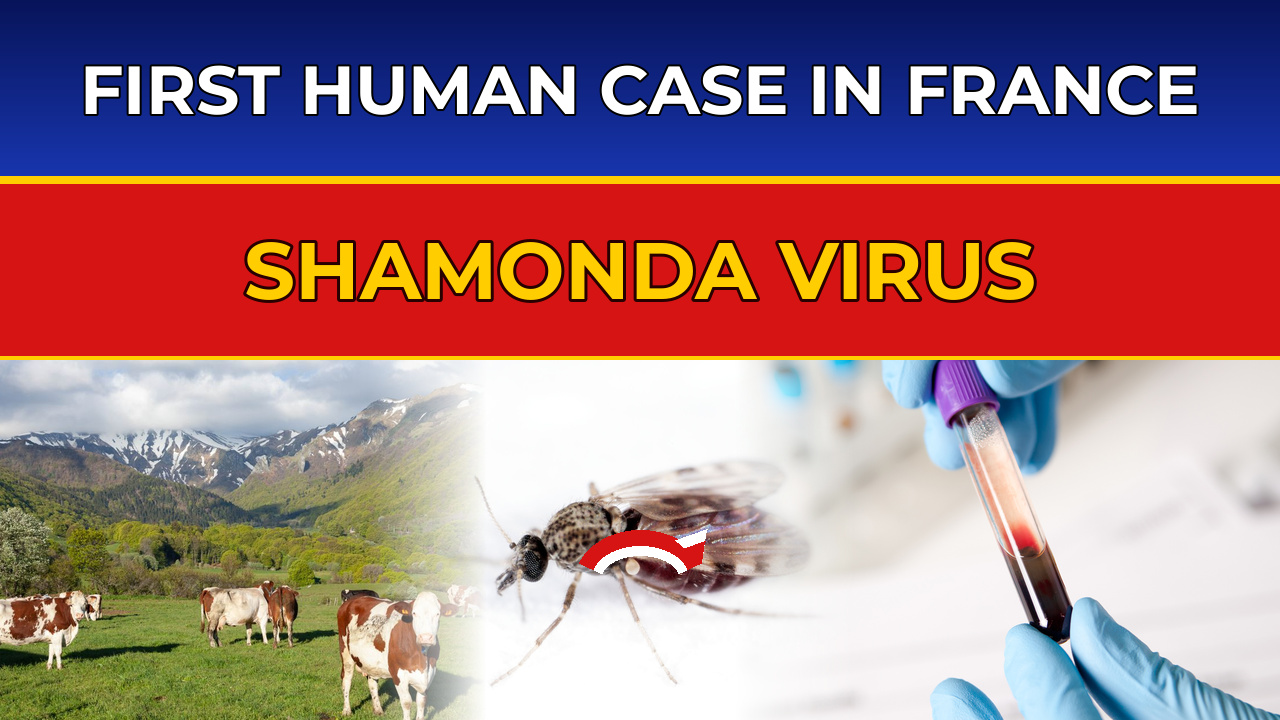
France has reported the first known human infection with the Shamonda virus — and the patient has died. Announced on Thursday, October 22, 2026, it is the first time this livestock virus has been detected in a person. But officials urge calm: the patient was severely immunocompromised, French authorities say there is “no health risk to the general public”, and the WHO calls it an isolated case unlikely to spread further. Here is everything confirmed so far — and what it means for Pakistan’s livestock owners.
| Detail | Confirmed information |
|---|---|
| Announcement date | Thursday, October 22, 2026 — France’s health and agriculture ministries |
| The patient | An adult in Lyon with a severely weakened immune system, being treated for a serious illness at the Hospices Civils de Lyon; the patient died in early October 2026 |
| Likely exposure | A biting midge bite in eastern France, where the virus was circulating in livestock earlier this year |
| Virus type | Orthobunyavirus group (family Peribunyaviridae, Simbu serogroup) — same group as the Schmallenberg virus |
| Main animals affected | Cattle, plus sheep, goats, horses and alpacas |
| First detected | In cattle in Nigeria, 1965; later found in parts of Africa and Japan |
| European arrival | First identified in Europe in late July 2026; cases in 12+ countries by October 20, including France, Germany, Spain and Ireland |
| Official risk assessment | Isolated, exceptional case; no health risk to the general public (French ministries, WHO, ECDC) |
| Pakistan status | No cases reported in Pakistan; no travel or food restrictions advised |
What is the Shamonda virus?
Shamonda is a virus that has lived quietly in veterinary textbooks for over 60 years — first isolated from cattle in Nigeria in 1965, later found sporadically across West, East and Southern Africa and in Japan. Until this week, it had never been detected in a human being anywhere in the world.
Scientists classify it as an Orthobunyavirus — the same group as the Schmallenberg virus that caused reproductive losses in European livestock in the early 2010s. A scientific preprint describes it as a single-stranded RNA virus in the family Peribunyaviridae, order Bunyavirales, Simbu serogroup — in plain terms, a midge-borne livestock virus with a long animal track record and, until now, no human one.
How the first human case was found
The case surfaced in Lyon, where a severely immunocompromised patient being treated for a serious illness at the Hospices Civils de Lyon was found to carry the virus. The patient died in early October 2026.
French authorities believe the infection came from a midge bite in eastern France, where the virus had circulated in livestock through spring and summer. The neurological complications observed before death are “very likely linked” to Shamonda — though investigations are still ongoing. This was not a healthy person infected in the community, but a hospitalised, severely immunocompromised patient — a distinction that shapes the entire risk assessment.
Symptoms in animals
In cattle, Shamonda usually looks like familiar, vague illness: fever, diarrhoea, fatigue and a drop in milk production — not generally fatal, British veterinary authorities note. The real damage is reproductive: abortions and severe foetal malformations in pregnant animals, the same pattern as its cousin Schmallenberg. Some horses have developed neurological disorders.
An outbreak in a breeding herd can mean serious economic losses even when animals survive — which is why European bulletins have tracked it closely since the summer.
How the virus reached Europe
Europe first identified Shamonda in late July 2026, on cattle farms in France — though French officials now believe it had been circulating since the spring, undetected. By October 20, cases had appeared in more than a dozen countries, including top cattle breeders France, Germany, Spain and Ireland; the French animal-health bulletin also listed Austria, Belgium, Italy, Liechtenstein, Luxembourg, the Netherlands, Portugal, Slovenia and the UK’s Jersey.
One reason it may be undercounted: Shamonda is not WOAH-notifiable and is not covered by the EU’s Animal Health Law, so countries need not report it. WOAH says the long-term impact of the European variants remains uncertain.
Is there a risk to humans?
The short answer, from every major authority: no — not for the general public. France’s ministries say “no health risk to the general public” has been identified; the WHO calls it an isolated case unlikely to spread further; the ECDC says it is “carefully monitoring the situation”.
Rare, exceptional infections do make headlines — TimelyUps recently covered a Russian lab worker’s death from a mysterious virus. The Shamonda case differs in a key way: there is no evidence of person-to-person spread, and the virus needs a midge vector to move between hosts. No quarantines, no travel restrictions.
One case in a severely immunocompromised patient does not establish Shamonda as a human pathogen — only that infection is possible in extreme circumstances.
How authorities are responding
France has notified the WHO and the ECDC, as international rules require, and the ECDC is working with French authorities to investigate any public health implications. For now the response is surveillance, not restrictions — track the virus in livestock, watch for unusual human cases, share data. That measured tone is itself informative.
Pakistan has run large-scale vector surveillance before — including during KP’s dengue outbreak response — and the machinery for monitoring unusual cases already exists.
Should Pakistan worry?
Let us separate what is confirmed from what is precaution, because that distinction matters.
Confirmed: No Shamonda cases have been reported in Pakistan — not in animals, not in people. Its known range is parts of Africa, Japan and now Europe. French, WHO and ECDC assessments all say the general public faces no risk, and no travel restrictions, import bans or behaviour changes have been advised.
Context: Pakistan is one of the world’s great livestock-keeping countries, with tens of millions of cattle and buffalo underpinning rural livelihoods and a growing export trade — Punjab’s livestock exports jumped 43 percent in recent reporting. A midge-borne cattle virus that causes abortions and milk drops is exactly the kind of disease a livestock economy this valuable should keep on its radar — not because it is here, but as standard vigilance.
Precaution (general good practice, not a response to any outbreak): farmers should watch for clusters of fever, diarrhoea, sudden milk drops or abortions in a herd and report unusual patterns to the provincial livestock department. Midges thrive in warm, wet conditions, so vector awareness in the monsoon and post-monsoon season is sensible anyway.
Bottom line: no emergency, no reason to avoid dairy or meat, no basis for panic. But Pakistan’s veterinary surveillance should know the name “Shamonda” — and livestock owners should know what it looks like, just in case.
What livestock owners can do
If you keep cattle, buffalo, sheep or goats, the guidance applies to any midge-borne disease. Know the signs: unexplained fever, diarrhoea, sudden milk-yield drops, abortions or deformed calves — any one has many causes, but a cluster deserves a veterinary visit. Reduce midge exposure: keep animals from marshy standing water at dusk and dawn, and keep sheds clean and drained. And report early: unusual disease clusters reported to the livestock department protect neighbouring herds too — surveillance only works if farmers speak up.
For consumers of milk and meat, the French ministries, WHO and ECDC agree: there is no identified health risk. Standard food hygiene is all that is needed.
The Shamonda story is a reminder of how closely human and animal health are linked — and how quickly a virus known only to veterinarians for six decades can become global news. For now the verdict is calm but watchful: an exceptional case, a virus to monitor, and no cause for alarm.
Frequently asked questions
By Fatima Raza — Health Desk, TimelyUps. Updated: October 22, 2026.