Pakistan’s Skills Crisis Costs $31.5 Billion a Year, World Bank Warns
By Bilal Ahmed | Business Desk | October 15, 2026 | Updated: October 15, 2026 Pakistan is losing an estimated $31.5 billion every year because its young people cannot find work that matches their education — or cannot find work at all. The figure comes from the World Bank, and surfaced this week as the…
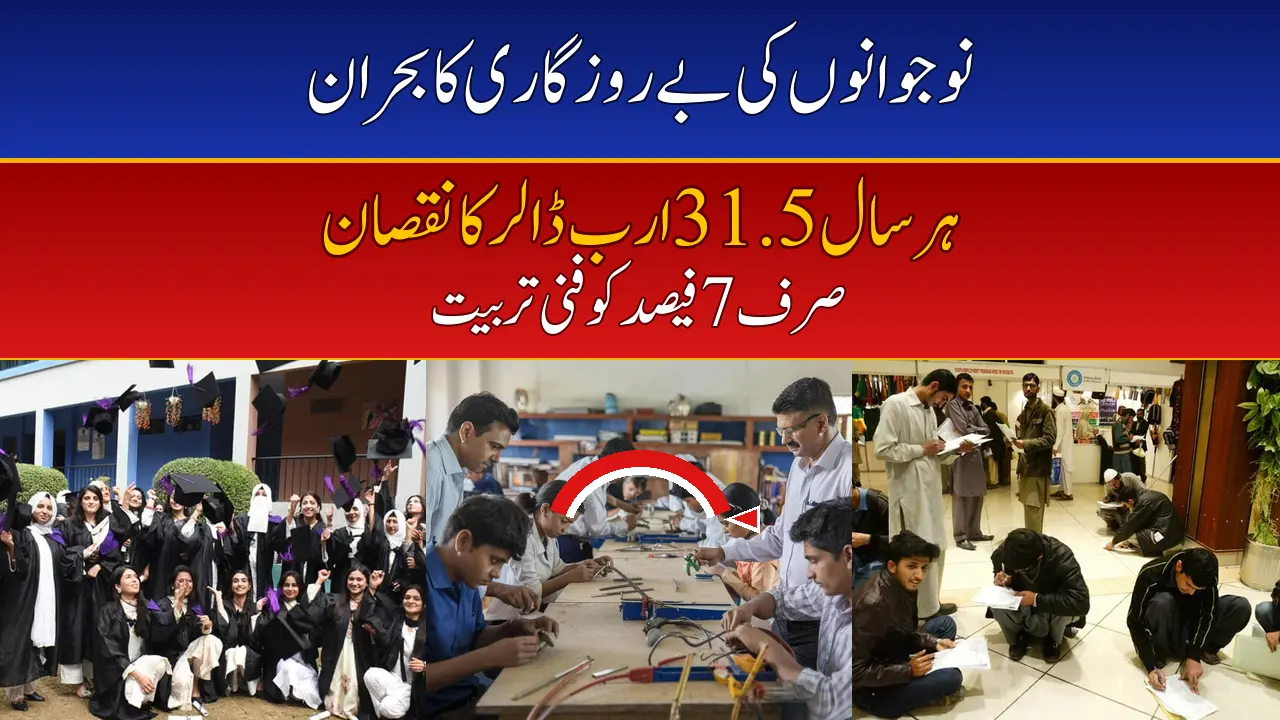
Pakistan is losing an estimated $31.5 billion every year because its young people cannot find work that matches their education — or cannot find work at all. The figure comes from the World Bank, and surfaced this week as the World Economic Forum’s annual Global Future Leaders meeting opened in Dubai, where Pakistan was presented as a case study in bridging the education-employment gap. Only 7% of Pakistani youth have access to formal technical and vocational training, against a regional average of 22%.
$31.5 billion is not an abstract statistic. It is the salary a graduate son never earned, the export order a factory never fulfilled. And, as Dawn reported on October 14, it is a crisis of structure, not talent — Pakistan’s young people are not failing the system; the system is failing them.
The Numbers at a Glance
- Annual cost: $31.5 billion in lost productivity and unrealised export potential (World Bank estimate)
- Vocational training: Only 7% of Pakistani youth vs 22% regional average
- NEET (15–29): Nearly one in three — not in education, employment or training; among young women, more than half
- Graduate unemployment: 18.3% nationally, vs 14.7% across all education levels
- Graduates aged 20–24: 32.8% unemployment — nearly one in three (Gallup Pakistan analysis of Pakistan Labour Force Survey 2024-25)
- Global stage: Highlighted at WEF Global Future Leaders meeting, Dubai, Oct 13, 2026 — session: “How to boost youth employment in Pakistan for the age of AI”
The $31.5 Billion Number
To grasp the scale: $31.5 billion a year is roughly the size of Pakistan’s entire annual export bill in some recent years. It evaporates quietly — exporters turning down orders for lack of trained operators, software houses hiring two of fifty interviewed graduates.
The estimate counts two things: lost productivity (employable people sitting idle) and unrealised export potential (orders never won because the workforce cannot meet international standards). Dawn’s October 14 report framed it as the bill for an education-to-employment pipeline built for a different century.
It is not Pakistan’s only flashing red indicator. Days earlier, the Global Hunger Index 2026 ranked Pakistan the worst performer in South Asia — the skills crisis is the economic twin of that humanitarian one.
Only 7% Get Formal Training
This is the statistic that explains almost everything else. Just 7% of Pakistan’s youth get formal technical and vocational training, versus a 22% regional average. Out of every hundred young Pakistanis, ninety-three never get a structured shot at learning a trade in a proper institution.
Instead, the system pushes everyone toward one narrow door: a university degree. The labour market’s answer has been consistent — a degree alone does not get you hired, while the trades that pay ask for skills no classroom taught.
Parents will recognise the trap. The family funds a four-year degree because “degree kay baghair kuch nahi milta” — then the graduate emerges with a transcript, no portfolio, no network, and employers want all three. In countries that solved this, the vocational path carries prestige and wages; in Pakistan it is the consolation prize. That bias keeps the 7% figure so low.
Graduates Hit Hardest — 32.8% of the Youngest Can’t Find Work
The most jarring number comes from Gallup Pakistan’s analysis of the Pakistan Labour Force Survey 2024-25: unemployment among graduates aged 20 to 24 is 32.8% — nearly one in three of the most recently educated cannot find work.
Nationally, graduate unemployment is 18.3% — above the 14.7% overall rate across all education levels. The more educated you are, the more likely you are to be unemployed: that inversion is the signature of a broken pipeline, with nearly one in three young graduates jobless.
The NEET Crisis — and the Young Women Left Behind
Nearly one-third of Pakistanis aged 15 to 29 are NEET — not in education, employment or training. In a country where roughly two-thirds of the population is under 30, that is tens of millions of young people with no connection to the economy at all.
For young women the figure is devastating: more than half of young women aged 15–29 are NEET — about mobility, safety, workplace culture and transport. Each one is a potential earner — and the economy is writing them off.
Why Degrees Don’t Convert: the “Architectural” Problem
The most important framing came from Dawn’s reporting: this is not a talent or effort problem but an “architectural” one — the missing layer between classroom and career: mentorship, guidance, industry networks, apprenticeships, honest signals about where jobs are.
In Pakistan, a degree has become the start of the job search, not the end of one. Students pick fields on decade-old prestige — or an uncle’s advice — not on where jobs are. Nobody told thousands of new BBA graduates the market was saturated; nobody showed the FSc student that a two-year technical diploma plus freelancing skills would out-earn most private-sector graduate jobs.
And in the vacuum, predators thrive. Desperate job-seekers are prime targets for advance-fee scams and fake employment agents — the same desperation SECP’s new Corporate Intelligence Unit is being built to police. When the legitimate pipeline fails, the illegitimate one fills the gap.
What a Fix Would Actually Look Like
The figures surfaced at the WEF’s annual Global Future Leaders meeting in Dubai, which opened Tuesday, October 13, in a session on “How to boost youth employment in Pakistan for the age of AI.” The AI framing matters: the window in which low-skill labour alone could absorb the youth bulge is closing.
No single policy fixes a $31.5 billion leak, but the missing pieces are concrete:
- Career guidance as infrastructure. Trained counsellors in every secondary school and college, with real data on which sectors hire, at what salaries, with what skills.
- Industry-linked vocational training at scale. Move the 7% toward the 22% regional average, with curricula built alongside employers. Apprenticeships on real equipment convert to jobs at rates classroom-only programmes never match.
- Fix the prestige problem. While technical training stays the path for “those who couldn’t get into university,” families will keep bankrupting themselves for market-less degrees.
- Bring young women into the count. Safe transport, remote-work pathways, enforced workplace protections. More than half of young women sitting out is a policy choice, not inevitability.
- Publish honest labour-market signals. Graduate employment outcomes by university and field, updated yearly. When institutions must publish how many graduates got jobs, curricula change fast.
The honest caveat: none of this is quick. But the cost of not starting is in the World Bank’s number — $31.5 billion, every year.
The Bottom Line
Pakistan’s youth skills crisis is not a story about unmotivated young people. It is the story of a country that educates millions and employs a fraction of them — losing $31.5 billion a year in the gap. Talent is not the constraint; the missing mentorship, guidance and market signals are. The answer starts with something unglamorous: build the bridge between classroom and career, and stop pretending the degree alone is the destination.
Frequently Asked Questions
What is Pakistan’s youth skills crisis in simple terms?
Pakistan produces large numbers of graduates, but only 7% of youth get formal vocational training (vs 22% regionally) and employers say graduates lack job-ready skills. The World Bank puts the cost at $31.5 billion a year.
How did the World Bank arrive at the $31.5 billion figure?
It combines lost productivity (employable youth idle or underemployed) and unrealised export potential (workforce unable to meet international skill standards). It is annual and recurring — the bill repeats every year.
How many Pakistani youth actually get vocational training?
Only about 7%, per the figures Dawn reported on October 14, 2026 — far below the 22% regional average. Most young Pakistanis are channelled toward degrees with no structured technical or trade training.
What is the graduate unemployment rate in Pakistan?
Nationally 18.3% — above the 14.7% overall rate across all education levels. For graduates aged 20–24, Gallup Pakistan’s analysis of the Labour Force Survey 2024-25 puts it at 32.8%.
What does NEET mean, and how many Pakistani youth are NEET?
NEET means “not in education, employment or training.” Nearly one-third of Pakistanis aged 15–29 qualify — and among young women that age, the share is more than half.
Why is this called an “architectural” problem, not a talent problem?
Pakistani youth are not less capable than peers elsewhere. What is missing is the structure between classroom and career — mentorship, guidance, networks, apprenticeships, honest data on which fields hire. Without it, a degree becomes the start of a job search instead of the end of one.
What fixes are being proposed for the skills crisis?
The WEF Dubai discussion centred on career guidance backed by real labour-market data, industry-linked vocational training and apprenticeships, restoring the prestige of technical careers, bringing young women into the workforce, and publishing graduate employment outcomes by university and field.