Petrol Diesel Price October 23, 2026: New Rates in Pakistan
By Bilal Ahmed, Business Desk | Updated: October 23, 2026 The government has cut petrol prices by Rs1.60 per litre to Rs377.71 and raised high-speed diesel by Rs1.64 to Rs391.75 per litre, with the new rates taking effect on Friday, October 23, 2026. The revision was issued late Thursday night under the daily petroleum pricing…
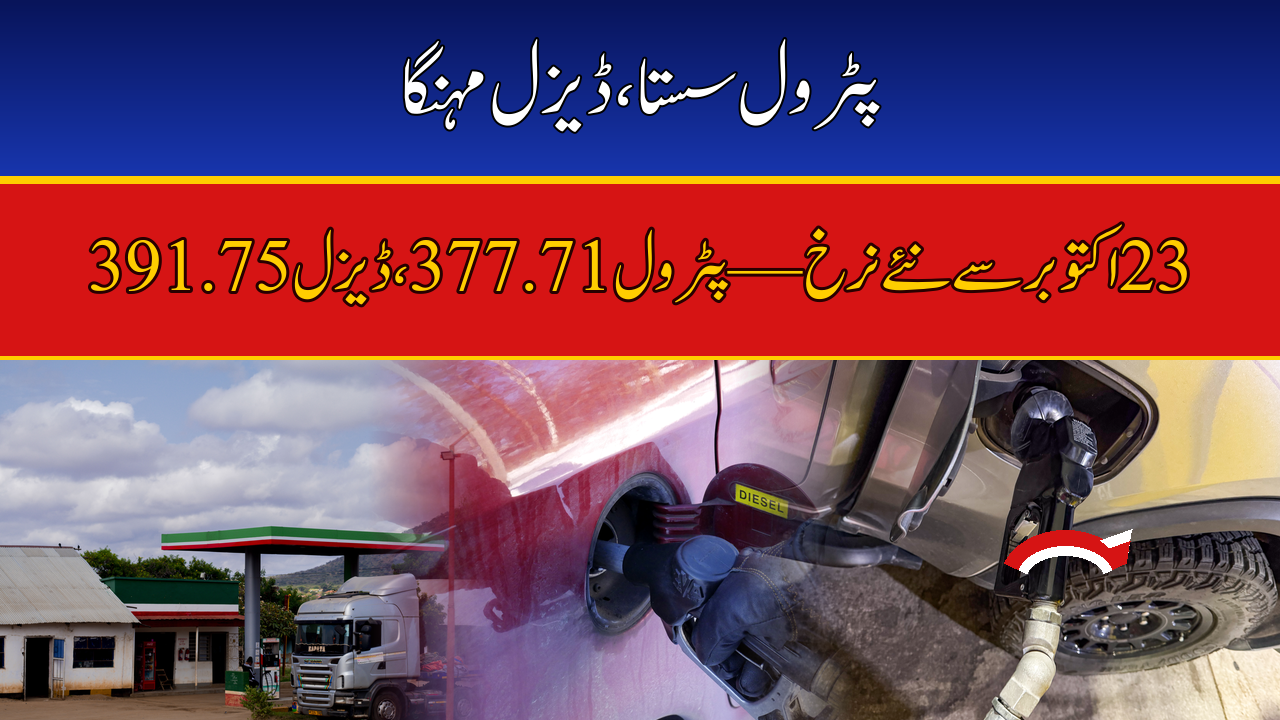
The government has cut petrol prices by Rs1.60 per litre to Rs377.71 and raised high-speed diesel by Rs1.64 to Rs391.75 per litre, with the new rates taking effect on Friday, October 23, 2026. The revision was issued late Thursday night under the daily petroleum pricing mechanism, which adjusts fuel prices Monday through Friday on the basis of international market benchmarks.
Here are the new rates in one glance:
| Product | Change | New rate (per litre) | Effective |
|---|---|---|---|
| Petrol | −Rs1.60 | Rs377.71 | Oct 23, 2026 |
| High-speed diesel (HSD) | +Rs1.64 | Rs391.75 | Oct 23, 2026 |
Petrol has now fallen two days in a row, but diesel has gone the other way — up both days, and today’s Rs1.64 hike is more than five times yesterday’s. For a 40-litre car tank, the petrol cut means about Rs64 saved per fill-up versus Thursday. Diesel is the consequential number: at Rs391.75 it costs Rs14.04 per litre more than petrol, and the freight, farming and transport costs built on it will feel today’s revision long after the pump boards change.
How the October 23 revision was announced
The Oil and Gas Regulatory Authority (OGRA) issued the notification on Thursday night, October 22, revising the ex-depot prices of petroleum products in line with the pricing mechanism set by the federal government. A press release from the Petroleum Division followed, confirming the new rates and their Friday, October 23 effective date.
According to the Petroleum Division, the revision was driven by global developments — specifically changes in Platts rates, premiums, and incidental costs. Petroleum Minister Ali Pervaiz Malik has said prices are set on the seven-day average of international market prices, in line with international practice — so this morning’s rates reflect the weighted average of the week behind us, not a single day’s crude move. One timing detail matters: because these rates were notified on Friday, they hold through the weekend — the next notification arrives on Monday, October 26.
What changed yesterday: the October 22 revision
Fuel prices are moving almost every working day now, so context helps. Just a day earlier, on Thursday, October 22, the government had cut petrol by Rs2.71 to Rs379.31 per litre and raised HSD by Re0.31 to Rs390.11 per litre, under the same daily mechanism. The net movement over two days: petrol is down Rs4.31 per litre from where it stood on Wednesday (Rs382.02), while diesel has climbed Rs1.95 (from Rs389.80). Petrol’s two-day slide is the second straight day of relief for motorists; diesel’s two-day climb — Re0.31, then Rs1.64 — is the steeper, accelerating number. (Our full coverage of yesterday’s revision: Petrol, Diesel Price October 22, 2026: New Rates Announced.)
Why diesel went up while petrol came down
The split — petrol down, diesel up — is the question every filling station will hear today. The short answer: OGRA does not price both fuels off the same crude number. Petrol and diesel each have their own Platts benchmark, and those two product markets move on their own supply-demand stories. Internationally, diesel (gasoil) tightness has been running ahead of petrol lately: when refinery margins on middle distillates widen, the diesel benchmark rises faster than the petrol one. At Rs1.64, today’s diesel hike is more than five times yesterday’s Re0.31 move — not a rounding adjustment, but real momentum in the diesel benchmark.
The global picture: Brent hits a five-month high
The Petroleum Division ties each revision to global developments, and this week’s international context is loud. On Thursday, Brent crude futures rose $2.42 (2.2%) to $111.24 a barrel at 10:45am EDT — a five-month high, on track for the highest close since May 18 — while WTI gained $1.14 to $98.29. The driver: Houthi attacks in Saudi Arabia, feeding fears of supply disruption in the world’s largest oil-exporting region. Technicians also note Brent entered technically overbought territory for the third time this week — momentum, not fundamentals alone, is pushing prices.
Our coverage of the market fallout is here: PSX Crashes 2,000 Points as Oil Hits $112 on Houthi Attacks in Saudi Arabia. For consumers, the link is direct: the 7-day international average that sets tomorrow’s pump price is being built while crude sits at these levels. If Brent stays elevated through the weekend, Monday’s notification (October 26) could erase part of petrol’s two-day relief.
More on this story: our October 22 revision coverage has the full breakdown, and the PSX–oil market report explains how the Houthi attacks in Saudi Arabia pushed crude to $111+. Visit our Business section for ongoing fuel and economy coverage.
What the Rs1.60 cut means for motorists
The practical maths, on petrol at Rs377.71 per litre: a 70cc motorcycle (10-litre tank) saves about Rs16 per full tank versus Thursday; a 125cc bike (13 litres) about Rs21; a small car (35 litres) about Rs56; a family sedan (40–50 litres) roughly Rs64–80.
Modest on its own — but this is the second straight day of cuts, and the two-day total of Rs4.31 per litre works out to Rs172 saved on a 40-litre tank versus Wednesday’s rate.
Diesel’s Rs1.64 hike: transporters, farmers, fares
The consequential side of the notification. High-speed diesel at Rs391.75 per litre is up Rs1.95 in two days, and at Rs14.04 above petrol, diesel is widening its lead as the premium commercial fuel. Diesel fuels nearly all intercity freight, public buses, tractors, tube wells and backup generators — so diesel hikes feed into the cost of goods, fares and farming inputs with a lag. Today’s rise alone adds about Rs65.60 to a 40-litre diesel fill.
The Rs100-per-litre relief scheme: still on
Yes — the Prime Minister’s fuel relief scheme announced on September 13 continues alongside these daily revisions. Eligible motorcyclists (~10 million) and rickshaw users (~800,000) get a Rs100-per-litre subsidy on up to 20 litres per month (up to Rs2,000/month relief); small-car owners up to 800cc (~1 million) get up to 30 litres per month (up to Rs3,000/month) — about 11.8 million beneficiaries in total. The scheme sits on top of the notified daily rates, so today’s Rs1.60 petrol cut applies to the subsidized price too.
How the daily pricing mechanism works
Pakistan moved to a daily (Monday to Friday) petroleum pricing mechanism, announced July 17, 2026, replacing the weekly review cycle that had followed the Middle East conflict (attacks on Iran and the Strait of Hormuz shutdown began February 28). Under the daily system, OGRA recalculates ex-depot prices on working days using the formula set by the federal government, factoring in Platts rates, premiums and incidentals.
OGRA prices off the average international market prices of the previous seven days — a moving average, not a single day’s crude move — and Friday-notified rates hold unchanged through Saturday and Sunday. The levy cap is set by the federal cabinet, and OGRA announces the revision without needing the Prime Minister’s approval, which is what allows an overnight turnaround.
What this means in practice: notifications land late at night and take effect the next day; weekend prices hold steady at Friday’s rates; small daily moves can compound into large swings over a month — watch the two-week trend, not single days; and pump stations adjust dispenser rates to the notification, so midnight prices may differ from 8am ones.
What to expect next: weekend hold, then Monday’s notification
Because these rates were notified on Friday, October 23, they hold through Saturday, October 24 and Sunday, October 25 — no weekend revision is possible under the mechanism. The next notification arrives on Monday, October 26, taking effect that same day. The question at every pump this weekend: does the two-day petrol relief survive Monday? The 7-day international average now being priced includes a week when Brent climbed to a five-month high of $111.24 — so if crude’s momentum holds, Monday’s revision could swing the other way, and diesel’s upward trend (up Rs1.95 in two days) has the wind at its back.
For the long view on fuel costs in Pakistan, see our evergreen guide: Petrol Price in Pakistan — Today’s Rates, History & Trends.