IRSA Projects 22% Water Shortage for Rabi Season — 33 Million Tonne Wheat Target at Stake
Pakistan’s wheat farmers are heading into the Rabi sowing season with a warning already on the books. The Indus River System Authority’s Advisory Committee has approved an overall 22 per cent water shortage for the Rabi season 2026-27 for Punjab and Sindh — the two provinces that grow nearly all of the country’s wheat. The…
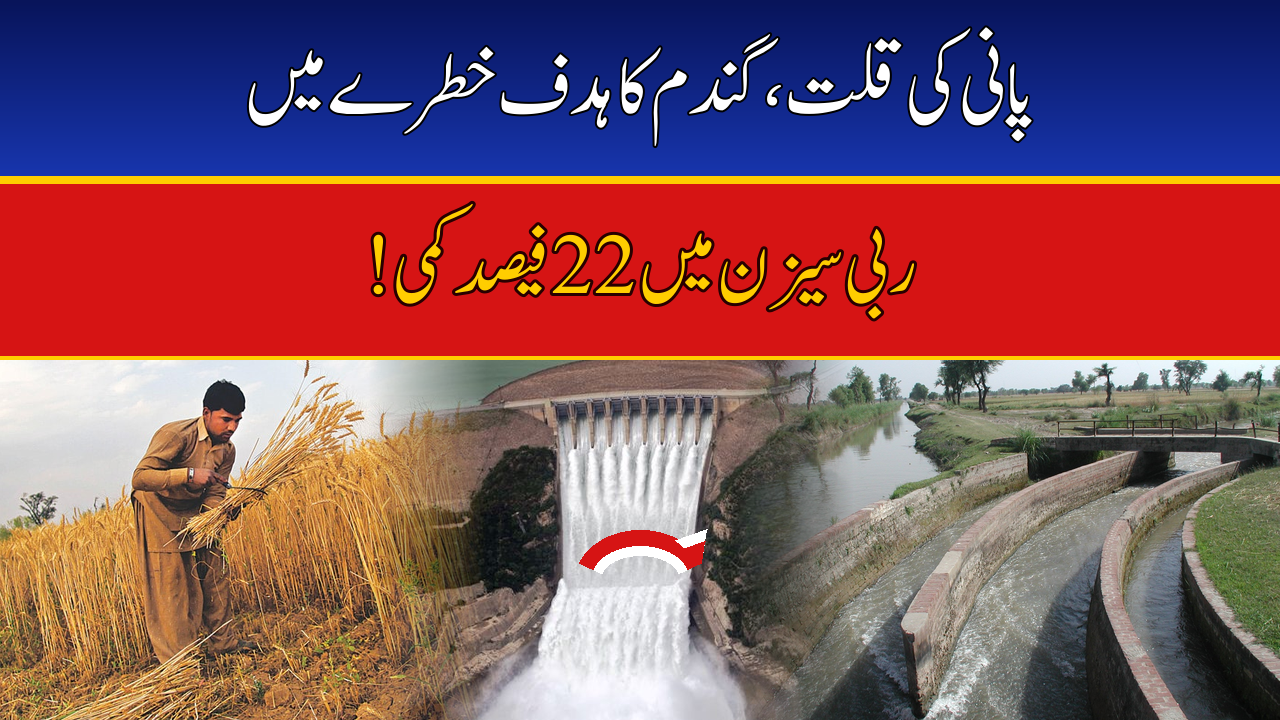
Pakistan’s wheat farmers are heading into the Rabi sowing season with a warning already on the books. The Indus River System Authority’s Advisory Committee has approved an overall 22 per cent water shortage for the Rabi season 2026-27 for Punjab and Sindh — the two provinces that grow nearly all of the country’s wheat. The decision, taken at a meeting in Islamabad on October 6, puts the government’s proposed 33-million-tonne wheat production target under immediate pressure before a single seed goes into the ground.
The timing could hardly be more delicate. The wheat sowing window is opening, the Federal Committee on Agriculture has deferred finalising Rabi targets until a support price is announced, and the Pakistan Meteorological Department has flagged soil moisture stress after below-normal rainfall in recent months. Here is what the official numbers say — and what they mean for farmers, millers and anyone who buys atta.
What IRSA actually decided
The IRSA Advisory Committee, chaired by Amjad Saeed, approved the anticipated water availability criteria for the Rabi season running from October 1, 2026 to March 31, 2027. After running multiple inflow scenarios through the WAA-Tool — a forecasting system developed jointly by Australia’s CSIRO, the University of British Columbia’s watershed model and local stakeholders — the committee settled on likely rim-station inflows of 21.268 million acre-feet (MAF), with 4 per cent conveyance losses for the Indus zone and zero for the Jhelum-Chenab zone.
On those inflows, the overall system shortage worked out to 22 per cent for both Punjab and Sindh, and the committee approved provincial water withdrawals of 29.183 MAF — slightly above the ten-year average of 28.73 MAF. The shortage figure will be reviewed periodically by the IRSA Authority as the season progresses.
One point worth getting right: some reports circulating today describe the 22 per cent figure as a projection for the Kharif season. The official record from the IRSA meeting — carried by APP and UrduPoint — is clear: the approved shortage is for the Rabi season. What IRSA did record about the just-ended Kharif 2026 season is also sobering: actual inflows came to 95.44 MAF, which was 8 per cent below anticipation, 7 per cent below the ten-year average, and 22 per cent below last year’s inflows.
The 33-million-tonne wheat target
A day after the IRSA meeting, the Federal Committee on Agriculture — chaired by Federal Minister for National Food Security Rana Tanveer Hussain — took up the crop picture. The committee was presented a proposed wheat production target of 33 million tonnes, based on cultivation over 9.763 million hectares. The provincial split: Punjab 25 million tonnes, Sindh 5 million tonnes, Khyber Pakhtunkhwa 1.5 million tonnes and Balochistan 1.5 million tonnes.
But the target is not yet final. The committee deferred finalising wheat and other Rabi crop targets until the government announces an indicative price or minimum support price — the number that tells farmers what their crop will actually be worth. The Prime Minister has separately constituted a committee to recommend policy measures to ensure adequate wheat production, and Rana Tanveer acknowledged that farmers are being squeezed by rising input, energy and transport costs.
The seed gap: only half the requirement is available
The tightest number in the whole picture may be seed. The Federal Seed Certification and Registration Department told the committee that about 611,793 tonnes of wheat seed will be available for Rabi 2026-27 — just 51 per cent of the estimated requirement of 1.191 million tonnes. Punjab fares best at 67 per cent of its requirement (553,009 tonnes), while Sindh has only 23 per cent (40,874 tonnes). Khyber Pakhtunkhwa has an estimated 7,459 tonnes and Balochistan 10,452 tonnes — 13 per cent of its requirement.
For perspective: last year’s Rabi sowing faced almost exactly the same 51 per cent coverage (574,330 tonnes). Half the seed requirement, again. Farmers who saved their own seed will be in better shape; those depending on certified seed should plan early.
Fertiliser and credit: the rest of the equation
On fertiliser, the committee heard that total urea supply for 2026-27 is estimated at 3.95 million tonnes — 765,000 tonnes of carryover stocks plus 3.18 million tonnes of domestic production — against projected offtake of about 3.5 million tonnes, so urea looks comfortable. DAP is tighter: 766,000 tonnes of availability against expected offtake of 838,000 tonnes, leaving a 72,000-tonne shortfall to be covered through private-sector imports.
Credit is one bright spot. The State Bank has set an indicative agricultural credit disbursement target of Rs3.062 trillion for FY27, roughly 19 per cent higher than last year’s Rs2.573 trillion — a signal that the financing window for inputs will stay open.
What this means for atta prices down the road
This is the piece that connects the farm to the kitchen. Pakistan’s chakki atta prices have already been under strain — Karachi’s open-market rates have run well above official notifications, and wheat prices in Multan and Faisalabad have touched Rs5,400–5,500 per maund in recent weeks (our full city-wise breakdown here). A tight Rabi — short water, half the certified seed, deferred support price — is exactly the combination that keeps millers nervous and prices sticky.
The PMD does offer one hopeful note: while recent months brought below-normal rainfall and soil moisture stress, above-normal rainfall is forecast for October and November — the critical germination window. If that forecast holds, it could take real pressure off the system.
Frequently asked questions
What water shortage has IRSA approved for Rabi 2026-27?
The IRSA Advisory Committee approved an overall 22 per cent water shortage for Punjab and Sindh for the Rabi season (October 1, 2026 to March 31, 2027), with provincial withdrawals allocated at 29.183 million acre-feet against anticipated rim-station inflows of 21.268 MAF.
What is Pakistan’s wheat production target this year?
A target of 33 million tonnes has been proposed, based on 9.763 million hectares — Punjab 25M, Sindh 5M, KP 1.5M and Balochistan 1.5M tonnes. It is not yet final; the Federal Committee on Agriculture deferred finalisation until the government announces an indicative wheat price or minimum support price.
Is enough wheat seed available for sowing?
Only about half: 611,793 tonnes of seed is available against a requirement of 1.191 million tonnes (51 per cent). Punjab is best placed at 67 per cent of its requirement; Sindh has just 23 per cent.
How did the Kharif 2026 season actually turn out?
Actual Kharif 2026 inflows were 95.44 MAF — 8 per cent below anticipation, 7 per cent below the ten-year average, and 22 per cent below last year’s inflows, according to the IRSA Advisory Committee’s review.
Will the water shortage affect atta prices?
Indirectly but importantly: short water, half the certified seed and a deferred support price make for a tight Rabi, which tends to keep wheat — and therefore atta — prices elevated. Open-market chakki atta is already running well above official rates in cities like Karachi.
Is there any good news for the Rabi season?
Yes — the Pakistan Meteorological Department forecasts above-normal rainfall for October and November, the critical sowing and germination window, which could ease soil moisture stress. Urea supply also looks comfortable, and agricultural credit targets are up 19 per cent.