President Zardari to Visit Germany Oct 22-24 for Trade, Economic Talks
President Asif Ali Zardari will undertake a three-day visit to Germany from October 22 to 24, 2026, where he will meet German President Frank-Walter Steinmeier and hold talks with senior German leadership and business figures, the Foreign Office announced in Islamabad on Thursday. The trip puts trade and economic cooperation squarely at the top of…
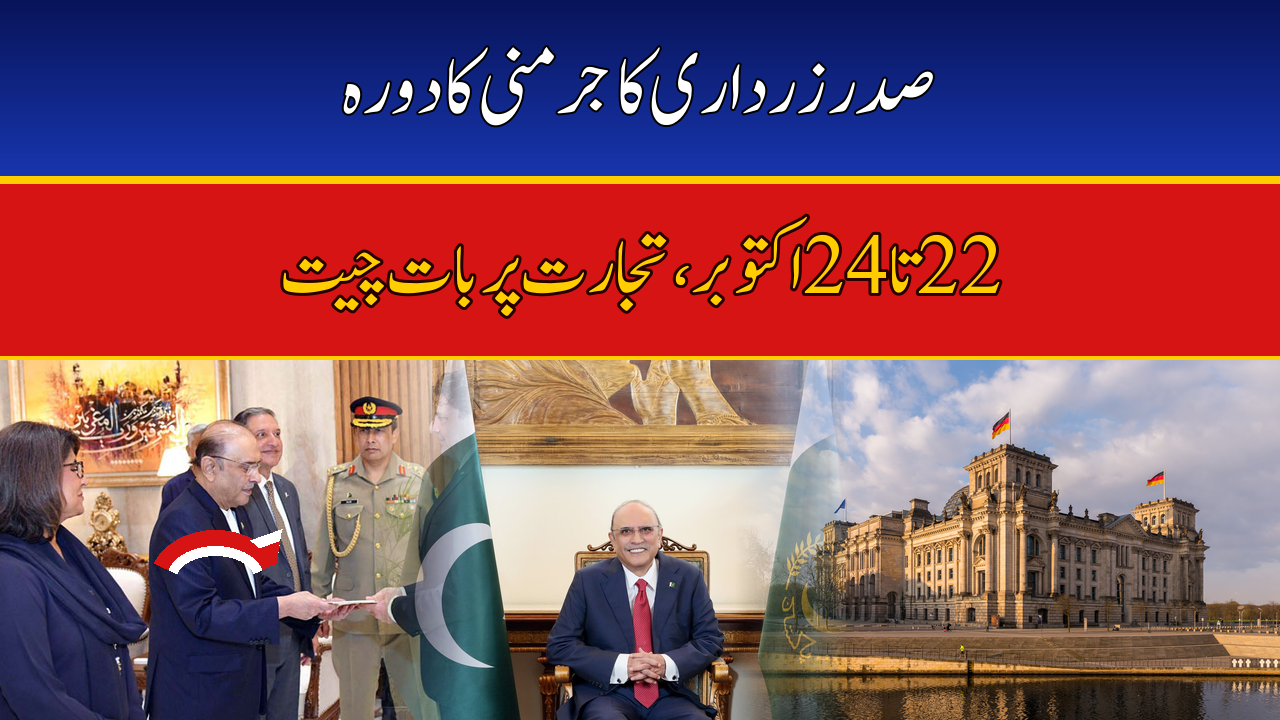
President Asif Ali Zardari will undertake a three-day visit to Germany from October 22 to 24, 2026, where he will meet German President Frank-Walter Steinmeier and hold talks with senior German leadership and business figures, the Foreign Office announced in Islamabad on Thursday. The trip puts trade and economic cooperation squarely at the top of the agenda — and lands at a symbolic moment, with Pakistan and Germany commemorating 75 years of diplomatic relations this year.
The announcement came through a Foreign Office press statement (PR No. 300/2026) issued on Thursday, October 22, 2026. According to the statement, the visit forms part of ongoing high-level exchanges between the two countries and carries special significance as both sides mark three-quarters of a century of formal diplomatic ties.
| Who | President Asif Ali Zardari of Pakistan |
|---|---|
| Where | Germany (meetings with the German leadership and business community) |
| When | October 22–24, 2026 |
| Announced | Foreign Office press statement PR No. 300/2026, issued October 22, 2026 |
| Main meeting | German President Frank-Walter Steinmeier |
| Other meetings | Senior German leadership and German business leaders |
| Agenda focus | Pakistan–Germany bilateral relations, with particular emphasis on economic and trade cooperation |
| Milestone | 75 years of Pakistan–Germany diplomatic relations in 2026 |
| Accompanying | Sindh Chief Minister Murad Ali Shah is expected to join the delegation |
What the Foreign Office announced
Islamabad’s official announcement was brief but deliberate. The Foreign Office confirmed that President Zardari’s visit will unfold over three days, from October 22 to 24, and that his schedule centres on the highest levels of the German state. Beyond President Steinmeier, the statement says Zardari will engage with senior German leadership and business leaders — a clear signal that this is a working visit with substance, not a ceremonial courtesy call.
The Foreign Office described the trip as holding “special significance” because of the 75-year milestone — anniversary-year language that signals both capitals want the relationship to show momentum.
Who Zardari will meet in Germany
The headline meeting is with Frank-Walter Steinmeier, the President of the Federal Republic of Germany. In Germany’s political system, the presidency is largely a ceremonial office, but it carries real weight in foreign relations — state-level receptions set the tone for everything that follows in a visit.
Just as important, the statement confirms meetings with senior German leadership and business leaders. That second group is where the substance of this trip is likely to live — Pakistani delegations typically use Berlin visits to meet the executives and trade bodies that decide where German investment and import orders go. For a visit whose stated theme is economic cooperation, the boardroom conversations may matter as much as the palace ones.
Trade and the economy top the agenda
Every line of the announcement points back to one theme: the economy. The Foreign Office says discussions will focus on Pakistan–Germany bilateral relations “with particular focus on economic and trade cooperation.” That phrasing is about as direct as diplomatic statements get.
There is good reason for it. Germany is Pakistan’s largest trading partner inside the European Union, and the commercial relationship between the two countries runs deep — Pakistani textiles, garments and leather goods sell strongly in the German market, while Pakistan imports German machinery, chemicals and automotive equipment. Pakistan’s exports to the EU also ride on the GSP+ trade preference scheme, which gives Pakistani goods duty-free access to European markets — a lifeline for the country’s textile sector.
That backdrop is worth keeping in mind as the visit unfolds. Pakistan’s export engine is already running hot: textile exports rose 5.26% to $5.03 billion in the first quarter of FY27, with garments leading the charge. And the government has been stacking up trade roadmaps elsewhere too — Pakistan and Malaysia recently set a $5 billion trade target under a new investment roadmap. The Germany visit fits the same pattern: Islamabad is actively shopping its export and investment case to every major economic partner it can reach.
75 years of diplomatic relations: why the timing matters
Pakistan and Germany established diplomatic relations in 1951, and 2026 marks the 75th anniversary of that relationship. Anniversary years in diplomacy are never just about celebration — governments use them to refresh agreements, sign new frameworks and signal commitment to the next decade of a partnership.
The relationship has always had a strong economic spine, but it stretches well beyond trade. Germany has been a steady development partner, a destination for Pakistani students and professionals, and — through the EU — a voice in the debates that shape Pakistan’s market access to Europe. Berlin’s position inside the EU matters enormously for Islamabad: on questions like GSP+ renewal and migration policy, German backing carries real weight in Brussels. That European dimension also surfaced recently in the EU’s push for more legal migration from Pakistan, where visa policy and labour mobility are becoming part of the broader Pakistan–Europe conversation.
Murad Ali Shah expected to accompany the president
One notable detail in the reports around the visit: Sindh Chief Minister Murad Ali Shah is expected to accompany President Zardari to Germany. The matter came up in a meeting between Murad Ali Shah and German Consul General Thomas E. Schultze, suggesting the provincial angle of the visit is already being coordinated.
That is an interesting inclusion. Provincial leaders do not routinely join presidential delegations abroad, so the decision points to a specific purpose — very likely the investment and trade pitch. Sindh is Pakistan’s economic engine, home to Karachi’s ports and industrial base, and a natural focal point for German companies looking at trade or investment in Pakistan. Bringing the chief minister along signals that the delegation intends to talk specifics, not generalities.
It also mirrors a wider pattern: Pakistan’s provinces are increasingly running their own export drives. Punjab has set an ambitious Rs500 billion food export target for Saudi Arabia, and having Sindh’s chief executive in the room in Berlin suggests the federal government wants that provincial energy plugged directly into the Germany visit.
What this visit is about — and what it isn’t
It is worth being clear about what the announcement does and does not promise. The Foreign Office statement talks about discussions on bilateral relations with a focus on economic and trade cooperation — but does not announce any specific agreements, deals or investment figures, and it would be wrong to read those into the visit before anything is signed.
State visits like this typically produce joint statements, memoranda of understanding and follow-up mechanisms. The real test will be what gets signed — and, more importantly, what gets implemented in the months that follow.
For Pakistani exporters, the trip is a reminder that their biggest European market is paying attention.
Why this visit matters for ordinary Pakistanis
State visits can feel distant from daily life, but the trade agenda here connects directly to jobs and livelihoods. Pakistan’s textile and garment industries — the country’s largest formal employer — depend heavily on European markets, with Germany among the biggest buyers. Anything that strengthens Pakistan’s standing in Berlin helps protect the export orders that keep those factories running.
The 75-year anniversary also carries a quieter significance: relationships this old do not survive on autopilot. In a year when Pakistan is competing for investment with every other emerging economy in the region, a presidential visit is how a country signals it wants to be taken seriously. Whether that signal converts into contracts will be the story to watch after October 24.
Frequently Asked Questions
When is President Zardari visiting Germany?
President Asif Ali Zardari will visit Germany from October 22 to 24, 2026 — a three-day trip announced by the Foreign Office in Islamabad on October 22, 2026, through press statement PR No. 300/2026.
Who will President Zardari meet during the visit?
According to the Foreign Office, he will meet German President Frank-Walter Steinmeier, along with senior German leadership and German business leaders. The meetings will focus on Pakistan–Germany bilateral relations, particularly economic and trade cooperation.
Why is trade the main focus of the visit?
Germany is Pakistan’s largest trading partner in the European Union. Pakistan exports textiles, garments and leather goods to Germany, while Pakistani exporters rely on the EU’s GSP+ scheme for duty-free market access. The visit aims to deepen that economic relationship at a time when Pakistan is actively expanding its export markets.
What is the 75-year milestone about?
Pakistan and Germany established diplomatic relations in 1951, and 2026 marks 75 years of those relations. The Foreign Office said the visit holds special significance because of the anniversary, framing it as part of the high-level exchanges between the two countries.
Is Sindh Chief Minister Murad Ali Shah going to Germany with the president?
He is expected to accompany President Zardari, according to reports. The matter was discussed in a meeting between Murad Ali Shah and German Consul General Thomas E. Schultze. Sindh — home to Karachi’s ports and industrial base — is a natural focal point for German trade and investment interest.
Have any deals been announced for the visit?
No. The Foreign Office announcement confirms discussions on bilateral relations with a focus on economic and trade cooperation, but does not mention any specific agreements or investment figures. Any outcomes — such as memoranda of understanding or trade frameworks — will become clear during or after the October 22–24 visit.
By Fatima Raza — Updated: October 22, 2026