Pakistan, Maldives Sign 20 MoUs — Bilateral Trade to Jump from $13.9M to $200M in Two Years
Pakistan, Maldives Sign 20 MoUs — Bilateral Trade to Jump from $13.9M to $200M in Two Years By Bilal Ahmed, Business Desk | Updated: October 21, 2026 Pakistan and the Maldives have agreed to raise their bilateral trade from just $13.9 million to $200 million within two years — a more than fourteen-fold jump —…
Pakistan, Maldives Sign 20 MoUs — Bilateral Trade to Jump from $13.9M to $200M in Two Years
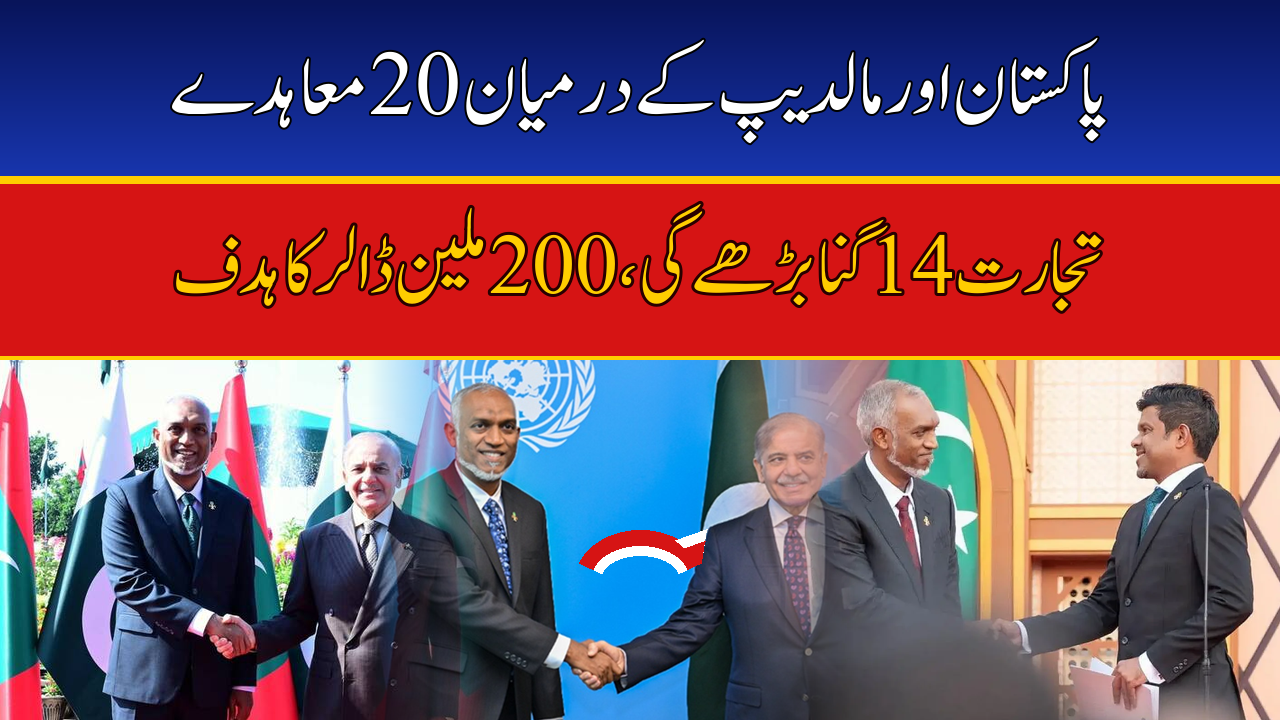
Pakistan and the Maldives have agreed to raise their bilateral trade from just $13.9 million to $200 million within two years — a more than fourteen-fold jump — as the two countries signed 20 memorandums of understanding covering defence, IT, health, agriculture, tourism and maritime security. The announcement came on Wednesday at the PM House in Islamabad, during the three-day state visit of Maldivian President Dr Mohamed Muizzu — the first visit by a Maldivian president to Pakistan in 11 years.
Addressing a joint press stakeout after the signing ceremony, Prime Minister Shehbaz Sharif called the talks “very productive and very fruitful” and said the $200 million trade target carried the “complete endorsement” of President Muizzu. “We will do our best jointly to raise this bilateral trade quantum from 13 million dollars to 200 million dollars in the next two years,” the prime minister said, admitting the current volume was “just a fraction of our potential.”
A 14x trade leap — what it actually means
Let’s put the number in perspective. At $13.9 million, Pakistan–Maldives trade is smaller than what a single mid-sized Pakistani textile exporter ships to Europe in a year. The Maldives imports nearly everything it consumes — food, construction material, medicines, furniture — mostly from the UAE, China, India and Singapore. Pakistan has never been more than a marginal supplier, which is exactly why both governments think the room to grow is enormous.
The prime minister made the point himself: this is not about wishful thinking, it is about a deliberate push into a market where Pakistani goods — rice, pharmaceuticals, textiles, surgical instruments, furniture — are already competitive but under-represented. To turn the pledge into shipments, the Maldives State Trading Organisation and the Trading Corporation of Pakistan signed a dedicated MoU on trade in agricultural commodities, food and other products, and a Pakistan–Maldives Business Forum is being held during the visit so business communities from both sides can convert handshakes into contracts.
The 20 MoUs: where cooperation is expanding
The signing ceremony, witnessed by PM Shehbaz and President Muizzu as representatives exchanged pre-signed documents, covered an unusually wide field:
- Defence and security: MoUs on strengthening defence ties and maritime security cooperation; cooperation against illicit drug trafficking.
- Technology: IT, cybersecurity, artificial intelligence, digital skills and innovation. Pakistan also pledged technical assistance to the Maldives in the IT sector.
- Health: health cooperation, an MoU between the Maldives Food and Drug Authority and Pakistan’s Drug Regulatory Authority, and recruitment of health professionals. Around 250 Pakistani doctors and paramedics already serve in the Maldives, and Pakistan offered to send more.
- Agriculture and fisheries: separate agreements on agricultural and fisheries cooperation.
- Education and training: technical and vocational education, broader educational cooperation, and MoUs between the Maldives’ National College of Policing and Law Enforcement and Pakistan’s National Police Academy, plus between the Maldivian Civil Service Commission and Pakistan’s Federal Public Service Commission and Civil Service Academy.
- Connectivity and culture: youth and sports development, air connectivity, tourism, arts, culture and heritage, social protection, and the environment.
A large number of Maldivian students have already studied at Pakistani universities and colleges, particularly in healthcare — a pipeline both sides want to widen.
Why this visit matters beyond trade
The timing is deliberate. The two countries are marking 60 years of diplomatic relations, established in 1966, and Muizzu’s visit is the first by a Maldivian president in 11 years. That symbolism matters in South Asian diplomacy: after years when Malé leaned heavily toward other partners, this reset — guard of honour, anthems, a sapling planted on the PM House lawns — signals the Maldives actively courting Pakistan again.
Defence cooperation got a quiet but significant mention. The joint statement referenced “strategic defence cooperation” and maritime security — relevant in an Indian Ocean where shipping lanes, fisheries disputes and transnational crime keep every littoral state alert. Pakistan, which already trains Maldivian police and military personnel, is positioning itself as the Maldives’ dependable partner in uniform as well as in business.
Earlier, Deputy Prime Minister and Foreign Minister Ishaq Dar called on President Muizzu in Islamabad, conveying greetings from President Asif Ali Zardari and PM Shehbaz, and underscoring cooperation in trade, investment, education, climate change and tourism. President Muizzu is also scheduled to meet President Zardari, who will host a state banquet in his honour.
Will $200 million actually happen?
Honest answer: it is ambitious, but not absurd. Fourteen-fold growth sounds dramatic until you remember the base is tiny. Pakistan exports over $30 billion a year globally; capturing a slice of the Maldives’ roughly $3.5 billion import market is a matter of logistics, credit and visibility — not industrial capacity.
The obstacles are real though. Shipping connectivity between Karachi and Malé is thin and expensive compared to the Colombo and Dubai routes Maldivian importers already use. Payment and credit arrangements between the two banking systems are underdeveloped. And MoUs, as every Pakistani businessperson knows, are promises, not purchase orders — the real test is the Business Forum this week and whether the two trading corporations follow through with actual tenders.
Still, there is a structural tailwind: the Maldives wants to diversify its suppliers, Pakistan wants new export destinations beyond its traditional markets, and both governments are now politically invested in showing results before the visit’s glow fades. If even half the 20 MoUs move from paper to projects, the $200 million figure stops looking like a headline and starts looking like a plan.
For context on where Pakistan’s own savers are parking their money while the economy rewrites its trade map, see our coverage of the new National Savings profit rates effective October 21, 2026.
What did Pakistan and the Maldives agree on trade?
The two countries agreed to raise bilateral trade from $13.9 million to $200 million within two years — more than a fourteen-fold increase. The target was announced by PM Shehbaz Sharif on October 21, 2026, with President Muizzu’s “complete endorsement.”
How many MoUs were signed during the Maldives president’s visit?
20 memorandums of understanding were signed and exchanged, covering defence, IT, cybersecurity, AI, health, education, agriculture, fisheries, tourism, maritime security, social protection, youth and sports, air connectivity, culture, the environment and institutional cooperation between police, civil service and drug-regulatory bodies.
Why is President Muizzu’s visit to Pakistan significant?
It is the first visit by a Maldivian president to Pakistan in 11 years and coincides with the 60th anniversary of diplomatic relations (established 1966). Muizzu arrived in Islamabad on October 20 for a three-day state visit, accompanied by First Lady Sajidha Mohamed and a high-level delegation.
What is the current trade volume between Pakistan and the Maldives?
Current bilateral trade stands at $13.9 million, which PM Shehbaz described as “just a fraction of our potential.” The Maldives State Trading Organisation and Pakistan’s Trading Corporation signed an MoU on trade in agricultural commodities, food and other products to change that.
How many Pakistani doctors work in the Maldives?
About 250 Pakistani doctors and paramedics currently serve in the Maldives, and an MoU on recruitment of health professionals was among the 20 signed. A large number of Maldivian students have also studied at Pakistani universities, particularly in healthcare.
What happens next after the MoUs are signed?
A Pakistan–Maldives Business Forum is being held during the visit to connect business communities, and PM Shehbaz pledged to prioritise implementation of the MoUs. President Muizzu is also scheduled to meet President Zardari, who will host a state banquet in his honour.
Sixty years of diplomatic ties, 20 agreements and a $200 million target: the Muizzu visit is the most substantive reset of Pakistan–Maldives relations in over a decade. The handshake photos will fade, but if the trade numbers move, October 21, 2026 will be remembered as the day the Indian Ocean’s smallest republic became one of Pakistan’s most deliberate economic bets.