SBP Says Inflation Will Ease to 5–7% in FY27 as Economy Stabilises — GDP Growth 3.5–4.5%
By Bilal Ahmed | 17 November 2026 Pakistan’s inflation is expected to ease gradually towards the State Bank of Pakistan’s medium-term target range of 5% to 7% during the financial year 2026-27 (FY27), the central bank said in its Annual Report on the State of Pakistan’s Economy for FY2025-26, released on Monday, 16 November 2026….
By Bilal Ahmed | 17 November 2026
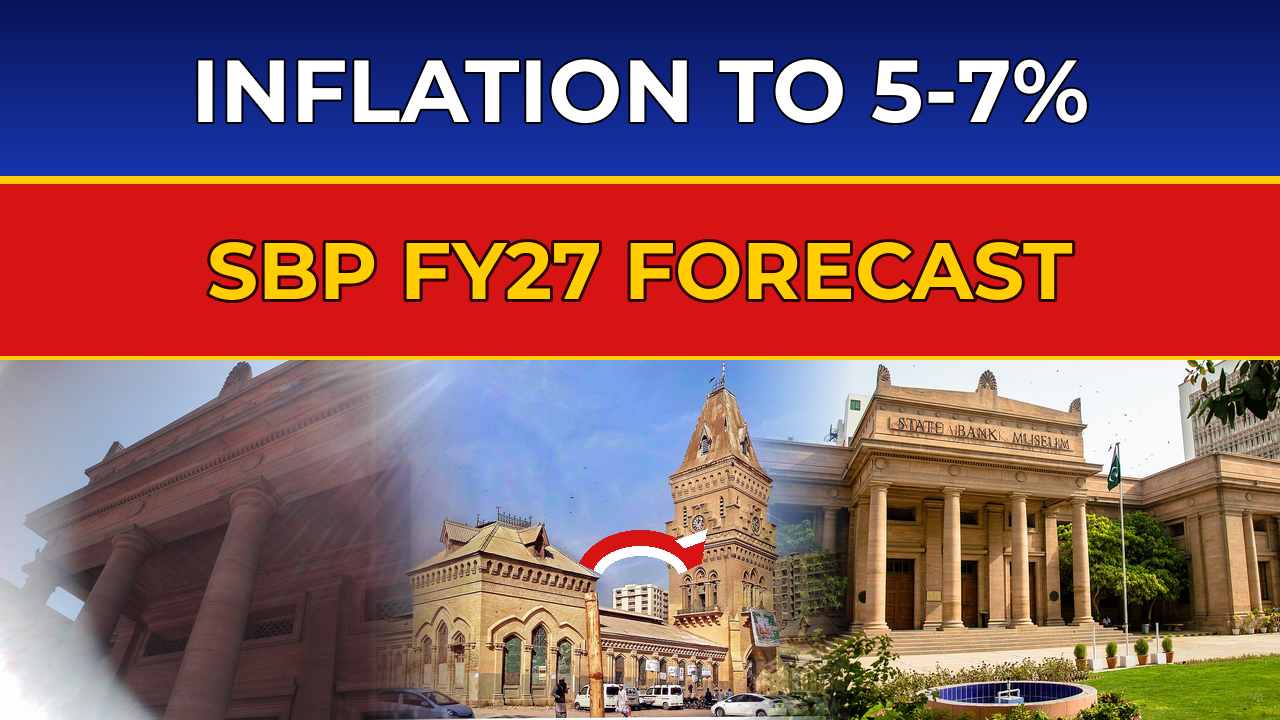
Pakistan’s inflation is expected to ease gradually towards the State Bank of Pakistan’s medium-term target range of 5% to 7% during the financial year 2026-27 (FY27), the central bank said in its Annual Report on the State of Pakistan’s Economy for FY2025-26, released on Monday, 16 November 2026. The report also projects real GDP growth of 3.5% to 4.5% in FY27, with the current account deficit likely to stay between 0% and 1% of GDP and the fiscal deficit between 3.0% and 4.0% of GDP.
That is the headline message from the central bank’s most detailed annual assessment of the economy: stability has improved, but the path ahead still depends on disciplined monetary and fiscal policy, continued reforms under the IMF programme, and an external environment that remains uncertain.

SBP’s FY27 projections at a glance
The annual report sets out the central bank’s central expectations for FY27 in four headline numbers. Together, they sketch an economy that keeps growing at a moderate pace while inflation slowly returns towards target and both the external and fiscal deficits stay contained.
| Indicator | SBP projection for FY27 | What it means |
| Consumer price inflation | Easing gradually towards 5% to 7% | Price rises slow down, but do not stop |
| Real GDP growth | 3.5% to 4.5% | Moderate, steady expansion of the economy |
| Current account deficit | 0% to 1% of GDP | External account broadly balanced |
| Fiscal deficit | 3.0% to 4.0% of GDP | Government borrowing kept within a narrow band |
The report is clear that these are projections, not promises. The inflation path in particular is described as a gradual easing, which means the central bank expects disinflation to continue rather than a sudden drop to the target range.
FY26: stability held, but an energy shock pushed inflation back up
To understand the FY27 outlook, it helps to look at what happened in FY26. According to the report, prudent monetary and fiscal policies kept average national CPI inflation close to the upper bound of the 5% to 7% target range through the year, despite a serious shock: an energy price shock triggered by the conflict in the Middle East pushed year-on-year inflation into double digits from April 2026 onwards.
The monthly readings tell the story of that late-year pressure. Headline inflation stood at 9.2% year-on-year in July 2026 and rose to 11.1% in August 2026, while core inflation, which strips out volatile food and energy prices, was around 8.7%. In other words, the economy entered FY27 with inflation still above target, which is why the central bank frames the return to 5% to 7% as a gradual process rather than an immediate one.
| FY26 inflation reading | Figure | Context |
| Average national CPI inflation | Close to the upper bound of the 5% to 7% target | Held near target despite the energy shock |
| Year-on-year inflation from April 2026 | Double digits | Driven by the energy price shock from the Middle East conflict |
| Headline inflation, July 2026 | 9.2% year-on-year | Monthly reading reported in the annual report |
| Headline inflation, August 2026 | 11.1% year-on-year | Monthly reading reported in the annual report |
| Core inflation | Around 8.7% | Underlying price pressure excluding food and energy |
Even so, the report’s broader judgement is that the economy showed resilience against domestic and global shocks, with improvements across key macroeconomic indicators. Growth in workers’ remittances supported the current account, foreign exchange reserves were accumulated, and reforms continued under the IMF programme.
What 5% to 7% inflation actually means for households
This is the part that matters most at the kitchen table, and it is worth stating plainly: inflation easing to 5% to 7% does not mean prices will fall. It means prices will keep rising, just more slowly than they have been.
At 5% to 7% inflation, a basket of goods that costs Rs. 10,000 today would cost roughly Rs. 10,500 to Rs. 10,700 a year later if prices rose in line with the target range. That is a very different experience from double-digit inflation, where the same basket could cost Rs. 11,000 or more within a year, but it is still a real increase in the cost of living. Household budgets will only genuinely feel relief if incomes grow faster than prices.
That is also why the report’s emphasis on the energy shock matters. When global energy prices jump, the effect reaches Pakistan quickly through fuel and electricity costs, and from there into transport and food prices. The FY26 experience showed that even a year of careful policy can be knocked off course by an external shock, so the FY27 forecast comes with an implicit warning: the path to 5% to 7% is not guaranteed.
For readers tracking day-to-day costs, our regularly updated petrol price in Pakistan page follows fuel rates, which are one of the fastest channels through which global energy prices reach household budgets.
Growth of 3.5% to 4.5%: steady, not spectacular
The growth projection of 3.5% to 4.5% for FY27 points to a recovery that is real but modest. It is the kind of growth that can create jobs and support incomes if it is sustained, but it is not the pace that transforms living standards overnight. The report links the outlook to continued macroeconomic stability, the reform agenda under the IMF programme, and the resilience the economy showed in FY26.
The external side of the picture is part of the same story. A current account deficit of 0% to 1% of GDP would mean Pakistan is close to paying its own way in trade with the rest of the world, with remittances from overseas Pakistanis playing an important supporting role, as they did in FY26. Reserves accumulated during FY26 give the central bank more room to manage pressure, but reserves still need to be protected, because a widening deficit or a fresh external shock can reverse that cushion quickly.
On the fiscal side, a deficit of 3.0% to 4.0% of GDP would keep government borrowing contained, which matters for inflation as well: when the government borrows less, there is less pressure on interest rates and on the central bank to finance spending. Readers following the broader economy can also keep an eye on our Pakistan Stock Exchange coverage, which tracks how investors are responding to the same macroeconomic signals.
The cautious counterpoint: ADB expects inflation of 8.3%
Not every forecaster shares the central bank’s optimism on inflation. The Asian Development Bank, in its Asian Development Outlook published on 27 October 2026, forecasts Pakistan’s GDP growth at 3.7% in FY27, which sits inside the SBP’s 3.5% to 4.5% range, but it expects inflation to average 8.3%, above the SBP’s 5% to 7% target.
The ADB links the higher inflation outlook to the Middle East conflict, which it says has raised inflationary pressure. The gap between the two forecasts is a useful reality check: the SBP sees inflation easing towards target, while the ADB sees it staying above target for longer. Both agree on the direction of growth, but they disagree on how fast price pressure will fade.
That disagreement is normal in economic forecasting, and it is exactly why the SBP describes the easing as gradual. For households and businesses, the practical message is the same either way: plan for prices to keep rising, budget for the slower end of the range, and do not assume that the double-digit months of 2026 are permanently behind us until the monthly readings prove it.

What to watch next
The annual report sets the framework, but the monthly data will decide whether the FY27 projections hold. The numbers to watch are the monthly CPI releases, the core inflation trend, remittance inflows, the current account balance, and the reserve position. If headline inflation starts falling back towards single digits and stays there, the SBP’s path to 5% to 7% will look increasingly credible. If energy prices jump again, the FY26 pattern could repeat.
Gold often moves when inflation expectations shift, and our gold rate in Pakistan page tracks daily rates for readers watching how savers respond to price pressure.
For now, the central bank’s message is one of guarded confidence: the economy proved resilient in FY26, the building blocks of stability are in place, and inflation should ease towards 5% to 7% in FY27, provided policy stays steady and the world cooperates.
SBP to Revise Inflation Forecast in January 2027
The State Bank says its FY27 average inflation projection of 5.5-7.5% will be revised in January 2027, to account for higher oil prices and other key developments since the annual report was prepared. No replacement range has been given. The projection was based on an oil price of $80 per barrel, an assumption made in July, and the report estimated that a 10% increase in global energy prices would raise Pakistan’s consumer inflation by 1.2 percentage points after a year, with the effects persisting for two years.
The report also put the FY26 numbers in context. Average national CPI inflation was 7.1% in FY26, up from 4.5% in FY25, while real GDP grew 3.7%. The policy rate was raised by 100 basis points to 11.5% in April 2026. The latest monthly readings were 10.3% year on year in September and 9.6% in October.
FAQs
What is the SBP’s inflation forecast for FY27?
The State Bank of Pakistan expects consumer price inflation to ease gradually towards its medium-term target range of 5% to 7% during FY27, according to its Annual Report on the State of Pakistan’s Economy for FY2025-26, released on 16 November 2026.
Does 5% to 7% inflation mean prices will fall?
No. Inflation of 5% to 7% means prices still rise, but more slowly. A basket costing Rs. 10,000 today would cost roughly Rs. 10,500 to Rs. 10,700 a year later at that rate. Prices only fall if inflation turns negative, which is not what the SBP is forecasting.
What GDP growth does the SBP expect in FY27?
The SBP projects real GDP growth of 3.5% to 4.5% in FY27, with the current account deficit likely at 0% to 1% of GDP and the fiscal deficit between 3.0% and 4.0% of GDP.
Why did inflation rise again in FY26?
An energy price shock from the conflict in the Middle East pushed year-on-year inflation into double digits from April 2026 onwards. Headline inflation was 9.2% year-on-year in July 2026 and 11.1% in August 2026, with core inflation around 8.7%.
What does the ADB forecast for Pakistan in FY27?
The Asian Development Bank forecasts GDP growth of 3.7% in FY27, inside the SBP’s range, but expects inflation to average 8.3%, above the SBP’s 5% to 7% target, citing inflationary pressure from the Middle East conflict.
When was the SBP annual report released?
The State Bank of Pakistan released its Annual Report on the State of Pakistan’s Economy for FY2025-26 on Monday, 16 November 2026.
Updated: 18 November 2026. This article will be updated as new monthly inflation data is released.