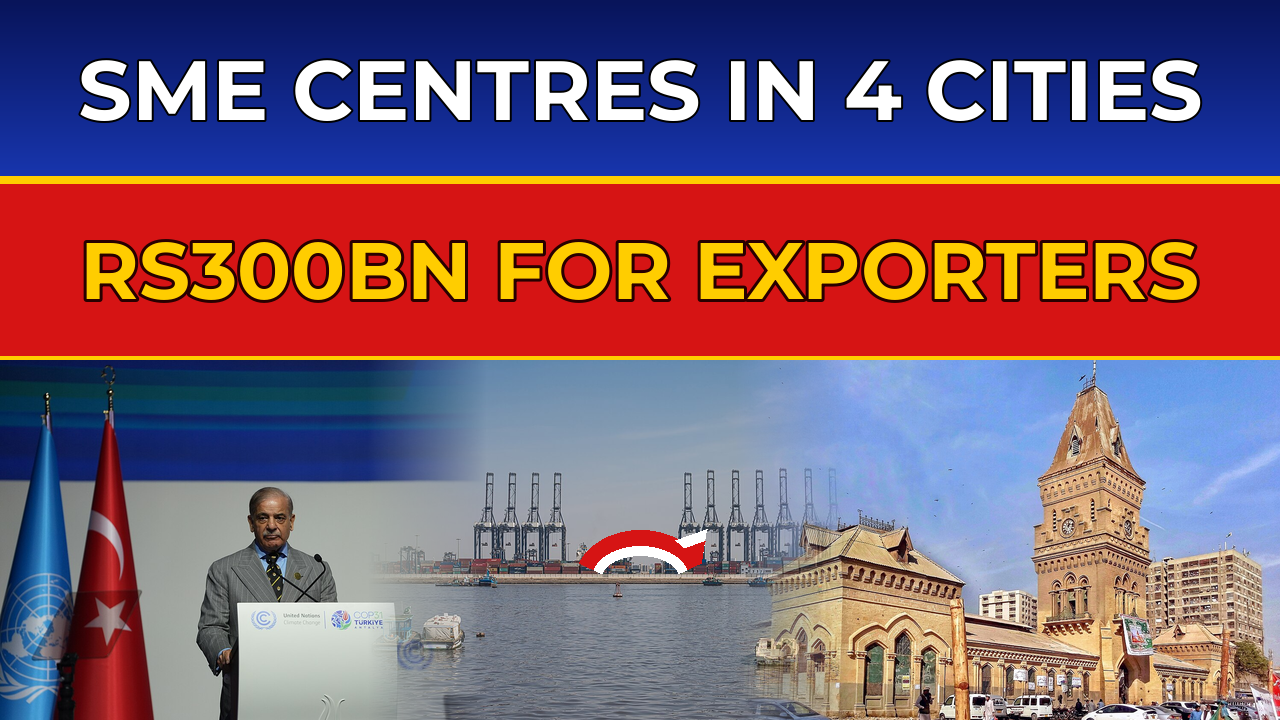
PM Approves District-Level SME Facilitation Centres in Lahore, Karachi, Peshawar, Quetta — Rs300bn Export Finance for Small Businesses
By Bilal Ahmed | Updated: 17 November 2026 Prime Minister Shehbaz Sharif has approved the establishment of SME facilitation centres at the district level across Pakistan, starting with pilot projects in Lahore, Peshawar, Karachi and Quetta, and allocated Rs300 billion under the Export Finance Scheme exclusively for small and medium enterprises and new exporters. The…
By Bilal Ahmed | Updated: 17 November 2026
Prime Minister Shehbaz Sharif has approved the establishment of SME facilitation centres at the district level across Pakistan, starting with pilot projects in Lahore, Peshawar, Karachi and Quetta, and allocated Rs300 billion under the Export Finance Scheme exclusively for small and medium enterprises and new exporters. The decision was taken on Monday, 16 November 2026, during a meeting with a delegation of SME exporters in Islamabad, and it puts small businesses at the centre of the government’s export push. If the pilots succeed, the centres will gradually open in every district of the country.

For the thousands of small workshop owners, textile makers, food processors and traders who have long complained that export support never reaches them, this is a practical change. Until now, a small exporter in a district town usually had to travel to a provincial capital, chase paperwork across several offices and still wait weeks for a bank decision. The new centres are meant to fix exactly that: one local place where a person who wants to start or grow a business can get guidance, information and a clear path to finance.
Update — 17 November 2026: Export Finance Raised to Rs1.5 Trillion
The finance package behind these centres grew bigger on Monday, 16 November 2026. Finance Minister Muhammad Aurangzeb chaired a review meeting at the Ministry of Finance on the revised Export Finance Scheme (EFS) and the progress of the State Bank’s SME Connect portal. The government has raised total financing under the EFS to Rs1.5 trillion for FY2026-27, up from Rs1 trillion — with the Rs300 billion SME share announced earlier sitting inside that bigger envelope.
| Export finance — the new numbers | Figure |
|---|---|
| Total Export Finance Scheme envelope, FY2026-27 | Rs1.5 trillion (up from Rs1 trillion) |
| Reserved for SMEs, agri-SMEs and new exporters | Rs300 billion |
| Outstanding SME financing, October 2026 | Rs1.148 trillion (Rs1.114 trillion in June 2026; Rs691 billion in June 2025) |
| PM’s SME financing target | Rs2.2 trillion by 2028 |
| SBP target | Rs1.5 trillion by June 2027 |
| Finance Ministry target | Rs2 trillion by June 2028 |
The revised schemes took effect on 1 November 2026 — the same day the SME Connect portal went live. The State Bank told the meeting that the portal is now the single place where small businesses register their profile, submit financing requests and track their status. The finance minister underlined that expanding SME credit matters because small firms drive jobs and exports — and the next milestone to watch is how fast the Rs300 billion SME share actually reaches exporters through their banks.
Key facts at a glance
| Detail | What was decided |
|---|---|
| Decision date | Monday, 16 November 2026 |
| Approved by | Prime Minister Shehbaz Sharif, in a meeting with a delegation of SME exporters in Islamabad |
| Pilot cities | Lahore, Peshawar, Karachi and Quetta |
| Nationwide rollout | Gradually in all districts after the pilot projects succeed |
| Export finance | Rs300 billion under the Export Finance Scheme, exclusively reserved for SMEs and new exporters |
| Finance circular | Exim Bank has issued a circular for the Rs300 billion allocation |
| Institutions reformed | TDAP and SMEDA to be modernised and restructured |
| Cold storage | Comprehensive plan ordered for a sustainable cold storage network for perishable exports |
| SME Connect portal | SBP portal live since 1 November 2026 at smeconnect.sbp.org.pk for online loan applications and tracking |
What the SME facilitation centres will do
The centres are designed as a first stop for anyone who wants to set up a business or take an existing small business into export markets. According to the Prime Minister’s Office handout, they will provide maximum awareness and guidance to citizens interested in establishing businesses, from basic information about registration and documentation to help in reaching the right financing and export support.
The Prime Minister directed that all possible measures be taken to raise public awareness about establishing and running businesses. That focus on awareness matters because many small business owners in Pakistan do not use formal finance or export schemes simply because they do not know the schemes exist, or because the process looks too complicated. A district-level centre, close to home and speaking the local business language, is meant to close that gap.
Members of the SME exporters’ delegation welcomed the government’s measures and presented proposals to further strengthen the sector. The Prime Minister formed a committee to examine their practical and actionable proposals and report back to him on implementation.
Pilot cities: Lahore, Karachi, Peshawar and Quetta
The four pilot cities were chosen to cover every province. Lahore anchors Punjab’s manufacturing and textile belt, Karachi is the country’s export and port hub, Peshawar serves Khyber Pakhtunkhwa’s traders and small manufacturers, and Quetta brings Balochistan’s businesses into the scheme from the start. The message is deliberate: this is a national programme, not a big-city programme.

| Pilot city | Province | Why it matters for SMEs |
|---|---|---|
| Lahore | Punjab | Textiles, manufacturing and Punjab’s small-industry belt |
| Karachi | Sindh | Pakistan’s main port and export hub |
| Peshawar | Khyber Pakhtunkhwa | Trade, small manufacturing and cross-border business |
| Quetta | Balochistan | Brings Balochistan’s small businesses into the export scheme |
Once the pilots prove themselves, the centres will be established in all districts. No timeline for the full rollout has been announced yet, and the Prime Minister’s Office has tied the expansion to the success of the first four centres.
Rs300 billion Export Finance Scheme for SMEs
The headline number in the announcement is the money. Rs300 billion has been allocated under the Export Finance Scheme for the SME sector and new exporters, and the Prime Minister made clear that the amount will be exclusively reserved for small and medium enterprises. The Export-Import Bank of Pakistan (Exim Bank) has already issued a circular in this regard, which means the allocation is not just an announcement but a working instruction to the banking system.
This is the financing side of the same policy. The facilitation centres will guide small businesses, and the Rs300 billion fund is the money those businesses can apply for. The combination is aimed at new exporters in particular: firms that have a product to sell abroad but have never exported before, and who usually find bank finance hardest to access.

TDAP and SMEDA to be modernised
The Prime Minister also approved the modernisation and restructuring of the Trade Development Authority of Pakistan (TDAP) and the Small and Medium Enterprises Development Authority (SMEDA). Both bodies are central to export promotion, but exporters have long complained that they move slowly and work in silos.
The reform is meant to align local industries with international export standards, so that Pakistani products can compete on quality and certification, not just price. Restructuring along modern lines should also bring TDAP’s trade promotion work closer to SMEDA’s enterprise development work, which is exactly the link small exporters need: support that follows a business from production to the foreign buyer.
Cold storage plan for perishable exports
Another practical decision from the meeting was a direction to present, at the earliest, a comprehensive plan for a sustainable cold storage system to support exports of perishable goods. Fruit, vegetables, meat and dairy lose value fast without a cold chain, and Pakistan’s growers and food processors lose export orders every year because the product cannot survive the journey in good condition.
A proper cold storage network would let small food exporters reach Gulf and other markets with fresh produce instead of being limited to nearby buyers. The Prime Minister asked for the plan quickly, which suggests this part of the package will move in parallel with the facilitation centres rather than waiting for them.
SME Connect portal: apply for loans online
The centres and the Rs300 billion fund sit alongside a digital change that is already live. The State Bank of Pakistan launched SMEConnect, its centralised SME financing portal, on 1 November 2026 at smeconnect.sbp.org.pk. From that date, all SME financing applications must be submitted through the portal, and applicants can track their application status and see the reason if it is rejected.
The portal gives every SME a single place to register a business profile, submit financing requirements to banks and development finance institutions, and follow the request through the system. It removes the need to visit branch after branch with paper files, which has been one of the biggest barriers for small businesses outside the major cities.
The financing environment is already moving in the same direction. State Bank Governor Jameel Ahmad told the Lahore Chamber of Commerce and Industry on 30 October 2026 that outstanding SME financing had reached about Rs1.11 trillion in June 2026, up from Rs491 billion in June 2024. The collateral-free loan limit for SMEs has been raised from Rs10 million to Rs50 million, and the SME loan application form has been simplified to a single page in collaboration with SMEDA and commercial banks. On 16 November, Finance Minister Muhammad Aurangzeb separately reviewed progress on the SME Connect portal and the export finance initiatives with the State Bank and Exim Bank.
What this means for small exporters
Taken together, the package addresses the three problems small exporters raise most often: they do not know where to get help, they cannot get affordable finance, and their goods cannot reach foreign markets in good condition. A district centre answers the first, the Rs300 billion fund and the SMEConnect portal answer the second, and the cold storage plan answers the third.
Describing SMEs as the backbone of the country’s economy, the Prime Minister said providing facilities to increase SME exports was the government’s top priority. “The primary purpose of today’s meeting is to facilitate exports for Pakistani small and medium-sized businesses,” he said.

The meeting was attended by Federal Ministers Rana Tanveer Hussain, Jam Kamal Khan, Dr Musadik Masood Malik, Ahad Khan Cheema, Muhammad Aurangzeb, Attaullah Tarar and Shaza Fatima Khawaja, Minister of State for Finance Bilal Azhar Kiani, Special Assistant to the Prime Minister Haroon Akhtar, the Governor of the State Bank of Pakistan, the Chairman of the Securities and Exchange Commission of Pakistan, and senior officials of the relevant departments.
What happens next
Three things to watch now. First, the pilot centres in Lahore, Peshawar, Karachi and Quetta need opening dates and locations, and small businesses in those cities should watch for the announcements. Second, the committee formed to review the exporters’ proposals must report to the Prime Minister, and its recommendations will shape how the centres actually work. Third, the cold storage plan is due at the earliest, and its detail will show whether perishable-goods exporters get real infrastructure or just another study.
The export numbers give the package a clear test. Pakistan’s exports need sustained growth, and small businesses employ a large share of the workforce, so if the centres, the Rs300 billion fund and the SMEConnect portal work as designed, the effect should show up in export orders from firms that have never exported before. TimelyUps will follow the pilot launches and update this story as the centres open.
Related stories
- Pakistan exports hit record $11.4 billion in July–October 2026
- Pakistan IT exports reach $435 million in September 2026, second highest ever
- Pakistan exports fall $1 billion after Afghanistan trade suspension
Frequently asked questions
What are the SME facilitation centres?
They are district-level centres approved by Prime Minister Shehbaz Sharif on 16 November 2026 to guide citizens who want to start a business or grow a small business into exports, providing awareness, guidance and help in reaching finance and export support.
Which cities will get the first SME facilitation centres?
Pilot projects will start in Lahore, Peshawar, Karachi and Quetta. After the pilots succeed, the centres will gradually be established in all districts across Pakistan.
How much money has been allocated for SME export finance?
Rs300 billion has been allocated under the Export Finance Scheme for the SME sector and new exporters. The amount is exclusively reserved for SMEs, and Exim Bank has issued a circular for it.
What is the SME Connect portal?
SMEConnect is the State Bank of Pakistan’s centralised online portal at smeconnect.sbp.org.pk, live since 1 November 2026. SMEs can apply for bank financing through it and track their application status. From 1 November 2026, all SME financing applications must be submitted through the portal.
What changes are planned for TDAP and SMEDA?
The Prime Minister approved the modernisation and restructuring of the Trade Development Authority of Pakistan (TDAP) and the Small and Medium Enterprises Development Authority (SMEDA) to promote exports and align local industries with international export standards.
What is the cold storage plan about?
The Prime Minister directed the authorities to present a comprehensive plan at the earliest for a sustainable cold storage system, so that perishable goods such as fruit, vegetables, meat and dairy can be exported in good condition.
Who can benefit from the Rs300 billion scheme?
The fund is reserved for small and medium enterprises and new exporters. Small businesses can apply for financing through the SBP’s SMEConnect portal, where they register their business profile and submit their financing requirements to banks and development finance institutions.