Dinosaur Blood Found After 115 Million Years: Scientists Detect Heme in Fossil in World-First Discovery
By Hira Shahid | Updated: 7 November 2026 Key Fact Detail Discovery Heme molecules found inside red-blood-cell-like structures in a dinosaur fossil — the first direct molecular evidence of compounds from dinosaur blood Fossil Partial hind limb of Aratasaurus museunacionali, a small predatory theropod about 3 metres (10 feet) long Age 115 million years old…
By Hira Shahid | Updated: 7 November 2026
| Key Fact | Detail |
|---|---|
| Discovery | Heme molecules found inside red-blood-cell-like structures in a dinosaur fossil — the first direct molecular evidence of compounds from dinosaur blood |
| Fossil | Partial hind limb of Aratasaurus museunacionali, a small predatory theropod about 3 metres (10 feet) long |
| Age | 115 million years old (Early Cretaceous) |
| Found | 2008, Romualdo Formation, northeastern Brazil |
| Published | Monday, 2 November 2026, in the Proceedings of the National Academy of Sciences (PNAS) |
| Lead researcher | Prof. Kliti Grice, Curtin University, Australia |
| Team | Curtin University; Japan Agency for Marine-Earth Science and Technology (JAMSTEC); Brazil’s National Museum; Regional University of Cariri; Johns Hopkins University |
| Key molecules | Heme B and a chemically altered form, 3,8-diethyl heme B; plus amino acids linked to collagen |
| How it survived | Rapid burial in a low-oxygen environment, a dense mat of microbes, and the mineral hausmannite |
| The catch | This is not liquid blood and not intact haemoglobin; no DNA was found, and at least one leading expert doubts the structures are red blood cells at all |
Scientists have found traces of dinosaur blood in a fossil for the first time. An international team led by Curtin University in Australia reports that a 115-million-year-old leg bone from Brazil contains tiny structures that look like red blood cells — and inside them, chemical fingerprints of heme, the iron-rich molecule that lets haemoglobin carry oxygen. The paper was published on Monday, 2 November 2026, in the Proceedings of the National Academy of Sciences (PNAS). It is not a vial of red liquid, and it is certainly not a step towards cloning a dinosaur. What the team found is subtler: molecular residue of blood, locked inside stone for 115 million years, still readable today.
Here is what actually happened, what it proves, what it doesn’t, and why one of the world’s most respected fossil scientists is not yet convinced.
What Scientists Actually Found Inside the Bone
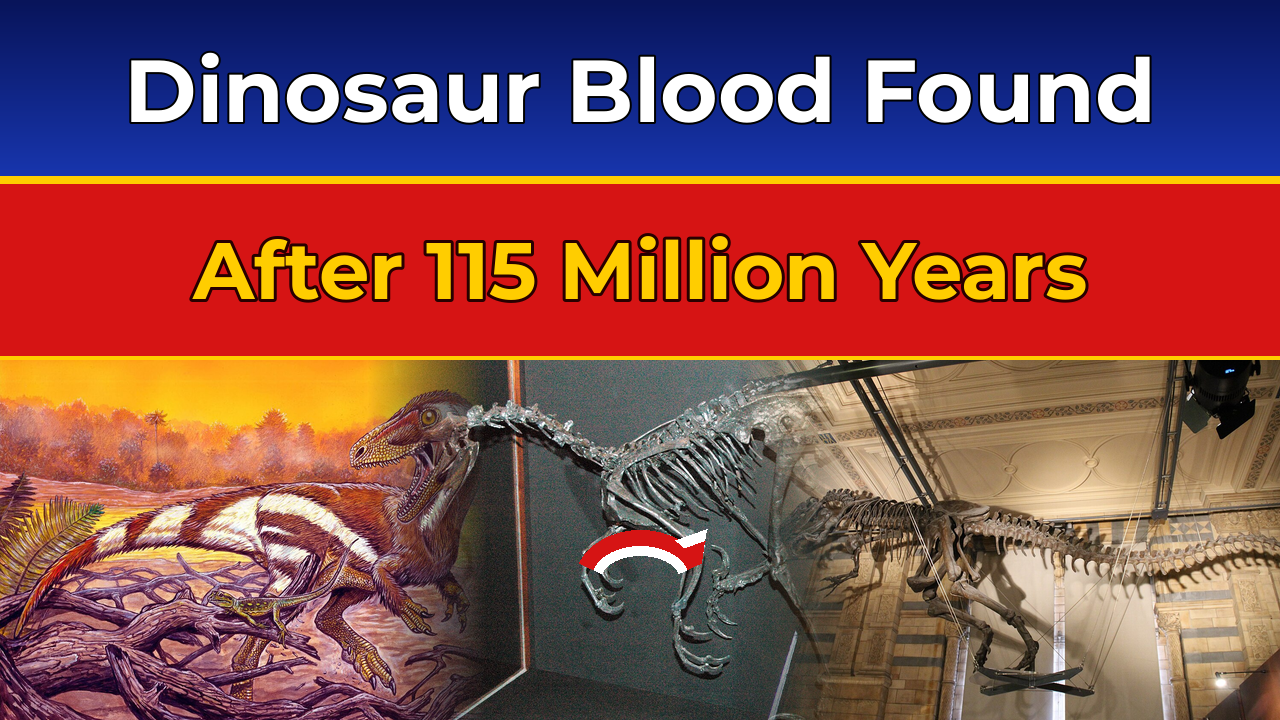
The fossil is a partial hind limb — the bones of a back leg — belonging to a small meat-eating theropod called Aratasaurus museunacionali. Looking inside the bone’s microscopic channels, the tiny passages that once carried blood vessels, researchers found numerous oval, mineralised structures shaped like red blood cells.
Shape alone would never have been enough. Palaeontologists have argued for decades about whether cell-like shapes in fossils are real biology or mineral trickery. So the team, headed by Prof. Kliti Grice of Curtin University, went after the chemistry, testing what those structures were actually made of.
The answer was heme — more precisely, two chemical fingerprints of blood: heme B, the variant found in haemoglobin, and a chemically altered version called 3,8-diethyl heme B, the kind of breakdown product you would expect after 115 million years of slow chemical change. Other tests confirmed iron, carbon and nitrogen in the same places, and the team also found amino acids associated with collagen, the protein found in connective tissue.
“To detect intact heme-derived molecules in 115-million-year-old red blood cells is astonishing: this really is a landmark discovery,” Grice said. In the authors’ view, it is the first time heme has ever been detected in a dinosaur fossil in situ — in place, inside the fossil itself, rather than in the rock around it. That “in place” detail is the heart of the claim.
The 115-Million-Year-Old Dinosaur Behind the Discovery
Aratasaurus museunacionali was not a giant. At roughly 3 metres (10 feet) long, it was a small, fast predator that lived during the Early Cretaceous, when the region that is now northeastern Brazil was a world of shallow lagoons and tropical heat. The specimen was found in 2008 in the Romualdo Formation, a rock layer famous for exquisitely preserved fish, turtles, crocodile relatives and pterosaurs. Dinosaur material there is rare, which makes this partial hind limb all the more precious. Today the fossil is housed at a palaeontology museum in northeastern Brazil.
Its name carries a story of its own. Aratasaurus combines the Tupi words ara (“born”) and atá (“fire”) with the Greek sauros (“lizard”), while the species name museunacionali honours Brazil’s National Museum. The fossil was held at the National Museum in Rio de Janeiro until a catastrophic fire destroyed much of the museum’s collection in 2018; the building holding this specimen was not affected.
How the Chemistry Proved It Was Blood
The strongest part of this paper is not any single test. It is the way several different lines of evidence point in the same direction, and the way the team tried to rule out the boring explanations first.
Start with location. The red-blood-cell-like structures appear exclusively inside the vascular canals of the bone, the narrow channels where blood vessels ran when the animal was alive — exactly where red blood cells should be. Just as importantly, the sediment surrounding the fossil contained none of these structures and no heme B. If the molecules had seeped in from outside, the sediment would show the same signature. It doesn’t: the sediment mostly contained compounds from plant and bacterial sources, while the fossil bone carried a distinct signature dominated by heme molecules.
Then there is the chemistry itself. The team did its analysis in place on the fossil, so imaging and spectroscopy could tie the heme signatures to the very same microscopic structures seen under the microscope. It wasn’t a case of grinding up a bone and finding a chemical somewhere in the powder. The blood molecules sit where the blood cells are.
The researchers also evaluated and ruled out several alternative explanations before concluding the structures were most likely authentic fossilised red blood cell remains. The collagen traces strengthen the case further: amino acids linked to connective tissue alongside the heme suggest real remnants of blood and soft tissue, not a mineral coincidence.
For context, the most famous earlier case came from Mary Schweitzer’s work on a Tyrannosaurus rex that lived about 68 million years ago — roughly 47 million years after Aratasaurus. Schweitzer found blood vessels and cell-like structures in that T. rex bone, along with evidence of heme. The new find pushes the confirmed survival of blood-derived molecules back by nearly 50 million years.
Why Some Scientists Are Not Convinced
Not everyone is ready to sign off on the “red blood cell” label — and the most important sceptic is the very scientist whose earlier work made this discovery possible.
Prof. Mary Schweitzer of North Carolina State University, the molecular palaeontologist behind the T. rex soft-tissue finds, accepts that molecules originating inside the animal can persist in fossils. Her objection is about shape, not chemistry. Birds and reptiles keep a nucleus in their red blood cells, which gives each cell a distinctive bulge. The structures in the Aratasaurus bone are concave, have no bulge, and are smaller than typical non-mammalian red blood cells. In Schweitzer’s words: “I am not convinced that the images they figure are remnant RBCs.”
That is a serious objection, and it deserves to be stated plainly rather than buried. The concave, disc-like shape is what you would expect from a mammalian red blood cell, which loses its nucleus — but dinosaurs were not mammals, and their closest living relatives, birds and crocodilians, have nucleated red blood cells with a visible bulge.
Grice’s team has an answer, of sorts: the cells may have been deformed as the bone fossilised, or dinosaur red blood cells unrelated to birds may simply have been shaped differently. Both are possible, and neither can be proven from a single specimen.
Credit where it is due: Schweitzer also praised the team’s work, calling the use of multiple analytical techniques an exciting advancement, and she does not dispute that heme and collagen can be present in the bone. The disagreement is narrower than the headlines suggest. It is about whether these particular structures are red blood cells, not about whether ancient molecules can survive. That is how science is supposed to work: a bold claim, a sharp challenge, and more work to settle it.
How Could Anything Survive 115 Million Years?
Blood is famously fragile. Leave it out, and it rots in days. How does any trace of it last 115 million years? The short answer is that the blood did not remain fresh or unchanged. The microscopic red blood cells turned into minerals during fossilisation. What survived is not blood as we know it, but a mineralised ghost of it — the shape preserved in stone, and a few stubborn molecules tucked inside.
The longer answer is a chain of lucky breaks. First, the dinosaur was buried rapidly in a low-oxygen environment, which slowed decay before bacteria and scavengers could destroy the soft tissues. The fossil was encased in a dense mat of microbes, which may have sealed it off further. Then came the chemistry of the rock itself: the mineral hausmannite, a manganese oxide, was present in the bone and can act a bit like an antioxidant, stabilising sensitive organic molecules and slowing their breakdown.
None of this guarantees preservation — it only makes it possible. Most dinosaur bones will never yield anything like this. The conditions have to line up: quick burial, little oxygen, the right minerals, and then 115 million years without the chemistry being wiped out by heat, water or tectonic violence.
What It Means for Fossils Sitting in Museums
Perhaps the most exciting implication of this discovery has nothing to do with this one dinosaur. It is about the millions of fossils already sitting in museum drawers and display cases around the world.
“Perhaps the most exciting implication is that museums around the world already hold an enormous, largely untapped scientific resource,” Grice wrote. Many fossils are not spectacular display specimens — just fragments and partial limbs collected decades ago and filed away. Until now, nobody had much reason to look inside them for blood chemistry. Now there is a reason, and a method.
The approach could be applied to other fossils: microscopy to find cell-like structures in the right places, chemistry done in place to tie molecules to those structures, and comparison with the surrounding sediment to rule out contamination. It is slow work, and it will not work on most specimens. But if even a small fraction of museum fossils preserve molecular traces, palaeontology could gain an entirely new kind of evidence — not just what dinosaurs looked like, but how their bodies actually worked.
The authors say the approach could open the door to molecular-level palaeontology, including studies of how blood, metabolism and activity levels evolved in extinct animals. Were some dinosaurs warm-blooded? Did their blood carry oxygen differently from modern reptiles? Those are questions bones alone have never been able to answer. Molecules might.
No, This Is Not Jurassic Park
Let’s end with the sentence the researchers themselves keep repeating: this discovery does not bring back dinosaurs, and it does not imply that DNA survived. The authors stress that their findings do not imply DNA survival and are “a long way from Jurassic Park.” The search for ancient DNA in these samples came back negative. Without DNA, there is no genetic code to read and no cloning — not now, not in any foreseeable future.
What survived is a chemical fingerprint, not a blueprint. That is still a landmark: it extends the known survival time of blood-derived molecules by nearly 50 million years, challenges a decades-old assumption about what fossils can preserve, and hands palaeontologists a new tool for reading the biology of extinct animals. It just doesn’t hand them a dinosaur.
Also on TimelyUps: the BYD Yangwang U9 Xtreme, the 503 km/h world-record fastest production car; OpenAI raising $11 billion at a $1.25 trillion valuation; and Apple HomeView, launched with price, pre-order details and Siri AI for Pakistan.
FAQs
Was real dinosaur blood found in the fossil?
Not liquid blood. Scientists found heme molecules — the iron compound in haemoglobin — inside mineralised structures that look like red blood cells in a 115-million-year-old Aratasaurus leg bone. It is a chemical fingerprint of blood, not fresh blood and not intact haemoglobin.
How old is the dinosaur fossil with the blood traces?
The fossil is 115 million years old, from the Early Cretaceous period. It is the partial hind limb of Aratasaurus museunacionali, a small predatory theropod found in northeastern Brazil in 2008.
Where was the dinosaur blood fossil discovered?
In the Romualdo Formation in northeastern Brazil, a rock layer famous for exquisitely preserved fossils. The bone was found in 2008 and is now housed at a palaeontology museum in northeastern Brazil.
When was the dinosaur blood discovery published?
The paper was published on Monday, 2 November 2026, in the Proceedings of the National Academy of Sciences (PNAS). The research was led by Prof. Kliti Grice of Curtin University in Australia, with collaborators from Japan, Brazil and the United States.
What is heme and why does it matter?
Heme is the iron-containing molecule in haemoglobin, the protein in red blood cells that carries oxygen and gives blood its red colour. Finding heme B and its altered form, 3,8-diethyl heme B, inside cell-like structures in the bone is the key evidence that the structures came from blood.
Do all scientists agree the structures are red blood cells?
No. Prof. Mary Schweitzer of North Carolina State University, a leading expert on dinosaur soft tissue, doubts the shapes match non-mammalian red blood cells, which keep their nucleus and show a distinctive bulge. She praised the team’s multiple analytical techniques but said she is not convinced the structures are remnant red blood cells.
Does this mean dinosaurs could be cloned like in Jurassic Park?
No. The researchers stress the findings do not imply DNA survival, and the search for ancient DNA in the samples came back negative. Without DNA there is no genetic code to reconstruct, so cloning is impossible. The discovery is about preserved blood chemistry, not a path to bringing dinosaurs back.