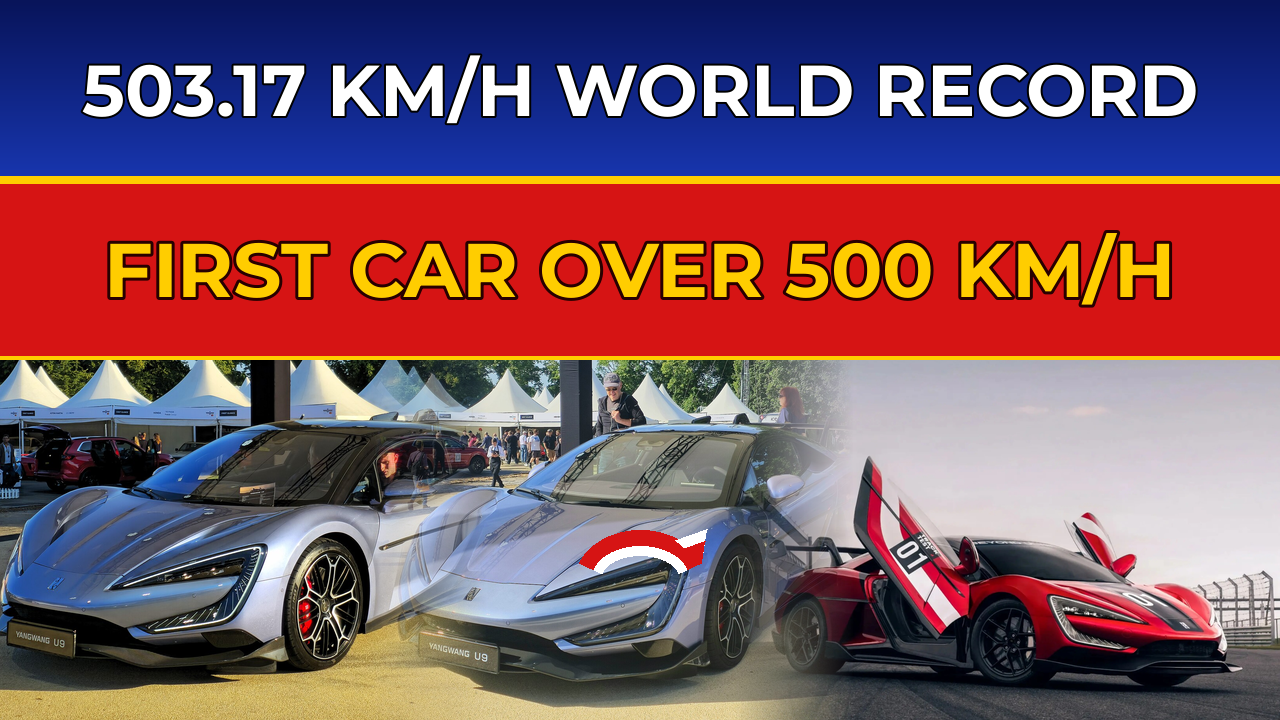
BYD Yangwang U9 Xtreme Hits 503.17 km/h — First Production Car Ever Over 500 km/h
By Fatima Raza | Updated 7 November 2026 The BYD Yangwang U9 Xtreme is now the fastest production car in the world. On 1 November 2026, the all-electric hypercar reached 503.17 km/h (312.66 mph) on a closed E11 section in Abu Dhabi, becoming the first production car ever past 500 km/h, with German racing driver…
By Fatima Raza | Updated 7 November 2026
The BYD Yangwang U9 Xtreme is now the fastest production car in the world. On 1 November 2026, the all-electric hypercar reached 503.17 km/h (312.66 mph) on a closed E11 section in Abu Dhabi, becoming the first production car ever past 500 km/h, with German racing driver Marc Basseng behind the wheel. Yangwang, BYD’s ultra-premium brand, announced it on Friday 6 November, saying the FIA recognised the run and it had earned four Guinness World Records titles. But the speed was measured in one direction, and the Guinness titles had not appeared on the Guinness website at announcement time.
BYD Yangwang U9 Xtreme: Key Facts
| Fact | Detail |
|---|---|
| Top speed | 503.17 km/h (312.66 mph), single-direction run |
| Date of the run | 1 November 2026 |
| Announced | 6 November 2026 |
| Location | Closed 10 km section of the E11, Al Dhafra, Abu Dhabi |
| Driver | Marc Basseng (Germany) |
| Power | 2,977 hp (3,019 PS / 2,220 kW) from four electric motors |
| Motors | Four 555 kW motors, up to 30,000 rpm |
| Voltage | 1,200-volt architecture |
| Previous best | 496.22 km/h, September 2025, ATP Papenburg, Germany |
| Production | Limited to 30 units worldwide |
| Price | More than CNY 20 million (about US$2.98 million); no official list price published |
| Verification | FIA-recognised; four Guinness titles claimed by BYD, not yet listed on the Guinness website (6 Nov 2026) |
The Record Run in Abu Dhabi
The run used a closed 10-kilometre section of the E11 in Abu Dhabi’s Al Dhafra region, including a seven-kilometre straight. The road was swept and checked for debris, in high temperatures, crosswinds and desert dust. At that speed the car covers almost 140 metres a second, so the braking zone alone needed most of that closed road.
Basseng — the German driver who set the car’s previous 496.22 km/h benchmark at ATP Papenburg in September 2025 — was the natural choice for the wheel. On 1 November, after overnight fine-tuning, his second pass produced 503.17 km/h — 6.95 km/h faster than the car’s own record.
The Machine: Four Motors, 2,977 Horsepower
Four independent motors, one per wheel through BYD’s e4 system, produce a combined 2,220 kW — 2,977 hp, or 3,019 PS. Each motor makes up to 555 kW (744 hp) and spins to 30,000 rpm. They run on what BYD calls the world’s first mass-produced 1,200-volt platform, fed by a track-grade LFP Blade Battery rated for 30C discharge, with a quoted power-to-weight ratio of 1,217 PS per tonne.
Power alone does not hold a car down at 500 km/h. The e4 system adjusts torque at each wheel more than 100 times per second, while DiSus-X active body control, titanium-alloy carbon-ceramic brakes and semi-slick tyres developed with Giti — built for speeds above 500 km/h — handle the forces involved. A carbon splitter, rear diffuser and swan-neck rear wing keep it pressed to the road. The standard U9, for comparison, runs an 800-volt system with four 240 kW motors for 960 kW (1,287 hp).
The Honest Fine Print
A record is only as strong as how it was measured, and this one carries two caveats. First, the 503.17 km/h run was measured in one direction only. Traditional production-car records averaged two runs in opposite directions, cancelling out wind and slope. Yangwang has not published a two-way average, so the number stands as a single-direction achievement, as the FIA certificate describes it.
Second, the Guinness position needs care. BYD says the run earned four Guinness titles — fastest production car, fastest electric production car, and two tyre titles for Giti — and the FIA has confirmed it recognised the achievement. NDTV Profit reports Guinness has acknowledged two achievements, both single-direction records. But as of 6 November 2026, the titles did not appear on the Guinness World Records website. The claim may still be true — but for now it rests on BYD’s announcement, FIA recognition and the event certificate, not an independent Guinness listing. Until the titles appear there, the accurate description is a BYD/FIA-announced record, not a Guinness-listed one.
The Crash Yangwang Did Not Hide
The most remarkable part of this story happened before Abu Dhabi — and Yangwang chose to show it, not bury it. During a top-speed shakedown at a closed facility in China, a U9 Xtreme went sideways, hit the barrier on one side and spun into the barrier on the other. Most of the car was destroyed. Driver Jiang Wen, a long-serving BYD test driver, got out on his own and walked away unhurt, with no fire visible — a detail that matters with a high-voltage battery on board.
Yangwang put the crash footage in a promo video ahead of the Abu Dhabi attempt, calling the preparation “not smooth sailing”. The team puts the impact at roughly 360 km/h, but that is its own account, not a measured number, and Yangwang has not released telemetry, a date or a cause. The programme continued, and Yangwang says the car later reached 457.89 km/h in China, which it calls a domestic record. The carbon-fibre passenger cell held together while the structures around it were destroyed — evidence that matters more than any top-speed number.
The Road to 500
Abu Dhabi was the third step in a deliberate ladder. In August 2025, a U9 engineering test car reached 472.41 km/h at ATP in Germany, breaking the then-global EV top-speed record. A month later, the Xtreme itself hit 496.22 km/h there with Basseng driving — the benchmark that stood until last weekend.
It can also turn: in September 2025 it lapped the Nürburgring Nordschleife in 6 minutes 59.157 seconds, the first all-electric production car under seven minutes there. The same hardware that keeps it stable at 500 km/h lets it corner at racing speeds.
Thirty Cars, More Than CNY 20 Million Each
For almost everyone, the Xtreme will remain a poster car: production is limited to 30 units, with no official list price. What we know comes from the Beijing Auto Show in April 2026, where the first production-standard Xtreme was unveiled: a BYD executive said one sold there for more than CNY 20 million, roughly US$2.98 million — the most expensive car sold at the event. It was handed to its buyer, Australian businessman Nick Politis, by BYD chairman Wang Chuanfu. It debuted globally and opened for pre-orders on 20 September 2025, and some customers have already moved towards production.
Why This Record Matters
For decades, the top-speed conversation belonged to petrol hypercars, and 500 km/h looked like the last wall only combustion engines could climb. An electric car breaking it on a public road, in desert heat, changes that conversation permanently. It is also a statement of intent from BYD, built on affordable mass-market EVs and now chasing the opposite end of the market. The technology underneath — the 1,200-volt platform, the 30,000 rpm motors — is hardware that eventually filters down into ordinary electric cars.
Tesla’s Roadster has been unveiled with SpaceX thrusters promised, and the fastest-electric-car contest is no longer a one-company story. Even in Pakistan, the direction of travel is visible: Pakistan’s car sales jumped 43 percent in the first quarter of FY27. Meanwhile, Tesla’s Cybertruck is heading for the end of production in mid-2027, a reminder that records, like models, get replaced.
What Happens Next
Two questions will decide how this record is remembered: whether Yangwang publishes a two-way average, and whether the Guinness titles appear on the Guinness website. Either way, the number is on the board: 503.17 km/h, 1 November 2026, Abu Dhabi. Somebody will have to beat it — and the next car to try will almost certainly be electric too.
Frequently Asked Questions
How fast did the BYD Yangwang U9 Xtreme go?
The U9 Xtreme reached 503.17 km/h (312.66 mph) on 1 November 2026 on a closed E11 section in Abu Dhabi — the first production car past 500 km/h, beating its own 496.22 km/h best from September 2025.
Who drove the record run?
German racing driver Marc Basseng. He also set the car’s previous 496.22 km/h record at ATP Papenburg, Germany, in September 2025.
Was the 503.17 km/h run measured in one direction or two?
It was a single-direction run; Yangwang has not published a two-way average. Traditional records averaged two opposite-direction runs to cancel out wind and slope.
Is the record recognised by Guinness World Records?
Not yet on the Guinness website. BYD says the run earned four Guinness titles, the FIA has recognised the achievement, and NDTV Profit reports Guinness has acknowledged two achievements — but as of 6 November 2026, the titles did not appear on the Guinness World Records website.
How much power does the Yangwang U9 Xtreme have?
The U9 Xtreme produces 2,977 hp (3,019 PS / 2,220 kW) from four electric motors, each making up to 555 kW (744 hp) and spinning to 30,000 rpm. It runs on a 1,200-volt architecture.
How much does the Yangwang U9 Xtreme cost, and how many will be built?
Production is limited to 30 units worldwide, with no official list price. A BYD executive said one sold at the Beijing Auto Show in April 2026 for more than CNY 20 million, roughly US$2.98 million.
How is the U9 Xtreme different from the standard Yangwang U9?
The Xtreme is a limited, track-focused version of the standard U9. The standard car, on sale in China since February 2024, uses four 240 kW motors for 960 kW (1,287 hp) on an 800-volt system and starts at CNY 1.8 million. The Xtreme upgrades to four 555 kW motors, a 1,200-volt platform, a track-grade battery, carbon-ceramic brakes and Giti semi-slick tyres.