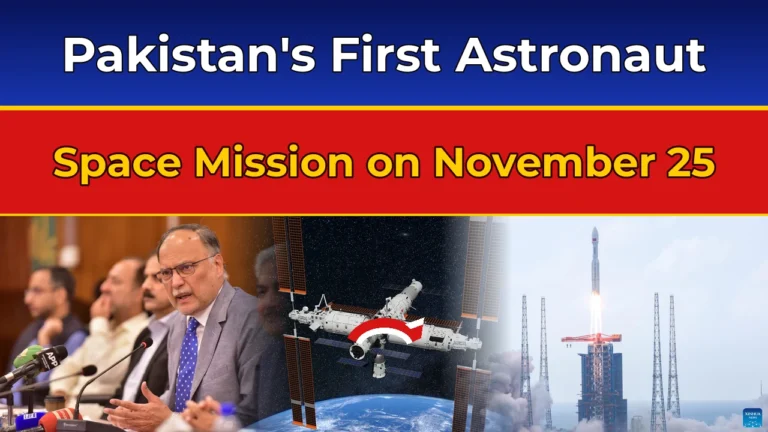
Tesla Roadster 2026 Unveiled: The ‘Flying Car’ With SpaceX Thrusters, 0–60 in Under 1 Second
By Fatima Raza | TimelyUps Technology Desk | Published: October 16, 2026 Tesla has finally shown the world its new Roadster — and it does things no road car has ever done. Unveiled on October 15, 2026, at a SpaceX test site in Texas, the redesigned Roadster drives upside down on ramps, flips mid-air, and…
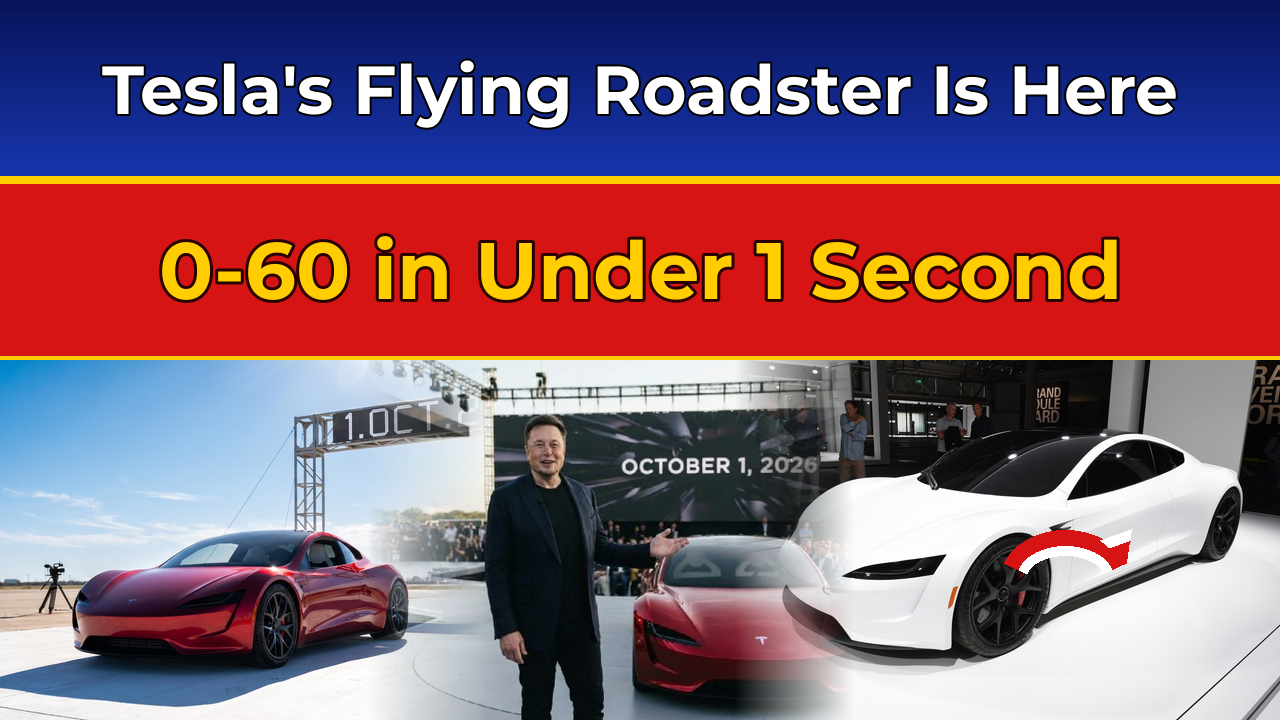
Tesla has finally shown the world its new Roadster — and it does things no road car has ever done. Unveiled on October 15, 2026, at a SpaceX test site in Texas, the redesigned Roadster drives upside down on ramps, flips mid-air, and lands back on its wheels using rocket-style thrusters, with a claimed 0 to 60 mph sprint of under one second. Production is targeted for 2028.
The two-seater, developed in collaboration with Elon Musk’s rocket company SpaceX, is the long-delayed second-generation Roadster — the same car Tesla first showed as a prototype in November 2017 and promised for 2020. Nine years later, it is back, angrier, and it can (briefly) fly.
Key Facts: Tesla Roadster 2026 Unveiling
- Unveiled: October 15, 2026, at SpaceX’s McGregor, Texas test facility (near Waco)
- Tech: Compressed-air thrusters co-developed with SpaceX; optional “SpaceX package”
- 0–60 mph: Under 1 second claimed (0.81 seconds quoted at the live demo)
- Top speed: Over 230 mph (370 km/h), per Musk
- Production: Targeted for 2028 — nearly a decade after the 2017 prototype
- Price: Not announced (the 2017 quote was a $200,000 base)
- Stunts demoed: Upside-down ramp drive, mid-air turn and landing, jumping a truck
The Unveiling: Nine Years in the Making
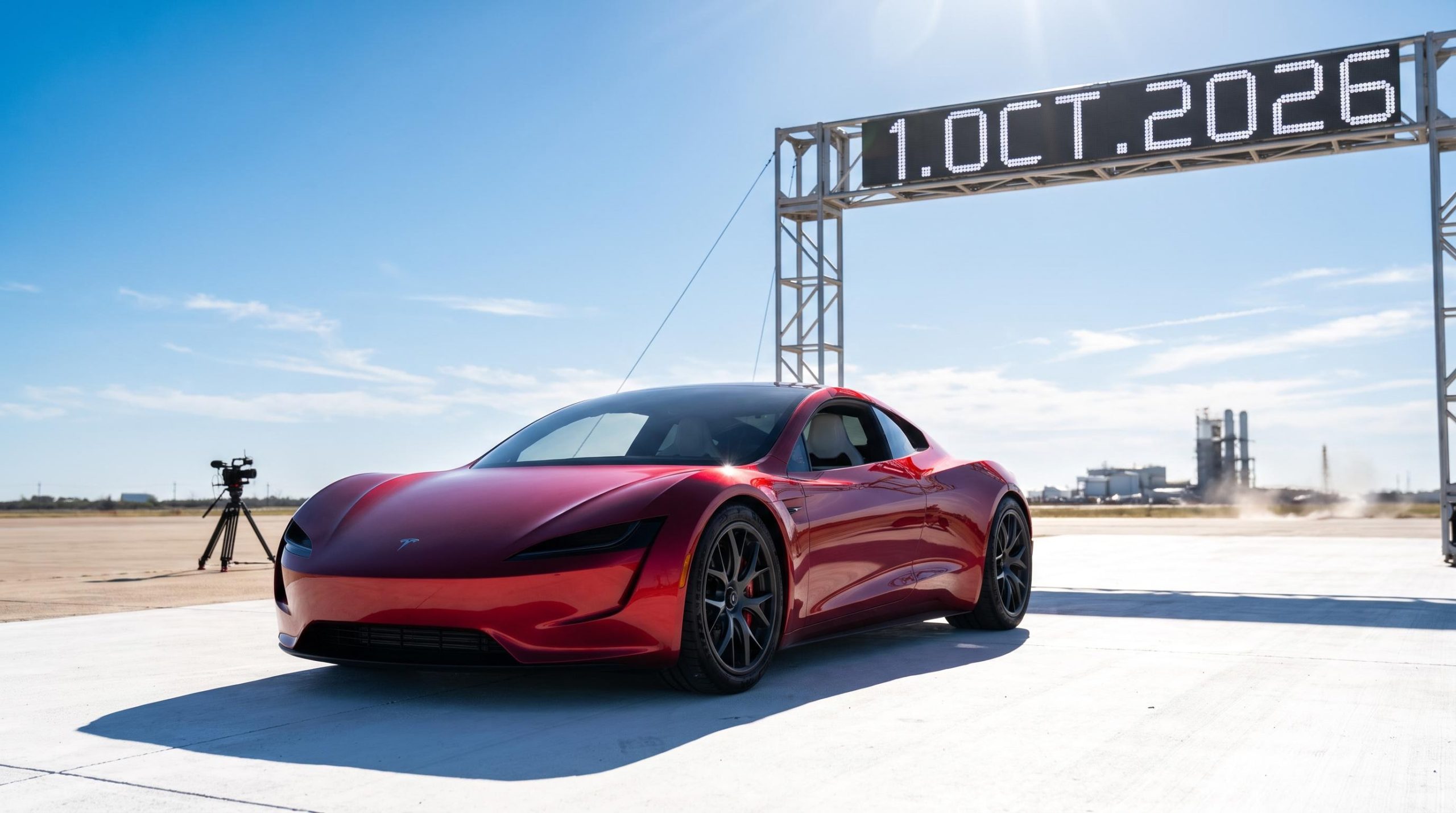
The event was supposed to happen on October 1, then got pushed back two weeks for weather — fitting, because the whole Roadster story has been a lesson in waiting. Tesla first revealed the second-generation Roadster prototype in November 2017 and said deliveries would begin in 2020. Then silence, then delays, then more promises. On October 15, Musk walked onto a stage at a rocket-testing facility in McGregor, Texas — a fitting venue for what came next — and finally pulled the sheet off the redesigned car.
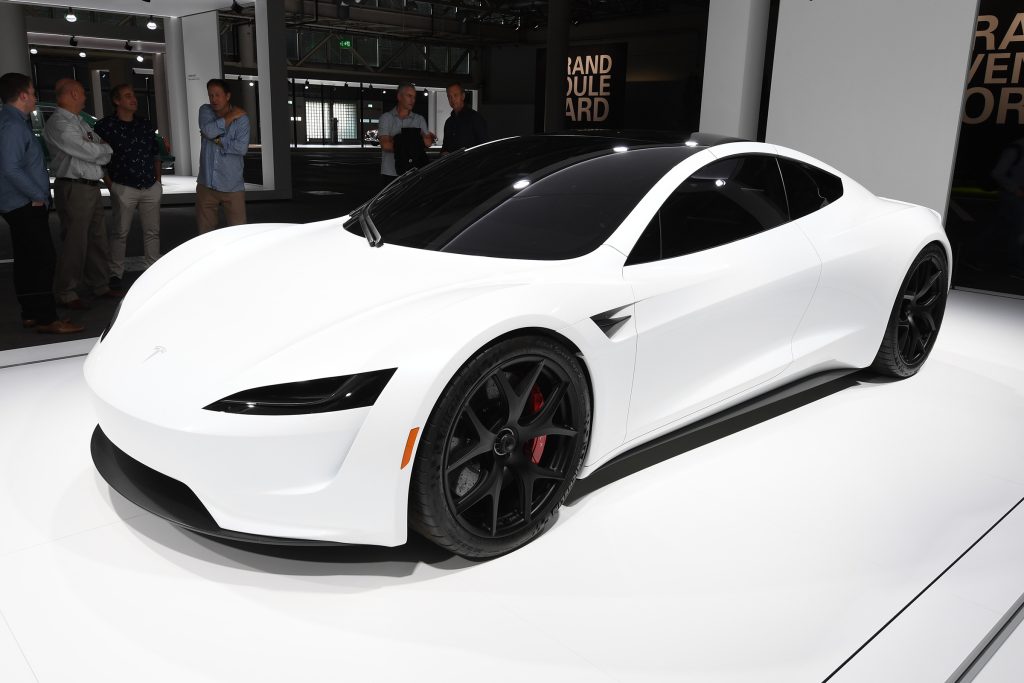
It looks different from the 2017 prototype: more angular, more aggressive, described by watchers as carrying design DNA from Tesla’s newer models. Tesla livestreamed the whole thing on X, where its account summed up the evening with two words: “Real life, baby.”
What It Actually Did on Stage
This was not a “here’s a car under a cover” launch. The Roadster performed. A white two-seater drove upside down along a ramp using a suction system, turned in mid-air, and landed back on its wheels using built-in thrusters. Later it used the same thrusters to jump clear over a truck and other vehicles, twisting in the air as it went.
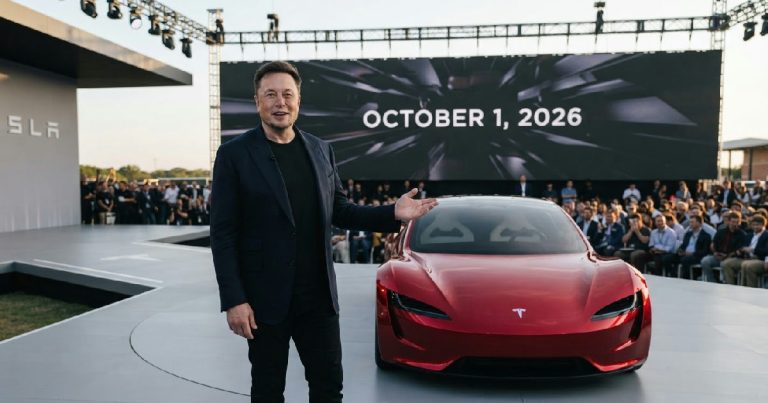
Before the demonstration, Musk was uncharacteristically honest about the odds. “By the way, success is not guaranteed,” he told the crowd. “I mean that. It’ll probably work, but if it doesn’t work, we’re at a safe distance.” It worked.
The performance claims are staggering. Vehicle engineering chief Lars Moravy said the car can hit 60 mph in under one second — the live demo quoted 0.81 seconds, and Musk believes they can go faster still. Top speed: over 230 mph. “It will crush every track record that has ever existed,” Musk claimed, per MotorWeek’s coverage.
The SpaceX Package: How the “Flying” Works
The headline technology is a compressed-air propulsion system developed with SpaceX. The proposed optional “SpaceX package” places 10 thruster nozzles around the car, fed by an onboard pressure-vessel tank that recharges through internal compressors. Blasts of pressurized air assist acceleration, braking, cornering — and short, localized hops.
Here is the honest engineering caveat, and it matters: what Tesla demonstrated is controlled jumping, not sustained flight. Smithsonian curator Roger Conner, who oversees vertical flight at the National Air and Space Museum, put it plainly — cars need bumpers and crumple zones, aircraft hate extra weight, and the Roadster’s display amounts to hopping rather than flying. Tesla itself has not explained how the thruster features would be legalized for public roads. The car is a rocket-assisted supercar, not a personal aircraft. Still a spectacle — just not a commute replacement.
The Numbers That Matter
- 0–60 mph: under 1 second (0.81s at the demo)
- Top speed: 230+ mph / 370+ km/h
- Thrusters: 10 nozzles, compressed-air, onboard recharge
- Seats: 2
- Production: 2028 target
- Price: undisclosed — 2017 quoted $200,000 base
- Delay: ~9 years since the 2017 prototype
No target price was announced at the event, which tells you something about how Tesla positions this car. Musk himself called it a “small potato situation” back in 2023 — the Roadster will not move Tesla’s finances. It is a statement piece.
Why Musk Did It — and Why Now
Analysts are reading this event as three things at once. First, a halo car: Morningstar analyst Seth Goldstein noted Tesla currently has no high-performance flagship to showcase its engineering, and the Roadster fills that gap. Second, a merger signal: Deepwater Asset Management’s Gene Munster called the reveal “the latest example of why Elon can’t wait to bring (Tesla) and (SpaceX) together,” pointing to Musk’s open interest in merging his two companies. Munster was blunter about the commercial case, calling the event “an engineering flex with no commercial value beyond embarrassing traditional car makers.”
Third, timing. The reveal lands days before Tesla’s third-quarter results — numbers that matter far more to investors than a 2028 sports car — and while Tesla is loudly pivoting toward self-driving technology and robotics. The Roadster is the showpiece; autonomy and robots are the business. We covered the week’s other big tech-moves story — OpenAI’s computing chief departure — and the pattern is the same: in 2026, the spectacle is the strategy.
What It Means for EV Watchers in Pakistan
Let us be realistic: a $200,000-plus halo car is not landing in Karachi showrooms any time soon. But cars like this one set the aspiration ceiling for the entire electric-vehicle conversation — the same way they did when the original Roadster helped kick off the EV era in 2008. Every automaker on Earth, including the Chinese brands entering Pakistan’s market, now has to answer a car that does 0–60 in under a second. Technology that debuts in halo cars has a habit of trickling down: today’s thruster theater is tomorrow’s traction-control innovation. Pakistan’s own EV policy push is young, and watching where the global frontier goes is how buyers here learn what to demand next.
If you are following how flagship tech launches are playing out in 2026, our coverage of the OnePlus 16 launch shows the same pattern from the phone world — the spec sheet moves first, the mass market follows.
The Bottom Line
The Tesla Roadster is back after nine years, and it is unlike anything on four wheels: a sub-one-second, thruster-assisted supercar that drives upside down and jumps trucks. Production is promised for 2028, the price is a mystery, and sustained flight this is not. But as a statement of what electric performance can look like — and as a preview of just how intertwined Tesla and SpaceX are becoming — October 15, 2026 was the night the “flying car” conversation stopped being a joke.
Frequently Asked Questions
When was the Tesla Roadster unveiled?
October 15, 2026, at a launch event at SpaceX’s test facility in McGregor, Texas (near Waco), led by Elon Musk. It was originally scheduled for October 1 but postponed for weather.
Can the Tesla Roadster really fly?
Not really — not yet. It demonstrated short airborne maneuvers: driving upside down on a ramp via suction, turning mid-air, landing with built-in thrusters, and jumping over vehicles. Experts describe this as controlled hopping, not sustained flight, and road legality of the thruster features is unclear.
What is the Tesla Roadster’s 0-60 time?
Under one second, per Tesla — the live demo quoted 0.81 seconds, and Musk said they believe they can beat that figure. Claimed top speed is over 230 mph (370 km/h). These figures have not been independently verified for a production vehicle.
When will the Tesla Roadster be produced, and what is its price?
Tesla is targeting production in 2028. No target price was announced at the event; when the car was first shown in 2017, Tesla quoted a $200,000 base price.
What is the “SpaceX package” on the Roadster?
An optional performance package co-developed with SpaceX: 10 compressed-air thruster nozzles connected to an onboard pressure-vessel tank (recharged by onboard compressors), used to assist acceleration, braking, cornering, and short jumps.
Why did Tesla take nine years to unveil the Roadster?
The second-generation Roadster was first shown as a prototype in November 2017 with deliveries promised for 2020. Tesla repeatedly delayed it as the company’s priorities shifted toward mass-market vehicles, self-driving technology, and robotics. The redesigned car unveiled in October 2026 is substantially different from the 2017 prototype.
Will the Tesla Roadster come to Pakistan?
There is no Pakistan launch plan announced. As a limited halo car priced well into supercar territory, it is unlikely to arrive officially any time soon — but its technology and performance benchmarks shape the global EV market, including the brands entering Pakistan.