Pakistan’s First Astronaut to Fly to Space from China on November 25
By Fatima Raza | October 19, 2026 | Technology Pakistan will send its first astronaut into space on November 25, 2026. Planning Minister Ahsan Iqbal announced the date on Sunday (October 18) at the closing ceremony of World Space Week in Narowal, confirming that a Pakistani astronaut will lift off from a Chinese space centre…
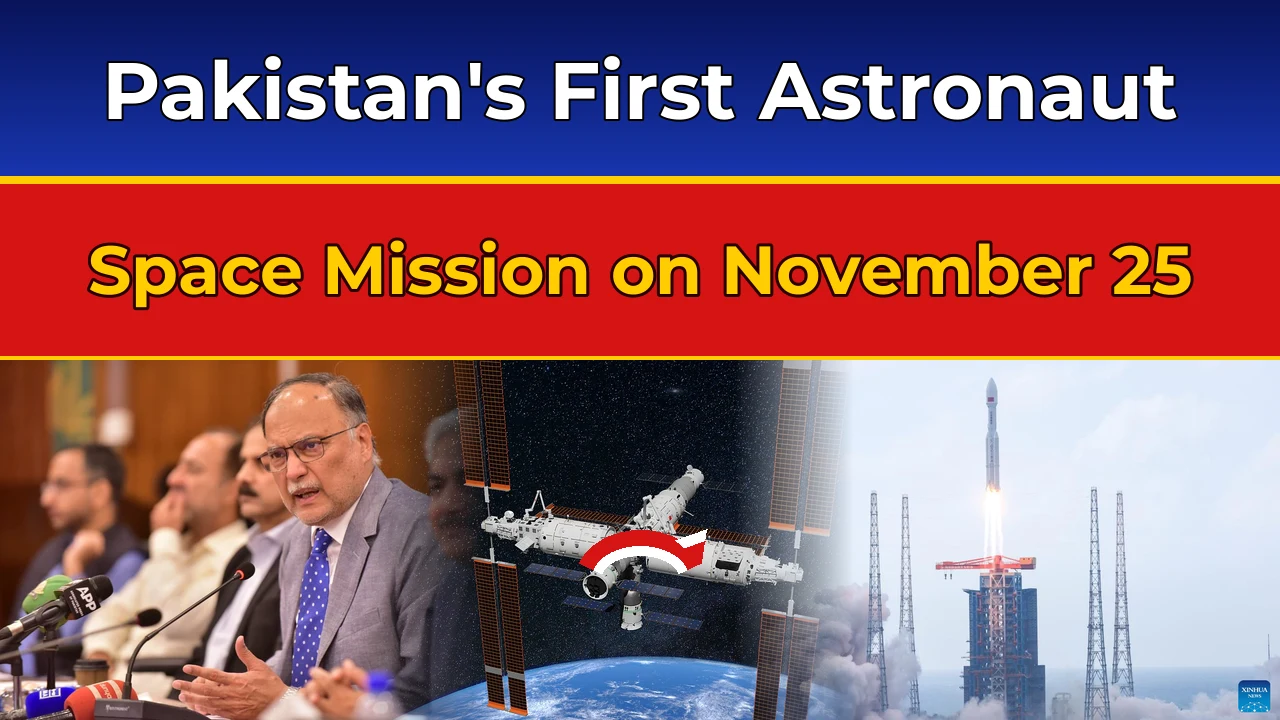
Pakistan will send its first astronaut into space on November 25, 2026. Planning Minister Ahsan Iqbal announced the date on Sunday (October 18) at the closing ceremony of World Space Week in Narowal, confirming that a Pakistani astronaut will lift off from a Chinese space centre aboard a Chinese mission bound for the Tiangong space station. The name on the flight suit is not public yet — it will be one of two Pakistan Air Force pilots, Zeeshan Ali or Khurram Daud, who have been training in Beijing since China shortlisted them earlier this year.
It is the kind of news that makes you stop scrolling. For decades, Pakistan’s space programme has been the quiet one — satellites, remote sensing, the odd launch announcement — while other countries grabbed the headlines. November 25 changes that. A Pakistani will float above the Earth, look down at the Indus river winding through the plains, and run science experiments designed back home. And it is happening in five weeks.
The Announcement: What Ahsan Iqbal Said in Narowal
The minister picked his stage carefully. World Space Week is the one week of the year when SUPARCO opens its doors to students, and the closing ceremony in Narowal drew a young crowd. Speaking there, Iqbal said Pakistan’s first astronaut would embark on a space mission from China on November 25, as part of the growing SUPARCO-China space cooperation.
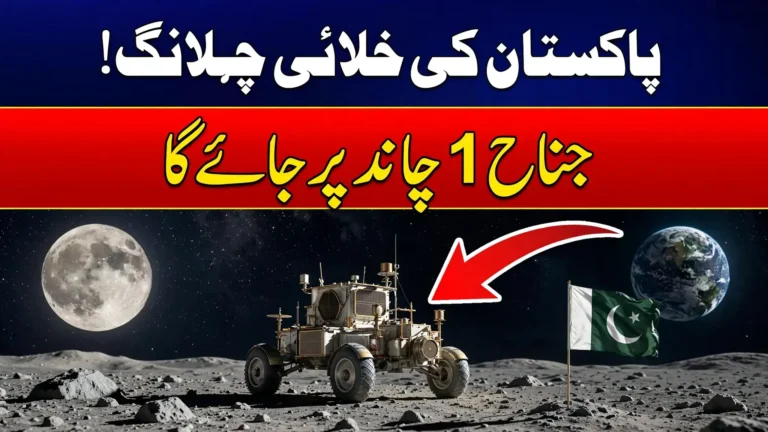
He did not stop at the headline. The minister laid out a roadmap that goes well beyond a single flight: Pakistan is targeting a lunar landing by 2035, a Pakistani-built lunar rover is slated to ride along on China’s Chang’e 8 mission around 2028, and the country’s first space museum will come up at the University of Narowal — the same city where he made Sunday’s announcement.
Read that again: a rover, a moon-landing target, and a museum, all attached to one announcement. This is no longer a ceremonial handshake. It reads like the opening of a programme.
Who Will Fly: Two Pilots, One Seat
Here is what we know about the crew selection — and what we carefully do not claim.
China selected two Pakistani candidates in April 2026: PAF pilots Zeeshan Ali and Khurram Daud. Both have been undergoing astronaut training in Beijing. One of them will fly as a payload specialist — the crew member responsible for conducting the mission’s science experiments — aboard a Chinese mission to the Tiangong space station, with a stay of roughly a week.
The final choice between the two has not been announced. Amer Gilani, who heads human spaceflight at SUPARCO, told Reuters last month that the final selection was expected in mid-to-late October. So the name could drop any day now. Until China confirms it, any article naming one of the two pilots as the astronaut is guessing. We are not guessing.
(A small housekeeping note: some outlets have rendered one candidate’s name as “Muhammad Zeeshan Ali” and others as “Zeeshan Ali.” They are the same person. We use “Zeeshan Ali” throughout.)
How Pakistan Got Here: The Road to November 25
The flight did not come out of nowhere. Pakistan and China signed a bilateral astronaut cooperation agreement in February 2025, formally opening the door for a Pakistani to train with and fly alongside Chinese astronauts. SUPARCO has been deepening its partnership with China’s space agency for years — from satellite launches to joint research — and human spaceflight was always the obvious next step.
The logic is straightforward. Building a crewed launch capability from scratch takes decades and billions; flying as a partner gets you into orbit now, with your own experiments, your own astronaut, and your own flag on the mission patch. For a country where the space budget has historically been modest, it is a pragmatic shortcut to the same milestone.
The Mission: A Week on Tiangong
The destination is Tiangong — “Heavenly Palace” — China’s permanently crewed space station, orbiting about 400 kilometres above Earth. The Pakistani astronaut will travel there as a payload specialist, which means the job is science, not just sightseeing: running experiments designed in Pakistan, testing how they behave in microgravity, and bringing the data home.
The stay is expected to last around a week — short by space-station standards, but long enough to run a full experiment schedule. For Pakistan’s research community, it is a first: Pakistani-designed science, executed by a Pakistani, in orbit.
Think about what that means for a schoolkid in Narowal or Multan watching the launch on November 25. The distance between “astronaut” and “someone like me” collapses in a single afternoon.
Beyond the Flight: 2035 and the Moon
The minister’s longer-term targets deserve their own look, because they show this flight is meant to be a beginning, not a one-off:
- Chang’e 8 (~2028): a Pakistani-built lunar rover is planned to fly on China’s Chang’e 8 lunar mission — Pakistan’s hardware on the Moon, years before any Pakistani sets foot there.
- Lunar landing by 2035: Pakistan has set a target of landing on the Moon by 2035. Ambitious, yes — but with a rover on Chang’e 8 and an astronaut flight under its belt, it is an ambition with scaffolding under it.
- Space museum at the University of Narowal: the country’s first space museum, giving students a physical place to connect with the programme.
Each of these was announced by the minister on Sunday alongside the November 25 date, as part of the same SUPARCO-China cooperation push.
Why This Flight Matters More Than the Headlines Suggest
Space firsts are easy to dismiss as prestige projects — flags and photo ops. But there is a harder, more practical case for this one.
First, the science is real. Microgravity experiments in materials, biology, and Earth observation produce data you simply cannot get on the ground, and the payload-specialist role exists precisely to maximise that return. Second, the pipeline effect is real: every country that has flown an astronaut has seen a measurable bump in students choosing science and engineering. Third, the partnership model matters — Pakistan is buying a seat at the table of human spaceflight at a fraction of the cost of going alone, while building the domestic institutions (SUPARCO’s human spaceflight office, the university museum) that make the next steps possible.
And then there is the simplest reason of all. On November 25, a Pakistani will look out of a spacecraft window. Millions of Pakistanis will be looking up at the same sky. That shared moment is worth more than any press release.
There is also a quiet institutional win here that deserves mention. SUPARCO has spent years building the unglamorous backbone — ground stations, satellite programmes, university partnerships — that makes a moment like November 25 possible at all. A human spaceflight office, a training pipeline in Beijing, a museum in Narowal: these are the bricks of a programme that outlasts any single launch. The astronaut gets the headlines, but the institutions decide whether Pakistan flies once or keeps flying.
What to Watch Next
Three things, in order:
- The name. China is expected to confirm which of the two pilots flies — Zeeshan Ali or Khurram Daud — in the coming days, with final selection expected in mid-to-late October.
- The experiments. SUPARCO has not yet detailed which Pakistani science experiments the payload specialist will run on Tiangong. That announcement will tell us how serious the science return is.
- The launch itself. November 25, from a Chinese space centre. Mark it — this is the one Pakistan will remember.
Frequently Asked Questions
When is Pakistan’s first astronaut going to space?
November 25, 2026, according to the announcement made by Planning Minister Ahsan Iqbal on October 18, 2026, at the World Space Week closing ceremony in Narowal. The astronaut will launch from a Chinese space centre aboard a Chinese mission to the Tiangong space station.
Who is Pakistan’s first astronaut — Zeeshan Ali or Khurram Daud?
Not confirmed yet. China selected two PAF pilots as candidates in April 2026 — Zeeshan Ali and Khurram Daud — and both have been training in Beijing. One of them will fly. Amer Gilani of SUPARCO’s human spaceflight programme told Reuters the final selection was expected in mid-to-late October 2026.
What will the Pakistani astronaut do on the Tiangong space station?
The astronaut will fly as a “payload specialist” — the crew role dedicated to conducting science experiments. The mission will carry out experiments designed in Pakistan, with a stay of roughly one week aboard Tiangong.
How did Pakistan get a seat on a Chinese space mission?
Pakistan and China signed a bilateral astronaut cooperation agreement in February 2025, under the broader SUPARCO-China space cooperation. China then selected two Pakistani candidates in April 2026 and has been training them in Beijing.
What are Pakistan’s other space plans — the Moon mission and rover?
Alongside the November 25 flight, the minister announced a lunar landing target of 2035, a Pakistani-built lunar rover planned for China’s Chang’e 8 mission around 2028, and Pakistan’s first space museum at the University of Narowal.
Where can I watch the launch?
Broadcast and streaming details for the November 25 launch have not been announced yet. SUPARCO and the Ministry of Planning typically share coverage plans closer to launch day — we will update this article when they do.