China’s CE-25A Electric Aircraft Completes First Crewed Flight
By Fatima Raza | 15 November 2026 | Technology China’s COMAC CE-25A, a 19-seat all-electric passenger aircraft, completed its first crewed flight on Saturday, 14 November 2026, taking off from Binzhou Dagao Airport in Shandong province with two pilots and a flight-test engineer on board. The battery-powered aircraft stayed airborne for 16 minutes and 38…

By Fatima Raza | 15 November 2026 | Technology
China’s COMAC CE-25A, a 19-seat all-electric passenger aircraft, completed its first crewed flight on Saturday, 14 November 2026, taking off from Binzhou Dagao Airport in Shandong province with two pilots and a flight-test engineer on board. The battery-powered aircraft stayed airborne for 16 minutes and 38 seconds, covered 60.4 kilometres, and landed safely, marking the first time people have flown in the 10-tonne electric demonstrator after 19 uncrewed test flights earlier in the year. The Civil Aviation Administration of China has accepted COMAC’s application for type certification, but no date for commercial passenger flights has been announced.
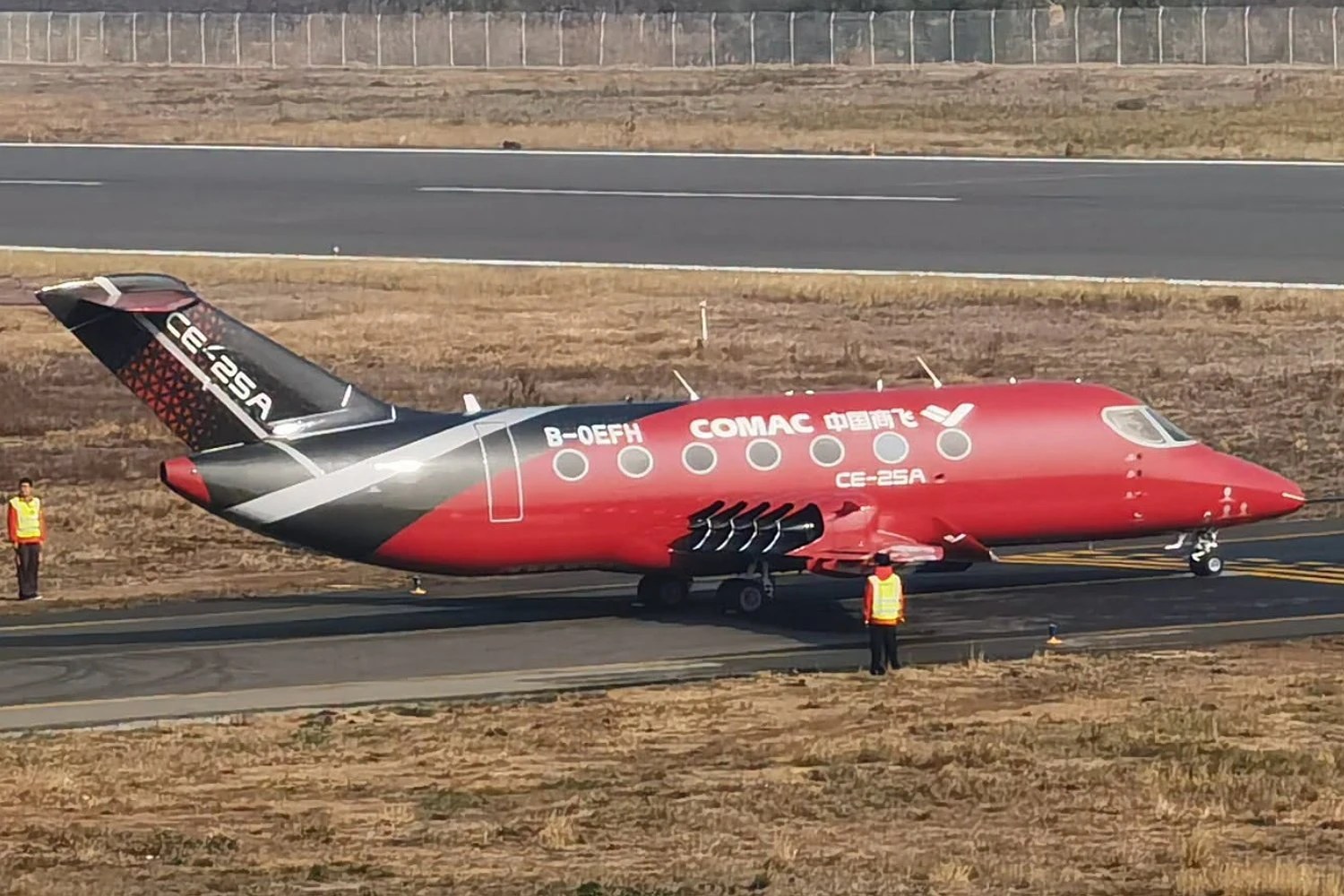
The COMAC CE-25A on the runway at Binzhou Dagao Airport. The red demonstrator, registration B-0EFH, carries the CE-25A name on its tail. Photo: COMAC / Air Data News.
Key facts: the CE-25A first crewed flight
| Detail | Confirmed fact |
|---|---|
| Aircraft | COMAC CE-25A, 19-seat all-electric passenger aircraft |
| First crewed flight | Saturday, 14 November 2026 |
| Airport | Binzhou Dagao Airport, Shandong province, China |
| People on board | Two pilots and one flight-test engineer |
| Time airborne | 16 minutes 38 seconds |
| Distance flown | 60.4 kilometres (37.5 miles) |
| Total test activity | 57 minutes 46 seconds |
| Maximum take-off weight | 10 tonnes (about 22,000 lb) |
| Developed by | COMAC, with CATL and Shanghai Jiao Tong University |
| Certification | CAAC has accepted the type certification application |
| Commercial flights | No date announced |
What happened over Binzhou on 14 November
The flight itself was short and deliberately careful. According to COMAC, cited by Chinese state media, the CE-25A took off from Binzhou Dagao Airport carrying two pilots and a flight-test engineer, completed the planned test normally, and landed with all key performance indicators meeting the required targets. The aircraft spent 16 minutes and 38 seconds in the air and covered 60.4 kilometres, while the complete test activity, including ground checks around the flight, was reported to have lasted 57 minutes and 46 seconds.
Images and video released after the test show the full-size CE-25A in the air over Binzhou. Until now, most publicly available photographs had shown it on the ground, and photos of the red demonstrator, registration B-0EFH, only began circulating publicly in late October 2026, even though the full-size aircraft had apparently been flying, without people aboard, for almost nine months by then.
COMAC describes the 14 November test as the aircraft’s first “crewed intelligent flight”. That wording matters, because the CE-25A is built around autonomous flight systems that allow pilots to monitor operations and intervene whenever necessary. But the company has not said how control was divided between the pilots and the automated systems during this flight, so it remains unclear how much of the 16-minute flight was flown autonomously. That detail is likely to come out as the test programme continues.
A correction on the headlines: this flight did have pilots
Some early headlines about the flight suggested the aircraft flew entirely on its own, with nobody at the controls. That is wrong, and it is worth saying plainly. The CE-25A’s first crewed flight carried two pilots and a flight-test engineer. Three people were on board.
The confusion is understandable but easy to clear up. The CE-25A is designed for autonomous operation, and it had already completed 19 autonomous flight verification tests before any human stepped inside its cockpit. Its first flight of all, on 2 February 2026, was uncrewed. So the aircraft can fly itself, and it has done so many times. But this milestone flight, the one on 14 November, was crewed: on a first flight with people aboard, you want experienced test pilots watching every system and ready to take over. That is the normal way flight testing works. A new aircraft proves itself empty first, then carries a test crew, and only much later carries paying passengers. The CE-25A has now reached the second of those three steps.
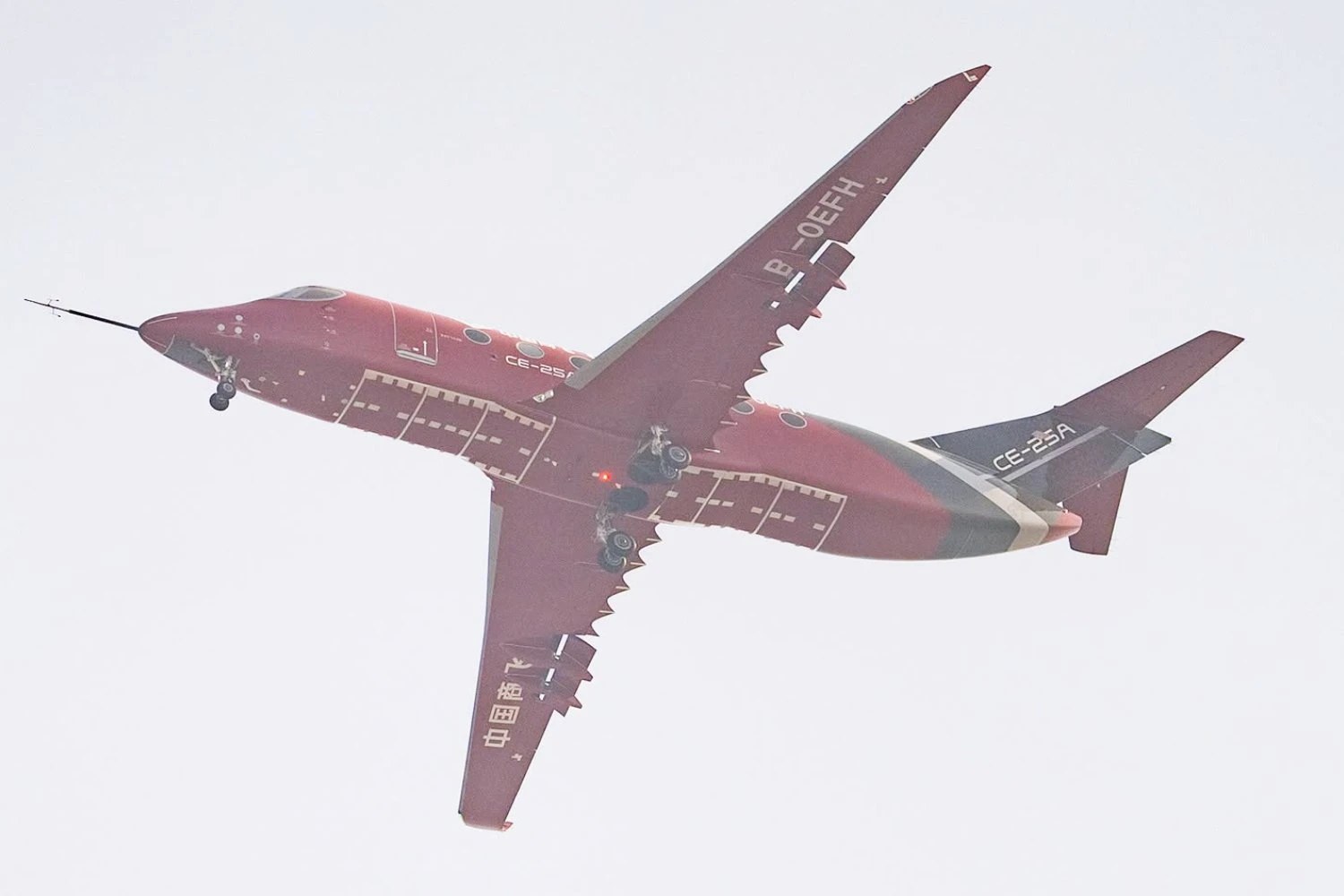
The CE-25A in flight over Binzhou on 14 November 2026, its landing gear still down shortly after take-off. Photo: COMAC / Air Data News.
How the CE-25A works: ten electric fans instead of two jet engines
The most unusual thing about the CE-25A is not just that it runs on batteries. It is how the power reaches the air. Instead of the two large engines hanging under the wings that you see on a normal regional airliner, the CE-25A uses 10 electrically powered ducted fans, five mounted on each wing, in a distributed electric propulsion arrangement that spreads thrust across the whole wing rather than concentrating it in two places.
Spreading many small fans across the wing can make the aircraft quieter, keep it flying safely if one fan fails, and let the wing generate lift more efficiently because the fans blow air directly over it. The trade-off is complexity: ten motors, ten sets of controls and a battery system big enough to feed them all, with no fuel to fall back on.
The batteries are the heart of the programme, which is why the partnership behind the aircraft matters. COMAC, the Commercial Aircraft Corporation of China, is building the CE-25A with CATL, the world’s largest battery maker, and Shanghai Jiao Tong University. CATL’s role is the clearest sign of what this project is really about: taking the battery technology China has already scaled up for electric cars and proving it can work in the air. Readers following the electric shift closer to home will recognise the pattern from the Chery Q electric hatchback launched at PAPS 2026, where the same battery-first thinking is reshaping road transport in Pakistan. The aircraft produces no direct carbon emissions during flight, which is the environmental case for it, though whether the whole journey is genuinely low-carbon also depends on how the electricity used to charge its batteries is generated.
The CE-25A in numbers
| Specification | CE-25A figure |
|---|---|
| Passengers | 19 seats |
| Maximum take-off weight | 10 tonnes (about 22,000 lb) |
| Propulsion | 10 electrically powered ducted fans, five per wing |
| Proposed range | 400 kilometres (about 249 miles) |
| Cruising speed | 300 kilometres per hour (about 186 mph) |
| Cruising altitude | 2,400 metres (about 7,900 feet) |
| Direct flight emissions | None (battery electric) |
| First autonomous flight | 2 February 2026 |
| Autonomous tests before crewed flight | 19 verification tests |
| First crewed flight | 14 November 2026, Binzhou, Shandong |
Put those numbers in context and the CE-25A’s intended job becomes clear. A 400-kilometre range and a 300 km/h cruising speed will not replace a jet on a long route. It is built for short hops between cities, the kind of route where a conventional turboprop burns fuel for a flight that lasts barely an hour: city pairs a few hundred kilometres apart, island connections, or remote regions where a short runway and a quiet aircraft matter more than speed. That is the market COMAC is aiming at, and it is the same short-route logic behind the growth of electric cars on Pakistani roads, from hatchbacks to the Avatr luxury electric brand launched in Pakistan by Master Changan.
From a 2023 unveiling to people on board
The CE-25A did not appear overnight. COMAC unveiled the project in 2023 and first tested it using a scaled demonstrator, a smaller version built to prove the design before the full-size aircraft was finished. The timeline released with the first crewed flight clears up the sequence: scaled-model testing first, then uncrewed flights of the full-size aircraft from 2 February 2026, then 19 autonomous flight verification tests, and finally the first flight with people aboard on 14 November 2026.
Even the name tells a story. According to COMAC, “C” stands for China and COMAC, “E” stands for electric propulsion, and “25” refers to China’s CCAR-25 certification standards for transport-category aircraft. The letter “A” identifies this as the first aircraft in the series: a real, certified passenger aircraft in the making, not a one-off experiment.
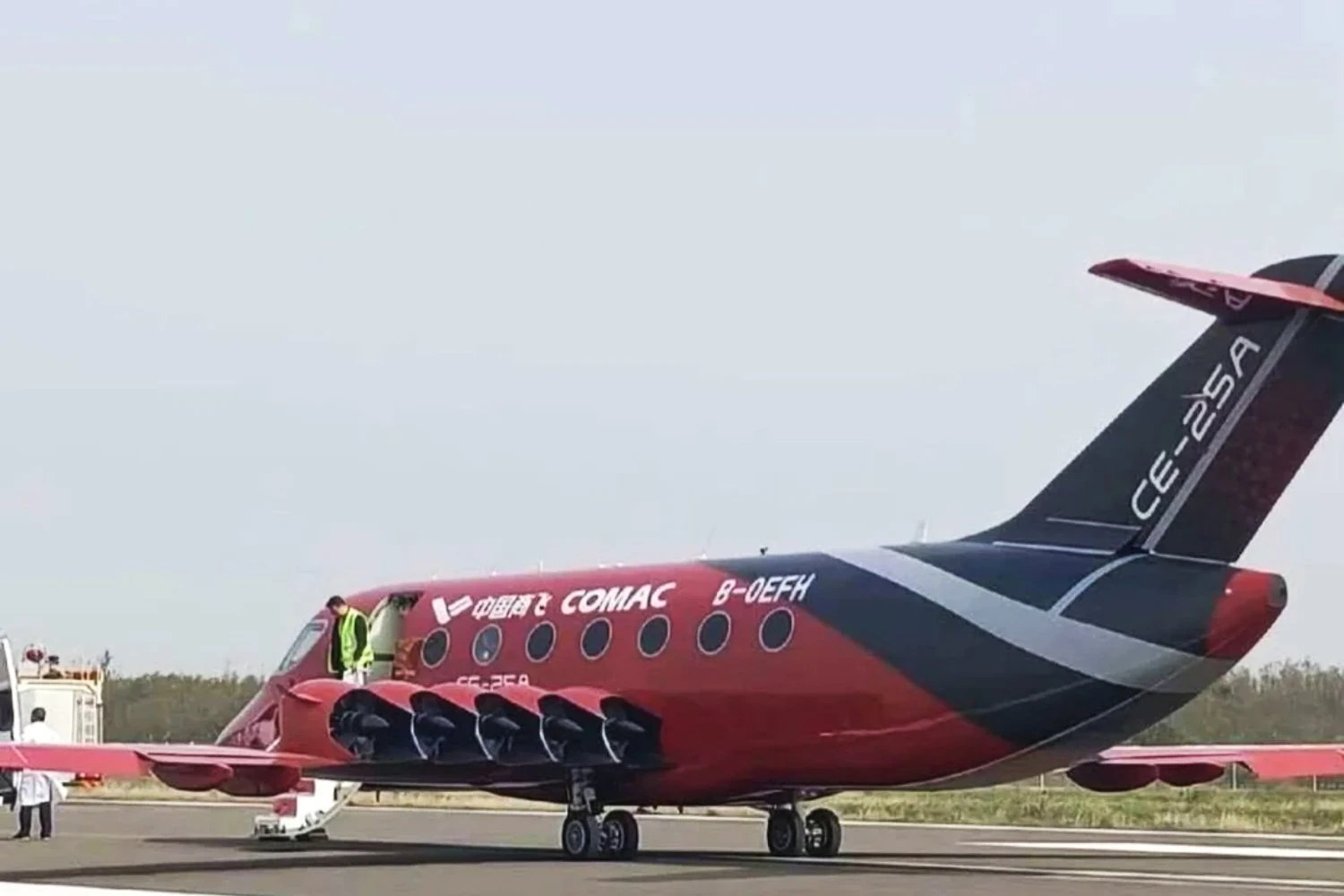
The CE-25A’s most unusual feature up close: a row of ducted electric fans mounted above the wing, five on each side. Photo: COMAC / Air Data News.
Certification: the long road before passengers can buy tickets
A successful first crewed flight is a milestone, not a finish line. Before the CE-25A can carry paying passengers, it must earn a type certificate from the Civil Aviation Administration of China (CAAC), the country’s aviation regulator. COMAC has applied, and the CAAC has accepted the application, so the certification process is formally under way. But acceptance is only the beginning: the regulator will want to see hundreds of hours of test flying, detailed safety evidence for the battery system and the distributed propulsion, and proof that the aircraft behaves safely when things go wrong.
That is why COMAC has announced no date for commercial flights. Electric aircraft face questions that conventional aircraft do not, and the battery is the biggest one: a battery fire in the air is far harder to deal with than one on the ground, and regulators will want to see exactly how the CE-25A’s battery system handles heat, damage and failure. Batteries are also heavy for the energy they hold, which is why the CE-25A’s range is 400 kilometres rather than 4,000.
None of this makes the flight unimportant. Getting people on board turns a laboratory project into a flying aircraft and lets test pilots start building the real-world evidence a regulator needs. But anyone expecting to book a ticket on an electric airliner soon should temper that excitement: certification of a brand-new aircraft type usually takes years.
A different aircraft, a different story: the flying taxi in Sri Lanka
The CE-25A should not be confused with another Chinese electric aircraft that made news in the same week. On 11 November 2026, three days before the CE-25A’s crewed flight, Sri Lanka demonstrated the EHang EH216-S, a pilotless two-seat air taxi, at Colombo Port City. The Civil Aviation Authority of Sri Lanka licensed EHang to test the aircraft, and the demonstration flight carried Ports and Aviation Minister Anura Karunathilaka and his deputy Janitha Ruwan Kodithuwakku as the first passengers.
The EH216-S is a different class of aircraft entirely: a small electric vertical take-off and landing machine powered by 16 electric motors and propellers, designed to carry two people about 30 kilometres in roughly 25 minutes, with a maximum take-off weight of 620 kilograms. Sri Lankan officials said testing could continue for about five months before commercial services are considered, and promoters hope to run an air-taxi service between the airport and Colombo city centre, a road journey of about half an hour.
The contrast is useful. The EHang is a pilotless two-seater for short city hops; the CE-25A is a 19-seat aircraft with pilots aboard, designed for longer hops between cities. Both are battery-electric and Chinese-built, and both flew with people aboard in the same week in November 2026, but they are not the same project, size or job.
What this means, and what to watch next
The CE-25A’s first crewed flight matters for three reasons. First, it proves at full scale that a 10-tonne, 19-seat aircraft can fly on batteries alone, a size no electric passenger aircraft has reached before with people aboard. Second, it shows China’s aviation industry moving beyond its well-known C919 jet airliner into an entirely new kind of aircraft, backed by the world’s biggest battery maker. Third, it comes in a week when electric flight also carried a government minister in Sri Lanka, which suggests the technology is moving from demonstration to real-world trials in more than one place at once.
What should readers watch for next? More test flights from Binzhou, and any word from COMAC on how the autonomous systems performed with pilots aboard. The next formal milestone will be progress in the CAAC type certification process. For Pakistan, the interest is practical rather than immediate: the same battery technology is already arriving on Pakistani roads, and Pakistan’s own technology ambitions are visible in projects like the Jinnah-1 lunar rover. If COMAC announces a timeline for commercial service, that will be the moment the CE-25A stops being a test programme and starts being an airline product. Until then, the honest summary is simple: a 19-seat electric aircraft has flown with people aboard for the first time, and the hard work of proving it safe for everyday passengers has only just begun.
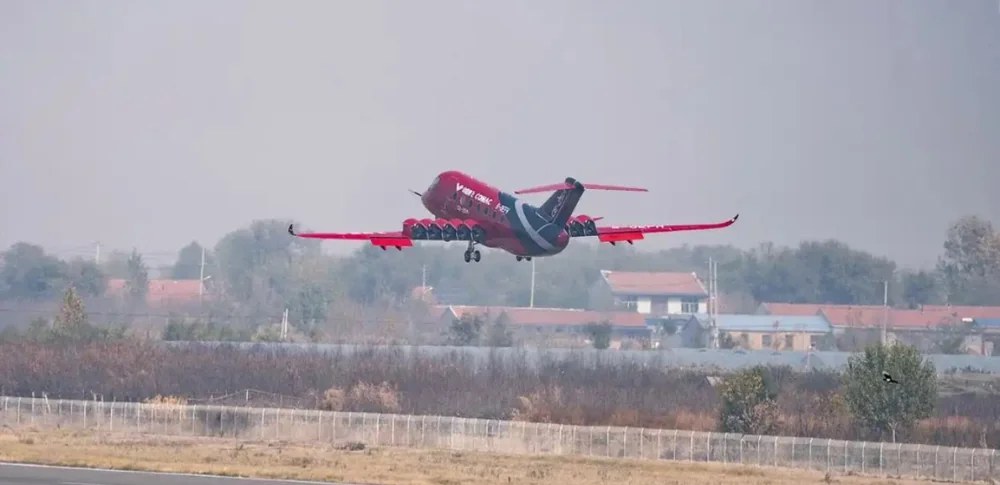
The CE-25A climbing away from Binzhou on its first crewed flight, 14 November 2026. Photo: Xinhua, via Qazinform.
Frequently asked questions
What is the COMAC CE-25A?
The CE-25A is a 19-seat all-electric passenger aircraft developed by China’s Commercial Aircraft Corporation of China (COMAC), with battery maker CATL and Shanghai Jiao Tong University. It has a maximum take-off weight of 10 tonnes and is powered by 10 electrically powered ducted fans, five on each wing.
When did the CE-25A make its first crewed flight?
On Saturday, 14 November 2026, from Binzhou Dagao Airport in Shandong province, China. The aircraft carried two pilots and a flight-test engineer, stayed airborne for 16 minutes and 38 seconds, and covered 60.4 kilometres.
Did the CE-25A fly without a pilot on board?
No. This is a common misunderstanding from misleading headlines. The first crewed flight carried two pilots and a flight-test engineer. The aircraft had already flown 19 autonomous, uncrewed test flights before people boarded, and it is designed for autonomous operation, but the 14 November flight itself had pilots aboard.
How far and how fast can the CE-25A fly?
COMAC lists a proposed range of 400 kilometres, a cruising speed of 300 kilometres per hour and a cruising altitude of 2,400 metres. Those figures describe the design target for short routes between cities, not long-haul flying.
When will passengers be able to fly on the CE-25A?
No commercial date has been announced. The Civil Aviation Administration of China has accepted COMAC’s application for type certification, but the aircraft must complete certification and extensive test flying before it can carry paying passengers.
Is the CE-25A the same as the flying taxi tested in Sri Lanka?
No. The Sri Lanka aircraft is the EHang EH216-S, a pilotless two-seat air taxi demonstrated at Colombo Port City on 11 November 2026. The CE-25A is a much larger 19-seat aircraft with pilots aboard. They are separate projects with different sizes, roles and manufacturers.