Vulcan Rocket Fails Mid-Flight, Destroying 40 Amazon Satellites in ULA’s First Failure in 20 Years
By Hira Shahid | 16 November 2026 A United Launch Alliance (ULA) Vulcan rocket failed roughly 10 minutes after liftoff from Cape Canaveral on Sunday, 15 November 2026, destroying all 40 Amazon Leo broadband satellites it was carrying. It is the first outright mission failure in ULA’s 20-year history, and a heavy blow to Amazon’s…
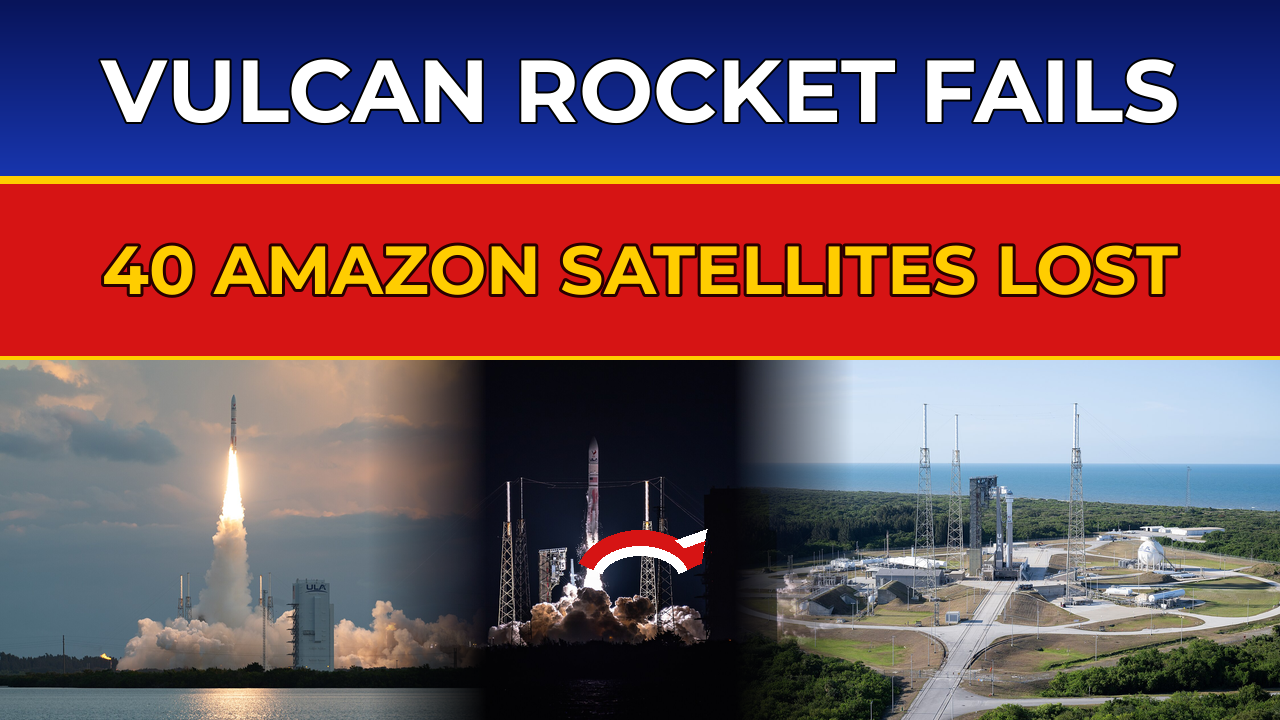
By Hira Shahid | 16 November 2026
A United Launch Alliance (ULA) Vulcan rocket failed roughly 10 minutes after liftoff from Cape Canaveral on Sunday, 15 November 2026, destroying all 40 Amazon Leo broadband satellites it was carrying. It is the first outright mission failure in ULA’s 20-year history, and a heavy blow to Amazon’s race to catch up with Elon Musk’s Starlink.
The rocket, flying the mission known as Amazon Leo LV-01 (also called Leo Vulcan 1), lifted off from Space Launch Complex 41 at Cape Canaveral Space Force Station in Florida at 12:40pm local time. ULA confirmed the vehicle “suffered an anomaly 10 minutes into the flight and failed to deliver the Amazon mission to orbit.” The cause is not yet known, and ULA says it will investigate with Amazon and the relevant authorities before Vulcan flies again.

Key Facts: The Failed Vulcan Launch
| Detail | What Happened |
|---|---|
| Mission | Amazon Leo LV-01 (Leo Vulcan 1), the first Vulcan flight carrying Amazon satellites |
| Rocket | United Launch Alliance (ULA) Vulcan Centaur, in a six-booster configuration with a Centaur V upper stage |
| Launch site | Space Launch Complex 41, Cape Canaveral Space Force Station, Florida |
| Liftoff | Sunday, 15 November 2026, 12:40pm EST (launch window 12:11–12:40pm EST) |
| Payload | 40 Amazon Leo broadband internet satellites — the largest batch Amazon had ever launched at once |
| Outcome | Anomaly about 10 minutes into flight; all 40 satellites lost and never reached orbit |
| Cause | Not yet known; ULA says it has no specific data yet on what occurred |
| ULA record | First outright mission failure since ULA was formed in 2006, ending a 20-year run of mission success |
What Happened in the 10 Minutes After Liftoff
The launch itself looked clean. Vulcan rose from the pad at 12:40pm, the first flight of the rocket in about nine months, and climbed to an altitude of around 95 miles (150 km). About six minutes in, the main booster and the payload fairing separated as planned, and the Centaur V upper stage — the part carrying the 40 Amazon satellites — lit its engines for the first of the planned firings needed to reach low Earth orbit.
Then came the anomaly. ULA’s live update stream confirmed the mission had “failed to deliver the Amazon mission to orbit,” and the company later issued a fuller statement: “Based on data received by our Launch Director, we confirm that the Vulcan vehicle launched from Space Launch Complex 41 suffered an anomaly 10 minutes into the flight and failed to deliver the Amazon mission to orbit.”
“Since the anomaly just occurred, we don’t have any specific data yet to understand what occurred today,” ULA added. The company said it would work with Amazon and the relevant organisations to investigate the failure, find the cause and apply corrective actions before Vulcan returns to flight. Blue Origin, which supplies Vulcan’s BE-4 main engines, is working with ULA on the investigation, according to a person familiar with the matter.
The Flight, Minute by Minute
| Time (EST, 15 Nov 2026) | Event |
|---|---|
| 12:11pm | Launch window opens at Space Launch Complex 41, Cape Canaveral |
| 12:40pm | Vulcan lifts off carrying 40 Amazon Leo satellites |
| About 12:46pm | Main booster and payload fairing separate as planned; Centaur V upper stage engines ignite |
| About 12:50pm | Anomaly about 10 minutes into flight; mission fails to reach orbit and all 40 satellites are lost |
A 20-Year Perfect Record Ends
For ULA, this was not just a lost payload. The company was formed in 2006 from the merger of Boeing’s Delta rocket programme and Lockheed Martin’s Atlas rocket programme, and until Sunday it had a 100% mission success record across its legacy Atlas and Delta families and its newer Vulcan rocket.
Sunday’s flight was only the fifth Vulcan flight since the rocket debuted in 2024, and it was meant to be a major return-to-flight milestone after a launch hiatus of about nine months. That pause had been drawn out by separate technical investigations into Vulcan’s solid rocket side boosters and its core BE-4 engines, supplied by Amazon founder Jeff Bezos’ Blue Origin.

Vulcan had already shown worrying signs. Its solid rocket booster nozzles suffered anomalies on the second flight in October 2024 and again on the fourth flight in February 2026. Both missions still reached orbit, but the US Space Force had not yet approved the rocket to resume flying national security payloads after the February incident. Before Sunday’s launch, ULA had fitted upgraded booster nozzles and retrofitted the BE-4 engines to fix an oxygen valve issue linked to a separate New Glenn rocket explosion in May 2026. Whether any of those earlier problems played a part on Sunday is not yet known.
The failure also lands under new leadership. Longtime chief executive Tory Bruno departed for Blue Origin in December 2025, and former Vulcan programme head Mark Peller stepped in as chief executive in August 2026. ULA was blunt about the setback in its statement: “Today, we did not meet that standard” of mission success.
What This Means for Amazon Leo
Amazon Leo — formerly known as Project Kuiper, renamed in November 2025 — is Amazon’s low-Earth-orbit satellite internet network, built to rival SpaceX’s Starlink. Sunday’s flight was the first of 38 Vulcan launches Amazon has bought from ULA, with Vulcan ultimately due to carry nearly half of the first generation of the constellation, which is planned to comprise 3,232 satellites.
The loss is a serious schedule blow. Amazon had deployed roughly 396 satellites in orbit before Sunday — about 12% of what it needs for global coverage — and the 40 lost on LV-01 would have taken that to around 436. Amazon has not carried out any launches since July 2026, and it has yet to launch its commercial internet service, which it had promised for 2026.

Amazon struck a calm note in its response. “There is risk with any launch, and that’s especially true for inaugural missions like LV-01,” the company said. “ULA has been a trusted partner for Amazon, and we believe they’ll learn from this mission and deliver on their long-term plans for Vulcan.” Amazon has also booked launches with other providers — SpaceX, Blue Origin and Europe’s Arianespace — to spread the risk, and it was already planning larger satellite configurations for later Vulcan missions.
The clock is also ticking on regulation. Under its original US Federal Communications Commission licence, Amazon had to deploy half of its first-generation fleet — 1,616 satellites — by July 2026. It missed that mark amid industry-wide rocket delays and received a conditional FCC waiver in June 2026, leaving it with a strict deadline to operate all 3,232 first-generation satellites by 30 July 2029.
Amazon Leo vs SpaceX Starlink: Where the Race Stands
The November loss underlines just how far behind Amazon sits. Starlink operates more than 11,100 working satellites — roughly two-thirds of all active satellites in Earth orbit — while Amazon has fewer than 400. Starlink also has its own reusable Falcon 9 and Starship rockets to keep deploying and refreshing its fleet; Amazon depends on outside launch providers.
| Factor | Amazon Leo | SpaceX Starlink |
|---|---|---|
| Satellites in orbit | Roughly 396 | More than 11,100 working satellites |
| Planned constellation | 3,232 first-generation satellites | About 12,000 satellites |
| Orbit altitude | 590–630 km | 340–570 km |
| Launch model | External providers: ULA, Blue Origin, SpaceX, Arianespace | Own reusable Falcon 9 and Starship rockets |
| Commercial service | Not yet launched; promised for 2026 | Serving millions of active users |
| Speeds | Leo Nano up to 100 Mbps; Leo Pro up to 400 Mbps; Leo Ultra up to 1 Gbps | US median about 120 Mbps down and 21 Mbps up; next-generation V3 satellites aim for gigabit speeds |
Starlink’s lead was underlined just two days before the Vulcan failure, when SpaceX deployed 26 large Starlink satellites during a test flight of its Starship mega-rocket, whose upper stage was caught for the first time on Saturday in Texas. Amazon’s other heavy-lift hope, Blue Origin’s New Glenn, has been grounded since one exploded during a test in May 2026. For more on Amazon’s hardware ambitions, see our report on Amazon’s Ring drone cam and Rover cam launch, and for the wider space race, NASA’s $10 billion Moon base contracts.
What Happens Next
The failure is expected to lead to a lengthy technical investigation that would keep Vulcan off the market for months, and the rocket’s return to flight will depend on finding the root cause and applying the fix. That matters beyond Amazon: Vulcan is ULA’s flagship rocket and the vehicle the US Space Force is waiting to clear for national security payloads.

Amazon’s next launch does not depend on Vulcan alone. An Arianespace Ariane 6 rocket is due to launch 36 Amazon Leo satellites no earlier than 23 November 2026 from Kourou in French Guiana, and Amazon has said it is already planning larger configurations for later missions. Whether LV-02 — the next Vulcan flight for Amazon — follows within weeks, as originally hoped, now depends on the investigation. If you are interested in a career in the space sector, see NASA’s astronaut applications for 2026, open until 3 December.
For now, the story of LV-01 is a reminder that spaceflight is unforgiving: ten minutes separated a routine-looking launch from the end of a 20-year perfect record, and Amazon’s satellite internet dream is now months behind where it hoped to be.
Frequently Asked Questions
How many Amazon satellites were lost in the Vulcan rocket failure?
All 40 Amazon Leo broadband satellites on board were destroyed. They never reached orbit. It was the largest batch of satellites Amazon had ever launched in a single flight.
When did the Vulcan rocket fail?
The ULA Vulcan rocket lifted off at 12:40pm EST on Sunday, 15 November 2026, from Space Launch Complex 41 at Cape Canaveral Space Force Station in Florida. It suffered an anomaly about 10 minutes into the flight, after the second stage had separated from the first-stage booster.
Was this ULA’s first rocket failure?
Yes. It was the first outright mission failure in ULA’s 20-year history. ULA was formed in 2006 as a joint venture between Boeing and Lockheed Martin, and until Sunday it had a 100% mission success record.
What caused the Vulcan rocket to fail?
The cause is not yet known. ULA said it had no specific data yet on what occurred and will work with Amazon and the relevant authorities to investigate, find the root cause and apply corrective actions before Vulcan returns to flight. No timeline has been announced.
How does Amazon Leo compare with SpaceX Starlink?
Starlink has more than 11,100 working satellites and is already serving millions of users, while Amazon Leo has roughly 396 satellites in orbit and has yet to launch its commercial service. Amazon’s first-generation constellation is planned at 3,232 satellites, against about 12,000 for Starlink.
When is Amazon’s next satellite launch?
An Arianespace Ariane 6 rocket is due to launch 36 Amazon Leo satellites no earlier than 23 November 2026 from Kourou in French Guiana. The next Vulcan flight for Amazon, LV-02, is on hold until the investigation into the LV-01 failure is complete.