Pakistan Set to Become First Country to Sign Digital and AI Compact
By Fatima Raza | October 19, 2026 Pakistan is set to become the first country in the world to sign the Digital and AI Compact, as Federal Minister for Information Technology and Telecommunication Shaza Fatima Khawaja flew to South Korea on Sunday to attend the Global AI and Digital Summit 2026 in Seoul. The minister…
By Fatima Raza | October 19, 2026
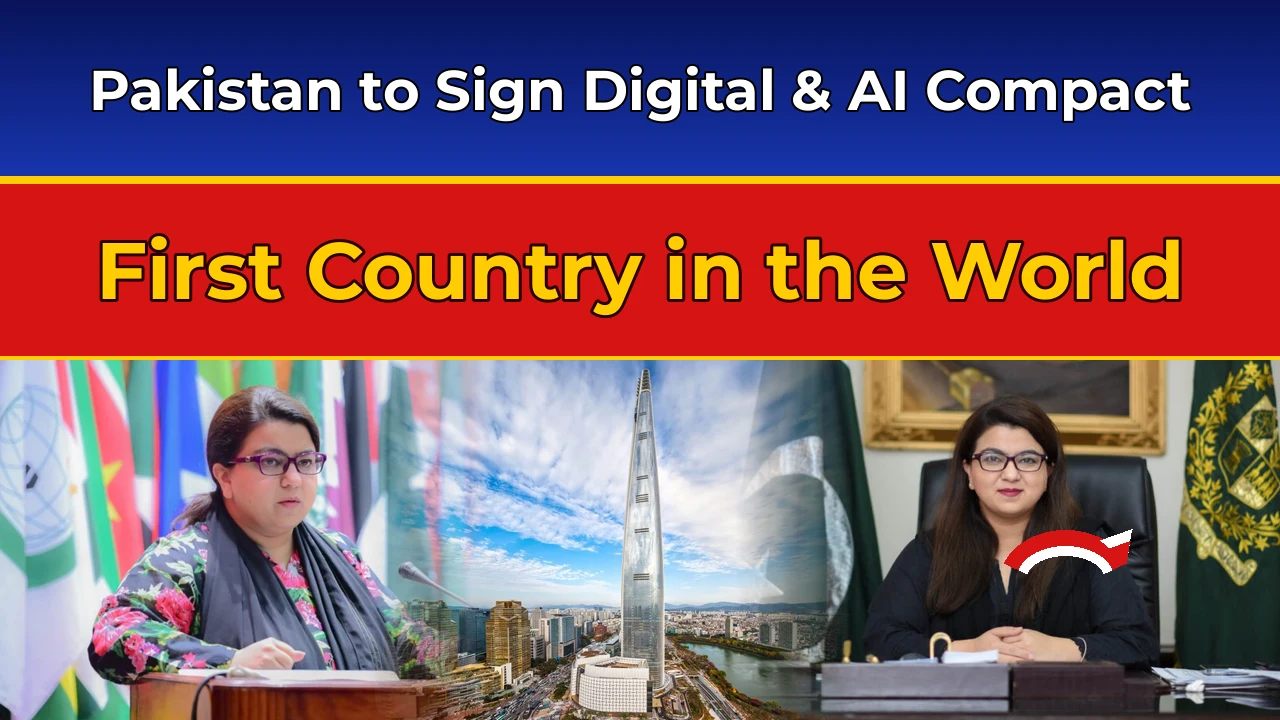
Pakistan is set to become the first country in the world to sign the Digital and AI Compact, as Federal Minister for Information Technology and Telecommunication Shaza Fatima Khawaja flew to South Korea on Sunday to attend the Global AI and Digital Summit 2026 in Seoul. The minister will present Pakistan’s future roadmap for digital transformation and artificial intelligence at a dedicated session on the compact — a move Islamabad hopes will put it at the front of the global race to set AI rules. Here is what is confirmed, the numbers behind Pakistan’s AI push, and what it could mean for ordinary Pakistanis.
| Digital and AI Compact — Quick Facts | |
|---|---|
| Event | Global AI and Digital Summit 2026, Seoul, South Korea |
| Dates | October 19–22, 2026 |
| Hosts | World Bank Group with South Korea’s Ministry of Science & ICT and Ministry of Finance & Economy |
| Pakistan’s representative | Shaza Fatima Khawaja, Federal Minister for IT & Telecom |
| Headline claim | Pakistan set to be the first country to sign the Digital and AI Compact |
| Key meetings | A Google vice president and a World Bank vice president |
| Status | Signing expected; officials have not announced a date or released compact details |
The Seoul summit: what is actually happening this week
If you have been following Pakistan’s tech policy over the last year, the name “Global AI and Digital Summit” will ring a bell — it is the kind of event where ministers show up with polished presentations and leave with memorandums. This one matters a bit more than usual, though. The summit, running from October 19 to 22 in Seoul, is hosted by the World Bank Group together with South Korea’s Ministry of Science and ICT and its Ministry of Finance and Economy, and it brings together governments, companies and development institutions to figure out how AI and digital transformation can deliver real development gains — not just headlines.
The World Bank has framed the event around a theme Pakistani readers will recognise instantly: responsible AI that builds trust, so innovation serves people and development goals. For a country where internet access is still uneven and digital public services are patchy, that framing is not decorative. It is the whole point.
During her visit, Shaza Fatima Khawaja will represent Pakistan at the summit and take part in the AI and Digital Ministerial Meeting, focused on Pakistan’s priorities in artificial intelligence and digital inclusion. She will also join sessions on equitable access to the internet and digital services worldwide — underlining, per APP, the importance of digital inclusion and expanding access to emerging technologies.
Who is Shaza Fatima Khawaja — and why she is the face of this trip
Shaza Fatima Khawaja is the federal minister holding the IT and Telecommunication portfolio, and she has spent the last year positioning Pakistan as a country that is done talking about digital policy and ready to implement it. Earlier, speaking at an event in Islamabad, she said Pakistan’s National AI Policy 2025 had been formulated after consultations — and that the government’s focus now was on implementation and execution: “we have to embrace the technology to take the country forward on the path of progress and development.”
Her Seoul itinerary reads like a diplomatic workweek. Beyond the ministerial sessions, she is scheduled to hold bilateral meetings with a Google vice president to discuss digital technology and AI matters of mutual interest, and separately with a World Bank vice president to discuss areas of cooperation. Neither meeting has a published agenda, but the pairing is telling: one conversation is about technology access and industry partnerships, the other about development financing and institutional support.
The centerpiece is the dedicated session on the Digital and AI Compact, where she will present Pakistan’s future roadmap for digital transformation and AI.
The Digital and AI Compact: what we know — and what we don’t
Let’s be honest about what is established and what isn’t, because this is where the story gets interesting.
What we know: Pakistan is set to become the first country to sign the Digital and AI Compact. That framing — “set to become” — comes from APP’s reporting and has been carried by The Nation, ARY News, The News and others on October 18–19. Being first matters beyond bragging rights: first signatories often get a seat at the table when a compact’s norms and working groups take shape.
What we don’t know: The compact’s terms have not been released. Officials have not said when the signing will take place or detailed the commitments Pakistan would make. The roadmap the minister is expected to present in Seoul has been described only in broad terms — digital transformation and AI — without specific measures or targets. No outcomes from the bilateral meetings have been reported yet, which is unsurprising: the summit only opened on October 19.
That is worth saying plainly because the phrase “first country” will travel fast on social media, and details blur with every share. Pakistan is expected to sign first. The signing has not been reported as completed. Treat every post that says “Pakistan HAS signed” with caution until an official announcement or summit readout confirms it.
What this means for Pakistan
Strip away the summit language and there are three reasons this story matters beyond the press release.
1. It forces the AI policy from paper to practice. The National AI Policy 2025 exists, consultations happened, and the minister herself says the phase now is implementation. A public commitment at a World Bank–hosted summit raises the cost of letting the policy gather dust. International audiences will ask what happened to the roadmap she presented.
2. It is a signal to investors and tech companies. IT and telecom export remittances hit a record Rs1.2 trillion — roughly $4.6 billion — in fiscal year 2025-26, a number the government repeats often because it is genuinely impressive. The government’s stated target under the National AI Policy 2025 is to create three million AI-related jobs by 2030. Being first to sign an international digital compact is the kind of signal that tells Google, the World Bank and others: Pakistan wants to be a serious partner, not a passive market.
3. The digital inclusion angle is the real test. Equitable internet access and digital services are not abstract for Pakistan — they are the difference between a freelancer in a small city getting paid or not, or a student accessing the same tools as one in Lahore. If the compact and the bilateral talks translate into cheaper connectivity, better digital services or training pipelines, that is where ordinary Pakistanis will feel it.
Pakistan’s AI numbers: the context behind the headlines
Numbers make this story concrete:
- Rs1.2 trillion ($4.6 billion): Pakistan’s IT and telecom export remittances in FY2025-26 — a record, and the government’s go-to proof that the digital economy is real.
- 3 million: AI-related jobs the government aims to create by 2030 under the National AI Policy 2025.
- October 19–22: The Seoul summit window — everything announced this week will be judged against these four days.
- First: Pakistan’s claimed position in the signing order for the Digital and AI Compact.
And the uncomfortable number: zero dedicated AI-specific regulatory structures in Pakistan today. No AI-specific regulatory framework exists at present — though the IT ministry says existing measures partially cover the gap: the National Cyber Security Policy 2021, the Pakistan Cloud First Policy 2022, the CERT Rules 2023, and sectoral regulations such as the Critical Telecom Data and Infrastructure Security Regulation (CTDISR). Whether a bundle of cyber, cloud and telecom rules amounts to an AI framework is exactly the question a summit commitment is meant to answer.
The Google and World Bank meetings: read between the lines
Two meetings, two different logics.
The Google vice president meeting is the industry conversation: digital technology and AI, “matters of mutual interest.” Google already has deep hooks into Pakistan’s digital economy — Android, cloud, and the developer ecosystem behind those Rs1.2 trillion in exports. For Pakistan, the ask is likely access: training, tools, and partnerships that feed the 3-million-jobs pipeline.
The World Bank vice president meeting is the development conversation: “areas of cooperation.” The Bank co-hosts the summit because it sees digital transformation as a development lever. This is where connectivity financing, digital public infrastructure and inclusion programs get discussed — the unglamorous stuff that decides whether AI policy reaches a village or stays in a PowerPoint.
Neither meeting has published outcomes yet. Watch for the readouts this week — the specifics, if any are announced, will matter more than the photo ops.
What to watch this week
Four things, in order of importance:
- The signing itself. Does Pakistan actually sign the Digital and AI Compact in Seoul, and what are its terms? Until a date and text are public, the story is “set to” — not “done.”
- The roadmap presentation. Will the minister’s session include concrete commitments — funding, timelines, programs — or stay at the level of approach and priorities?
- The bilateral readouts. Do the Google and World Bank meetings produce anything specific?
- Follow-through at home. The minister said implementation is the focus. The summit will test whether that holds once the delegation is back in Islamabad.
Pakistan showing up first at the table is a genuine diplomatic win. Turning it into jobs, connectivity and working digital services is the harder part — and that part begins after the summit ends.
Frequently asked questions
Has Pakistan already signed the Digital and AI Compact?
Not according to the reporting so far. Pakistan is set to become the first country to sign it, and IT Minister Shaza Fatima Khawaja travelled to Seoul for the Global AI and Digital Summit 2026 where she is expected to present the roadmap. Officials have not announced a signing date or released the compact’s terms — any claim that the signing is complete is unconfirmed until an official announcement.
What is the Global AI and Digital Summit 2026?
It is an international summit held in Seoul, South Korea, from October 19–22, 2026, hosted by the World Bank Group together with South Korea’s Ministry of Science and ICT and its Ministry of Finance and Economy. It brings together governments, companies and institutions to discuss how AI and digital transformation can deliver development gains, with an emphasis on responsible AI and digital inclusion.
Who is representing Pakistan at the Seoul summit?
Shaza Fatima Khawaja, the Federal Minister for Information Technology and Telecommunication. She will represent Pakistan at the summit, participate in the AI and Digital Ministerial Meeting, present Pakistan’s digital transformation and AI roadmap at a dedicated session on the Digital and AI Compact, and hold bilateral meetings with a Google vice president and a World Bank vice president.
What is the Digital and AI Compact?
It is an international compact on digital technology and artificial intelligence that Pakistan is expected to be the first country to sign. Its exact terms have not been made public. The minister is expected to present Pakistan’s future roadmap for digital transformation and AI during a dedicated session on the compact at the Seoul summit.
What is Pakistan’s National AI Policy 2025?
The National AI Policy 2025 is Pakistan’s AI policy framework, which the IT minister says was formulated after comprehensive consultations. The government has set a target of creating 3 million AI-related jobs by 2030 under the policy, and says the current phase is implementation and execution.
Does Pakistan have AI regulation?
There is currently no dedicated AI-specific regulatory structure in Pakistan. The government points to existing measures that partially address AI-related challenges: the National Cyber Security Policy 2021, the Pakistan Cloud First Policy 2022, the CERT Rules 2023, and sectoral regulations such as the CTDISR.