Amelia Earhart Expedition 2026: Taraia Object Ruled Out as Wreckage, Search Continues
Amelia Earhart Expedition 2026: Taraia Object Ruled Out as Wreckage, Search Continues By Fatima Raza Published: October 19, 2026 | Technology & Exploration | 6 min read Quick Facts Verdict: The Taraia Object is not Amelia Earhart’s missing plane. Announced Monday, October 19 (Nikumaroro local time), the team found “no conclusive evidence” the lagoon anomaly…
Amelia Earhart Expedition 2026: Taraia Object Ruled Out as Wreckage, Search Continues
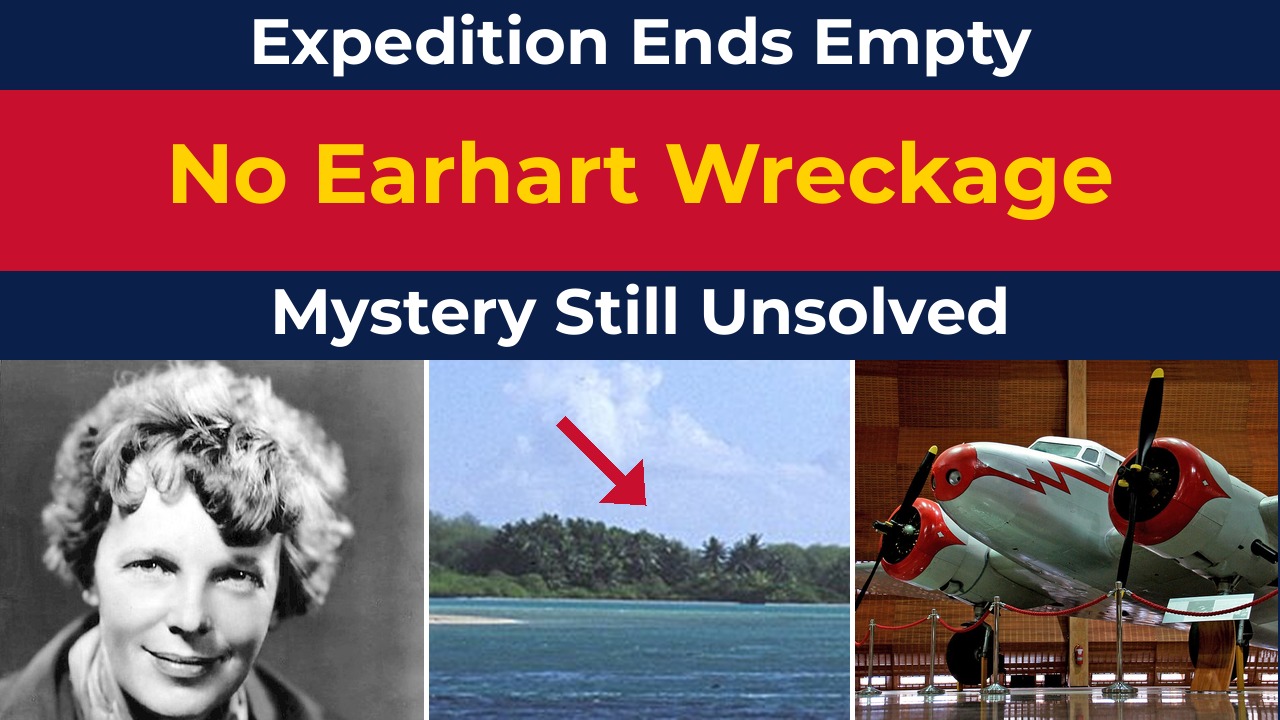
- Verdict: The Taraia Object is not Amelia Earhart’s missing plane. Announced Monday, October 19 (Nikumaroro local time), the team found “no conclusive evidence” the lagoon anomaly was wreckage of her Lockheed Electra 10-E.
- Who searched: A 17-member team from the Archaeological Legacy Institute, Purdue Research Foundation and Purdue University, led by Rick Pettigrew.
- Where: Taraia Peninsula lagoon, Nikumaroro – an uninhabited coral atoll in the Republic of Kiribati, South Pacific.
- What it really was: Large fallen trees and debris on a sandspit. Its “metallic” shine was a carbonate coating, not metal.
- What’s next: The search continues. Recovered artifacts face further analysis, and Purdue says it remains committed to solving the mystery.
No, the blurry plane-shaped shadow in the lagoon was not Amelia Earhart’s lost Lockheed Electra. That is the short, honest answer the Taraia Object expedition gave the world on Monday, October 19, after sailing thousands of miles across the Pacific to look at it with their own eyes. The anomaly that launched a reported $900,000 mission turned out to be something far more ordinary: a tangle of big fallen trees and storm-tossed debris lying along a sandspit, with a shiny carbonate crust that fooled satellites into seeing metal. I have been following this mystery for years, and this one stung – but the team is adamant about one thing: this is not the end of the story. The search for what happened to Earhart and her navigator Fred Noonan in 1937 goes on.
What the Expedition Announced on October 19
The announcement came from Nikumaroro itself on Monday morning, October 19, local time – the island sits 17 hours ahead of U.S. Eastern time, so it landed in American inboxes late on the 18th. Purdue’s wording was careful: the team found “no conclusive evidence to confirm a hypothesis that wreckage” from Earhart’s plane was in the lagoon.
That phrasing matters. They did not say “we proved it was nothing.” But the physical evidence was decisive: by the time the team arrived, much of the original object had fragmented and washed away, leaving only a single Y-shaped segment – a fraction of the anomaly’s original size.
The investigation was thorough: magnetometer surveys for iron, sonar scans of the lagoon bed, even an underwater hydraulic dredge to expose the object directly. What they pulled up was organic debris coated in a shiny concretized crust of coral sand – the very thing that had mimicked a metallic glint from orbit.
The Taraia Object: From Plane-Shaped Hope to Fallen Trees
How a shadow fooled everyone
The Taraia Object first showed up in satellite imagery of Nikumaroro’s lagoon in 2020, and historical aerial photos suggest it has been visible since 1938. Its outline matched the rough proportions of a Lockheed Electra’s fuselage and tail – close enough that Rick Pettigrew, ALI’s executive director and the expedition’s project director, believed it could genuinely be the missing aircraft.
It was a seductive idea. The object sat in shallow water near the Taraia Peninsula, a natural catchment area opposite the Tatiman Passage – the atoll’s channel to the open ocean. If anything entered the lagoon from the Pacific, it would plausibly settle exactly there. The theory fit. It just wasn’t true.
The twist nobody predicted
What the team found was almost poetic in its ordinariness: large trees on the peninsula’s sandspit – natural debris, rearranged by storms. And that tantalizing reflective surface, the detail that had everyone whispering “metal,” was a carbonate veneer: a shiny coral-sand coating. You can stare at satellite pixels for six years and see an airplane. You have to get in the water to see a tree.
A Stormy, Brutal Trip to the Middle of Nowhere
If anything, the journey underscored how hard this search is. The 17-person team – archaeologists, maritime specialists, technology experts, Kiribati government representatives, and a film crew – launched from Tarawa, Kiribati’s capital, on October 6 and traveled five days by sea to Nikumaroro.
Nikumaroro is not a forgiving workplace. The island is uninhabited, thick with vegetation, rats, and giant coconut crabs – huge nocturnal land crabs that make camping on the island too dangerous. The crew slept aboard their vessel offshore and landed each day by boat. Then the weather turned: strong winds and heavy seas, linked to El Nino, confined the team to their ship for three days. The trip had to be extended to recover the lost time.
Pettigrew had arrived brimming with confidence – he told USA Today before the trip that he was “very confident” and “pumped.” Searching for a plane that vanished 89 years ago takes a particular kind of stubborn optimism.
What They Found Instead
The expedition didn’t come home empty-handed. The team recovered numerous artifacts, including a steel tube about 30 inches long from the lagoon near the Taraia Peninsula. Those items face further analysis – and they matter beyond Earhart: understanding how debris moves through that lagoon sharpens every future search.
Why the Team Still Believes She Ended Up on Nikumaroro
This is where you need to read carefully, because what follows is one man’s conviction, not proven fact. Despite ruling out the Taraia Object, Pettigrew said: “The evidence for the castaway hypothesis, which brought us here, remained very, very strong. We think that it’s very likely that Amelia and her navigator, Fred Noonan, did in fact end up here on Nikumaroro Island.”
The castaway hypothesis – developed by The International Group for Historic Aircraft Recovery since the 1980s – holds that Earhart and Noonan landed on Nikumaroro’s reef flat and were marooned there. Its supporters cite radio bearings converging on the island, a 2018 analysis suggesting 1940-found bones belonged to a woman of Earhart’s stature, 1930s artifacts (a woman’s shoe, compact case, freckle cream jar, medicine vial), and a reef photo anomaly called the Bevington Object.
But skepticism is healthy. Dorothy Cochrane, an Earhart expert and retired Smithsonian curator, noted Nikumaroro has been searched more than 15 times “to no avail”: “They are one of many who have not found bona fide evidence of the Electra or Amelia or Noonan at Nikumaroro.”
That tension – a team’s deepening faith against an expert’s weary skepticism – is the honest state of this mystery in 2026. Steve Schultz, Purdue’s general counsel and field assistant, put it bluntly: “Unfortunately, we weren’t able to find that smoking gun.” Then the line that will define this mission: “Amelia Earhart never gave up – she kept pushing boundaries and flying into the unknown. That same fire fuels our search. She kept flying, and we will keep searching.”
A Mystery 89 Years in the Making
To understand why a tree stump in a lagoon made global news, remember what was lost. On July 2, 1937, Earhart and Noonan left Lae, Papua New Guinea, on the third-to-last leg of her round-the-world attempt, heading for Howland Island – about 400 miles northwest of Nikumaroro. They vanished. The U.S. launched one of the largest air-sea searches in history: two weeks over an area roughly the size of Texas. Nothing.
The Purdue connection runs deep. Earhart was a pioneering counselor and mentor to young women at Purdue, helped shape its aviation program, and her “Flying Laboratory” was purchased with Purdue Research Foundation funds. She intended to return the plane to Purdue after her flight.
And this is far from the first modern lead to evaporate. In 2024, Deep Sea Vision’s sonar detected a plane-like shape about 100 miles from Howland Island – a rock formation. In 2019, oceanographer Bob Ballard’s expedition to Nikumaroro ended in disappointment. The Taraia Object now joins the list: not a plane, just trees with a shiny coat.
What’s Next in the Search for Amelia Earhart’s Plane
Purdue has pledged to continue the search, saying the expedition “only deepens the resolve.” Meanwhile, Nauticos is raising $8-10 million for what it hopes will be a final expedition around Howland Island – a search area narrowed by experiments with a replica of Earhart’s radio system. It has completed three searches there since 2002.
My take, after years of watching these announcements cycle through hope and heartbreak: the mystery survives because every failed search still narrows the field. A ruled-out hypothesis is not wasted effort – it’s one fewer shadow to chase.