Govt Orders Foreign Nationality Declarations From Civil Servants
By Daniyal Sheikh, Pakistan Desk | Updated: October 23, 2026 The federal government has ordered all ministries and divisions to compile consolidated details of every civil servant’s declaration about foreign nationality, foreign travel documents, and the nationality status of their dependants. The directive came in an official notification issued by the Establishment Division on October…
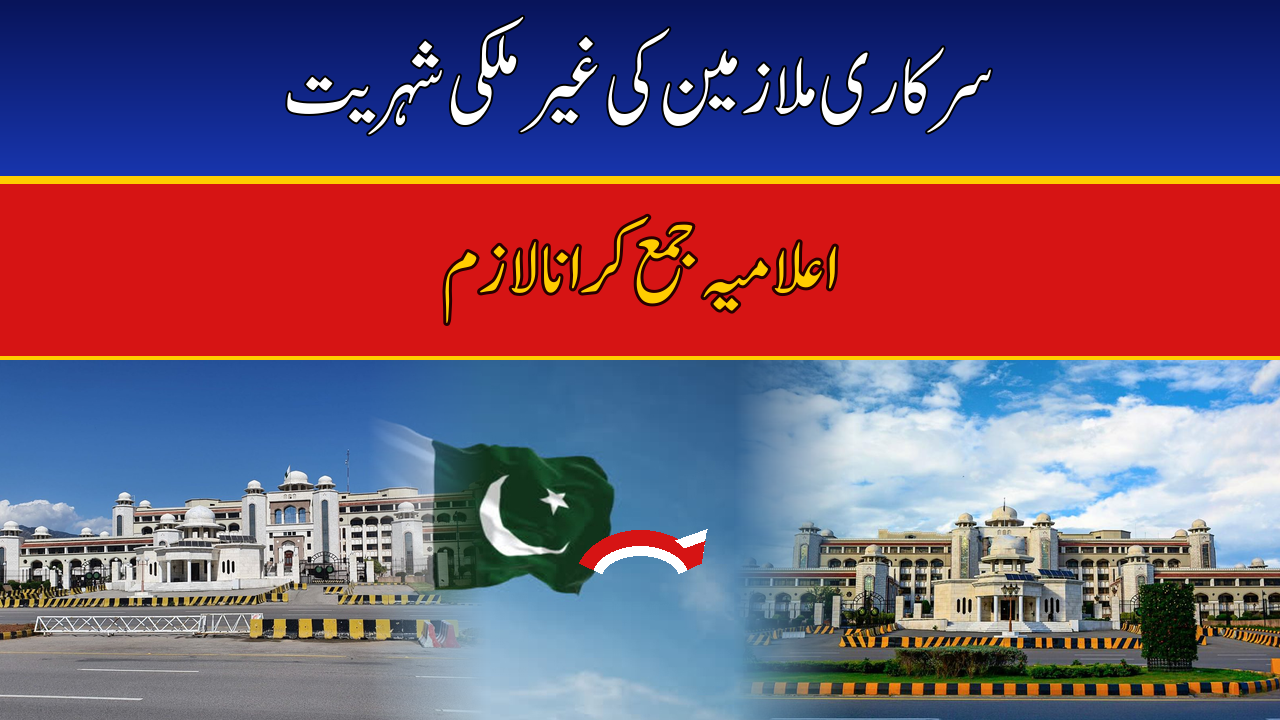
The federal government has ordered all ministries and divisions to compile consolidated details of every civil servant’s declaration about foreign nationality, foreign travel documents, and the nationality status of their dependants. The directive came in an official notification issued by the Establishment Division on October 21, 2026, and it marks the first major enforcement push under the Civil Servants (Disclosure and Regulation of Foreign Nationality) Rules, 2026 — the new framework that makes it misconduct for a government officer to hide a foreign passport or nationality from the state.
If you are a federal government employee, this is the moment the paperwork catches up with you. The grace period has already expired, the one-week warnings have already gone out, and now ministries are being told to put every officer’s name, designation, basic pay scale, and declaration status on one master list. Here is what the notification actually says, which rules it enforces, who is exempt, and what happens to officers who still have not complied.
| Fact | Detail |
|---|---|
| Notification issued by | Establishment Division, Government of Pakistan |
| Date of notification | October 21, 2026 |
| What it orders | All federal ministries and divisions must submit consolidated details of civil servants’ foreign nationality, travel document and dependants’ nationality declarations |
| Legal basis | Civil Servants (Disclosure and Regulation of Foreign Nationality) Rules, 2026 — notified in the official gazette in June 2026 |
| Declaration window | 90 days from gazette publication; expired September 2026 |
| What must be declared | Foreign nationality held, foreign travel documents possessed, marriage to a foreign national — by the officer and their dependants |
| Penalty for non-disclosure | Treated as misconduct under the Civil Servants (Efficiency and Discipline) Rules, 2020 — disciplinary action |
| Excluded groups | Pakistan Administrative Service (PAS), Police Service of Pakistan (PSP), Secretariat Group, Office Management Group (OMG) |
| Required format | Officer’s name, designation, basic pay scale (BPS), declaration status, and foreign nationality/travel-document status of officer and dependants |
What the October 21 notification actually says
The Establishment Division’s memorandum is less a request than an instruction. Addressed to every federal ministry and division, it directs them to compile — and hand over — consolidated information on the declarations made by their civil servants regarding foreign nationality and travel documents. Crucially, the compilation must also cover the nationality status of each officer’s dependants: spouses and children whose foreign passports or nationalities the state wants on record too.
The notification lays out a specific reporting format so that the data arrives in a uniform, comparable shape. For every officer, the ministry must list the officer’s name, designation, basic pay scale, confirmation of whether the declaration was submitted, and the foreign nationality or travel-document status of both the officer and their dependants. In plain terms, the government is building a single master register — a headcount, grade by grade, of who among its officers holds what foreign connection.
This is significant because until now, compliance with the foreign nationality rules was largely self-reported and unmonitored. The October 21 order moves the exercise from voluntary declarations into centrally audited territory. Ministries cannot simply say they asked; they have to show the lists.
The 2026 Rules behind the order
The notification does not create new law — it activates the Civil Servants (Disclosure and Regulation of Foreign Nationality) Rules, 2026, which were notified in the official gazette on June 1, 2026. These rules are the legal spine of the whole exercise, and two of their provisions do most of the heavy lifting.
Rule 3(3): what every civil servant must declare
Rule 3(3) places the disclosure duty squarely on the individual officer. Every civil servant is required to declare whether they hold the nationality of any foreign country, whether they possess foreign travel documents, and whether they are married to a foreign national. The obligation does not stop with the officer — the same declaration must cover their dependants. So if an officer’s spouse holds a foreign passport, or a child has dual nationality, that too must be disclosed in writing.
For officers reading this closely, the definition of “dependants” and “foreign travel documents” is deliberately broad. A second passport tucked away in a drawer, a foreign residency card that lets you travel on someone else’s document, a marriage to a citizen of another country — all of it falls within the declaration net. The rule is designed to leave as little room for creative interpretation as possible.
Rule 3(4): hiding it is misconduct
This is the teeth of the framework. Rule 3(4) states that failure to submit the declaration — or the submission of false information — constitutes misconduct under the Civil Servants (Efficiency and Discipline) Rules, 2020. That is the same rulebook the state uses to discipline officers for corruption, negligence, and insubordination, and it opens the door to the full range of punishments: censure, withholding of increments and promotions, reduction in rank, compulsory retirement, removal from service, and dismissal.
The message could hardly be clearer. A declaration is not a courtesy and the form is not optional. Officers who ignored the earlier deadlines are not merely late — under Rule 3(4), they are potentially exposed to disciplinary proceedings. This is why the October 21 notification carries weight: it operationalises the punishment side of the rules by demanding the lists that will expose who complied and who did not.
The 90-day window that expired in September
The timeline matters here, because the government is no longer asking for first-time declarations — it is enforcing ones that were already due. The Rules were gazette-notified on June 1, 2026, which triggered a 90-day declaration window. That window closed in September 2026, giving every covered civil servant roughly three months to put their foreign nationality status on record.
Many did not. Earlier this month, the government separately warned officials who had failed to disclose, issuing an office memorandum that gave defaulters a one-week deadline to come forward. That warning, in retrospect, was the last gentle step. The October 21 notification is the machinery moving to the next phase: rather than chasing individual officers, the state is now requiring their ministries to report them in consolidated form. The presumption has shifted from trust to verification.
Who is covered — and who is excluded
The reporting exercise covers civil servants across the federal ministries and divisions. But there is a notable carve-out, and it is worth understanding. Four elite service groups are excluded from this particular reporting: the Pakistan Administrative Service (PAS), the Police Service of Pakistan (PSP), the Secretariat Group, and the Office Management Group (OMG).
Why exempt the most prominent service cadres? The most plausible reading is that these groups are handled through their own separate service-specific reporting channels rather than being excused altogether. The PAS and PSP, for instance, already sit under tightly administered career structures with their own personnel records. Being excluded from this consolidated exercise does not mean being exempt from the disclosure obligation itself — it means the government is collecting their data through a different door. Officers in these groups should not mistake procedural exclusion for a free pass; the Rules apply to civil servants as a class.
For everyone else — the vast body of federal officers outside those four groups — the position is unambiguous. Your ministry is being told to compile your name, your designation, your BPS, your declaration status, and your foreign connections, and to send that up to the Establishment Division.
How the consolidated reporting will work
The notification prescribes a uniform format so the Establishment Division can compare apples to apples. Each ministry’s submission must record, officer by officer: name, designation, basic pay scale, whether the declaration was submitted, and the foreign nationality or travel-document status of the officer and their dependants.
Think about what that builds. Once compiled, the Establishment Division will hold a near-complete dataset of the foreign attachments of the federal bureaucracy — which officers hold foreign passports, which hold foreign travel documents, which are married to foreign nationals, and how foreign citizenship runs through their families. It is an unprecedented transparency exercise for the civil service, and it will inevitably feed into future decisions about postings, clearances, and career progression for officers with foreign ties.
What happens on non-compliance
Under Rule 3(4), failing to declare or declaring falsely is misconduct under the Efficiency and Discipline Rules of 2020. The disciplinary ladder under those rules runs from minor penalties — a censure note in the file, or a halt on increments — through major ones: reduction to a lower post or time-scale, compulsory retirement, removal from service, and dismissal.
The October 21 notification adds a practical dimension to that threat. Before this, non-compliance was invisible — no one knew who had filed and who had not, because there was no consolidated list. Now the lists themselves become the enforcement tool. An officer whose row reads “declaration: not submitted” is, in effect, self-identifying for disciplinary action. And an officer who filed a false declaration faces an even sharper risk, because the consolidated data will inevitably be cross-checked against passport, immigration and NADRA records that the state already holds.
None of this is theoretical. The one-week warning memorandum earlier this month signalled that the government was already preparing the ground. The consolidated reporting order is the follow-through — the state collecting the evidence base it needs to act.
Why the government is doing this now
To understand the urgency, you have to place this notification in the wider context of dual-nationality scrutiny in Pakistan’s state machinery. For years, the question of how many senior officers hold foreign passports — and whether those passports create conflicts of interest — has simmered in public debate. A civil servant with a foreign passport can, in a crisis, leave the country and the jurisdiction of Pakistani law; a decision-maker whose family lives abroad on foreign nationality can face questions about where their long-term loyalties lie.
The 2026 Rules were the government’s legislative answer: bring the whole thing into the open, put it on record, and attach misconduct consequences to concealment. The October 21 notification is the administrative answer: stop relying on officers to volunteer the information and start extracting it through their ministries.
There is also a signalling dimension. The explicit inclusion of dependants — spouses, children — reflects an understanding that an officer’s foreign exposure does not end at their own passport. And the disciplinary framing under the Efficiency and Discipline Rules tells the bureaucracy that the state treats concealment of foreign ties the way it treats corruption or insubordination: as a breach of the service’s fundamental trust.
What civil servants should do right now
If you are a federal officer who has not yet filed the declaration, the window for quiet compliance is closing fast. The earlier one-week office memorandum was the warning; the October 21 order means your ministry is about to report your status upward. Filing now — accurately and completely, covering your dependants — is the only safe route. A late, honest declaration may draw an adverse note; a missing or false one draws misconduct proceedings.
For officers who have already filed, there is little to do but ensure the record is complete: check with your ministry’s administration wing that your declaration has been captured in the consolidated submission, and correct any errors — especially around dependants’ details — before the data hardens into the master register. Once the Establishment Division holds the lists, correcting a false negative becomes very difficult.
Officers in the excluded groups — PAS, PSP, Secretariat Group, OMG — should watch for separate service-specific instructions rather than assuming the obligation does not reach them. The disclosure duty under the Rules is universal; only the reporting channel differs.
What to watch next
Several questions remain open. The notification does not publicly state the deadline by which ministries must submit their consolidated lists, and it does not say what verification methodology the Establishment Division will apply — though cross-matching against existing passport and immigration records is the obvious route. It also remains to be seen whether the government will publish aggregate statistics, such as how many officers hold foreign nationality, which would give the public a first real measure of the phenomenon.
Watch, too, for the first disciplinary cases. The credibility of the whole framework rests on what happens to the first officers whose names land on the “not submitted” or “false declaration” lists. A handful of visible proceedings under the Efficiency and Discipline Rules would send a louder signal to the bureaucracy than any memorandum. TimelyUps will continue to track this story as the lists are compiled and the first enforcement actions surface.
If you are following government employment news, also see our coverage of Sindh Government’s 571 Jobs with walk-in interviews from October 19, the SPSC Consolidated Advertisement No. 05/2026 for 54 government posts in Sindh, and the PM Youth Programme’s US healthcare jobs deal — all part of the current wave of public-sector opportunity and reform.
What did the Establishment Division order on October 21, 2026?
It directed all federal ministries and divisions to submit consolidated details of their civil servants’ declarations about foreign nationality, foreign travel documents, and dependants’ nationality status — including each officer’s name, designation, basic pay scale and declaration status.
What are the Civil Servants (Disclosure and Regulation of Foreign Nationality) Rules, 2026?
The legal framework notified in the official gazette in June 2026 requiring federal civil servants to disclose any foreign nationality, foreign travel documents, or marriage to a foreign national — for themselves and their dependants.
What is the punishment for not declaring foreign nationality?
Under Rule 3(4), failing to submit the declaration or providing false information counts as misconduct under the Civil Servants (Efficiency and Discipline) Rules, 2020 — which can lead to censure, withheld increments, demotion, compulsory retirement, removal from service or dismissal.
Has the declaration deadline passed?
Yes. The 90-day declaration window opened when the Rules were gazette-notified on June 1, 2026 and expired in September 2026. Earlier in October, the government issued a one-week warning memorandum to officials who had not disclosed, before moving to the consolidated reporting stage on October 21.
Are PAS and PSP officers exempt from the disclosure rules?
Not necessarily exempt from the rules — they are excluded from this particular consolidated reporting exercise, along with the Secretariat Group and the Office Management Group. Their data is expected to be collected through separate service-specific channels.
Do officers have to declare their family’s foreign nationality too?
Yes. Rule 3(3) requires the declaration to cover the officer’s own foreign nationality, foreign travel documents and marriage to a foreign national, plus the same details for their dependants — spouses and children.
Can a civil servant hold dual nationality under Pakistani law?
Pakistan permits dual nationality with a list of notified countries, but the 2026 Rules require government officers to disclose it. Concealing it is misconduct. Specific posts — particularly in sensitive or security-adjacent roles — may carry their own restrictions on dual nationals, which is one reason the state is building this register.
What should a civil servant who missed the deadline do now?
File the declaration immediately, completely and honestly — covering dependants — and confirm with their ministry’s administration wing that it has been captured in the consolidated submission before the data is sent to the Establishment Division.