Arc Browser Is Shutting Down on December 22, 2026: What Users Need to Do
Arc, the browser that tried to reinvent the internet, is officially shutting down. On Thursday, October 22, 2026, The Browser Company announced that Arc will stop working completely on December 22, 2026 — on both Mac and Windows — and is pushing every user toward its AI-first successor, Dia. If you still use Arc, you…
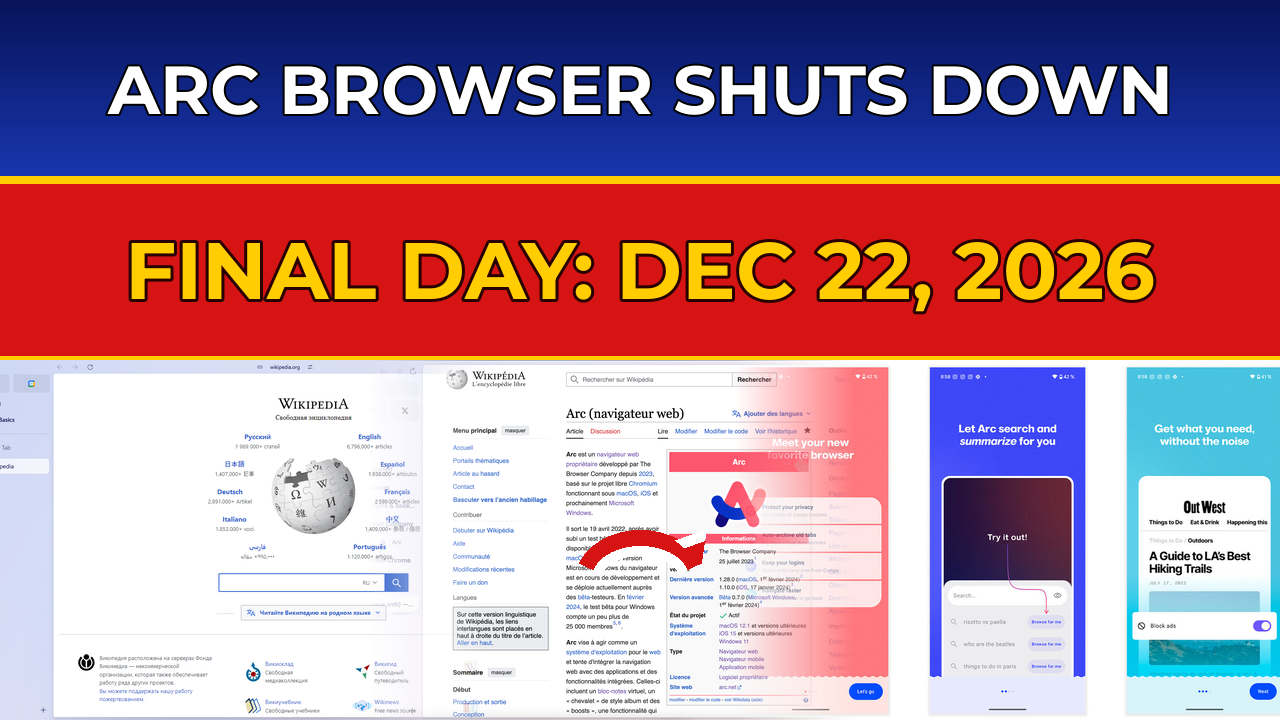
Arc, the browser that tried to reinvent the internet, is officially shutting down. On Thursday, October 22, 2026, The Browser Company announced that Arc will stop working completely on December 22, 2026 — on both Mac and Windows — and is pushing every user toward its AI-first successor, Dia. If you still use Arc, you have exactly two months to export your data, move your bookmarks and passwords, and decide where you are browsing next. Miss the December 15 data deadline and your Arc account details will be gone for good.
I have been watching Arc since its hyped 2022 debut, and honestly, this one stings. Arc was not just another Chromium reskin — it was the only mainstream browser in a decade that made tabs feel designed rather than inherited. But The Browser Company’s message this week is blunt: keeping a browser secure now demands everything the company has got, and that effort is going to Dia. Below is the full three-phase shutdown timeline, exactly what happens to your data, and the step-by-step migration path — verified against the company’s announcement and the coverage from TechCrunch, Thurrott and Digital Trends.
Arc browser shutdown — key facts at a glance
| Detail | Confirmed information |
|---|---|
| Announcement date | Thursday, October 22, 2026 — The Browser Company (CEO Josh Miller) |
| Final shutdown date | December 22, 2026 — Arc stops working on Mac and Windows; all accounts deactivated |
| Phase 1 — Oct 22, 2026 | No new Arc accounts can be created, effective immediately |
| Phase 2 — Nov 23, 2026 | Arc Search (iOS/Android) loses “Browse for Me”, sign-in and tab sync; removed from the Google Play Store; keeps working as a basic local browser |
| Phase 3 — Dec 22, 2026 | Arc desktop stops working entirely; accounts deactivated; personal data deleted within 30 days |
| Data request deadline | December 15, 2026 — last day to request a copy of your Arc account data or ask for deletion (covers account details and usage records, not on-device history or passwords) |
| Successor | Dia — The Browser Company’s AI-first browser; passwords, bookmarks, extensions and history import seamlessly |
| Company’s stated reason | Browser security workload: “Keeping a browser secure takes constant, dedicated work that is only increasing in the age of AI” |
| Background | End-of-life strategy first signalled May 2025; Atlassian acquired The Browser Company for $610 million in 2025 |
The three-phase shutdown timeline
The Browser Company is not flipping the switch overnight. The wind-down runs in three clearly dated phases, and each one takes something away from you — so the date that matters most depends on which Arc you use.
Phase 1 — October 22, 2026: no new accounts, effective now
The very day of the announcement, The Browser Company closed the door on new sign-ups. Nobody can create an Arc account from today onward, which also means Arc can no longer grow its way out of this — the user base is now frozen in place and shrinking. If a friend was thinking of trying Arc “before it goes”, that window has already closed.
Phase 2 — November 23, 2026: Arc Search loses its brains
The mobile story is subtler but still painful. On November 23, Arc Search on iOS and Android loses the features that made it interesting: the AI-powered “Browse for Me” summaries, sign-in, and tab sync all switch off. The app will still open as a basic local browser — your on-device browsing keeps working — but it is being delisted from the Google Play Store, so Android users will not even be able to reinstall it. In practice, November 23 is the day Arc Search becomes a zombie app.
Phase 3 — December 22, 2026: Arc dies on desktop
This is the big one. On December 22, Arc stops working entirely on Mac and Windows. Every Arc account is deactivated, and the company says all personal data tied to those accounts will be deleted within 30 days of shutdown. There is no “keep using it offline” loophole being offered here — when The Browser Company pulls the plug, the browser is done.
What happens to your data — and the December 15 deadline
Read this part carefully, because the deadlines are different for different kinds of data. December 15 is the last day you can request a copy of your Arc account data or request its deletion. That request covers your account details and usage records held by The Browser Company.
What it does not cover is the stuff sitting on your own machine: your local browsing history and saved passwords live in your device’s Arc installation, and those stay put until you move or delete them yourself. Practically speaking, that means two jobs: ask the company for your account data before December 15, and handle your local data (passwords, history, bookmarks) yourself by exporting it before December 22.
After shutdown, The Browser Company says personal data will be deleted within 30 days. If you are the cautious type — and after the year we have had in tech security, you should be — do not rely on a deletion promise; pull your data out first, then ask for deletion.
How to move from Arc to Dia without losing anything
Dia is the company’s chosen heir, and the migration path is deliberately frictionless — The Browser Company would very much like you to stay in the family. Here is what actually transfers, and how the concepts map over:
- Download Dia from the official site while Arc is still running on your machine — you will want both open side by side.
- Import your essentials. Passwords, bookmarks, extensions and browsing history port across seamlessly; Dia walks you through the import on first launch.
- Learn the new vocabulary. Arc’s Spaces become Profiles in Dia, folders become Pinned Tab Groups, and your pinned tabs import directly. The layout philosophy is familiar, just renamed.
- Check your Arc-only features. The headline Arc features you paid nothing for are free in Dia too — and the AI bits are optional, not forced. If you hated the idea of an AI browser, you can run Dia as a fairly conventional browser.
- Verify before December 15. Open Dia, confirm your bookmarks bar, saved passwords and extensions all arrived intact, then put in your Arc data request while the deadline still stands.
One honest caveat from someone who has migrated browsers more times than I can count: imports are never 100 percent. Skim your passwords list for anything odd, and keep a manual backup of anything you would cry over losing.
Why Arc is really dying — the security argument
The official explanation is worth quoting in full, because it tells you where the entire browser industry is heading: “Keeping a browser secure takes constant, dedicated work that is only increasing in the age of AI.” The Browser Company says Dia “was built from the ground up to meet today’s security standards”, and that its engineering and security teams are now focused there.
Strip away the corporate polish and the logic is hard to argue with. A browser is one of the most attacked pieces of software on earth — it runs untrusted code from every website you visit — and maintaining two full browsers means splitting the security team in half. In an era of AI-accelerated vulnerability hunting, a half-staffed browser is a sitting target. It is the same brutal week for tech security that gave us the AI-discovered PHP flaws — keeping software safe is getting harder, not easier.
There is also the money story. CEO Josh Miller admitted as far back as May 2025 that Arc was “simply too different” — a beautiful product that never gave most people enough reason to switch from Chrome. Then came the $610 million Atlassian acquisition in 2025, which changed the calculus: the company now has a parent, and parents demand focus. Dia — the AI browser with the enterprise-friendly story — won the internal argument.
And if you were hoping the community could save Arc by open-sourcing it, Miller has already closed that door. Open-sourcing Arc would mean giving away the ADK (Arc Development Kit) — the proprietary engine that also powers Dia. The company is not handing its crown jewels to competitors, full stop.
What made Arc special — a short obituary
For the uninitiated: Arc launched in 2022 as “an internet computer” rather than a browser. The sidebar replaced the tab bar. Spaces let you organise entire separate browsing lives — work, side project, holiday planning — each with its own tabs, theme and pinned sites. Boosts let you reskin any website with custom CSS. Easels were collaborative whiteboards baked into the browser. Auto-archiving tabs cleared your clutter without the guilt of closing things.
None of these were world-changing alone. Together, they made browsing feel considered — and for designers, researchers and tab-hoarders, nothing else has felt the same since. Arc’s tragedy is a familiar Silicon Valley one: beloved by a passionate niche, ignored by the masses, and ultimately too expensive to keep alive for love alone. The browser wars are still raging elsewhere, mind you — this same month saw WhatsApp building its own in-app browser for iOS, proof that everyone still wants to own the window you see the web through.
Users are not taking it quietly
The reaction on social media has been, in a word, grief. Long-time Arc evangelists are posting farewell threads, and the announcement has revived the loudest demand the community has ever made: open-source Arc. Petitions and threads asking Miller to release the code are circulating again — and being declined again, for the ADK reasons above.
There is a real undercurrent of frustration that goes beyond nostalgia. People organised years of their digital lives around Spaces and pinned tab groups; being told to migrate — even to a sibling product — feels like a landlord selling the building. The December 15 data deadline, in particular, has users urging each other not to sleep on the export.
Don’t want Dia? Your best Arc alternatives
Dia is the path of least resistance, but it is not the only one — and if Arc’s whole appeal was that it wasn’t Chrome, you may not want the company’s second act either. Shortlist, from closest in spirit to safest in practice:
- Zen Browser — the open-source, Firefox-based darling of the customisation crowd. Vertical tabs, workspaces and heavy theming; the closest thing to Arc’s soul, minus the polish.
- SigmaOS — another “rethink the browser” experiment with workspaces and a clean aesthetic. Mac-first, like Arc was.
- Firefox — the independent option. With vertical tabs now native and a strong extension ecosystem, it is the principled pick.
- Chrome or Edge — the boring, pragmatic pick. Everything works, everything syncs, nothing delights. Sometimes that is what you need during a forced migration.
Whichever you choose, export first and decide later — your data is portable, your habits are not. It has been a month of shock shutdowns in tech, from browsers to EA’s stunning closure of BioWare. The lesson keeps repeating: have an exit plan for every platform you depend on.
What you should do this week — the checklist
- Before November 23: if you use Arc Search on mobile, decide its replacement — the app loses its AI features and Play Store listing that day.
- Before December 15: request your Arc account data copy (or deletion) from The Browser Company.
- Before December 22: install Dia or your chosen alternative, import passwords/bookmarks/extensions/history, and verify everything arrived.
- On December 22: uninstall Arc. Pour one out for the sidebar. Move on.
Two months sounds generous until you remember how much of your life lives in a browser. Start the export this weekend — future you will be grateful. And if you are shopping for a new device to browse on, our coverage of the Redmi K100’s October 28 launch might interest you — the tech world, unlike Arc, is not slowing down.
Arc browser shutdown — FAQs
By Fatima Raza — Technology Desk, TimelyUps. Updated: October 23, 2026.