GCC Railway Agreement Signed in Manama: 2,117km Network to Link Six Gulf States by 2030
Manama, 8 November 2026 — A landmark agreement to build a single railway network linking all six Gulf Arab states was signed today in Manama, Bahrain. The deal covers a 2,117-kilometre integrated railway running from Kuwait in the north to Oman in the south, carrying both passengers and freight, with full operations targeted by December…
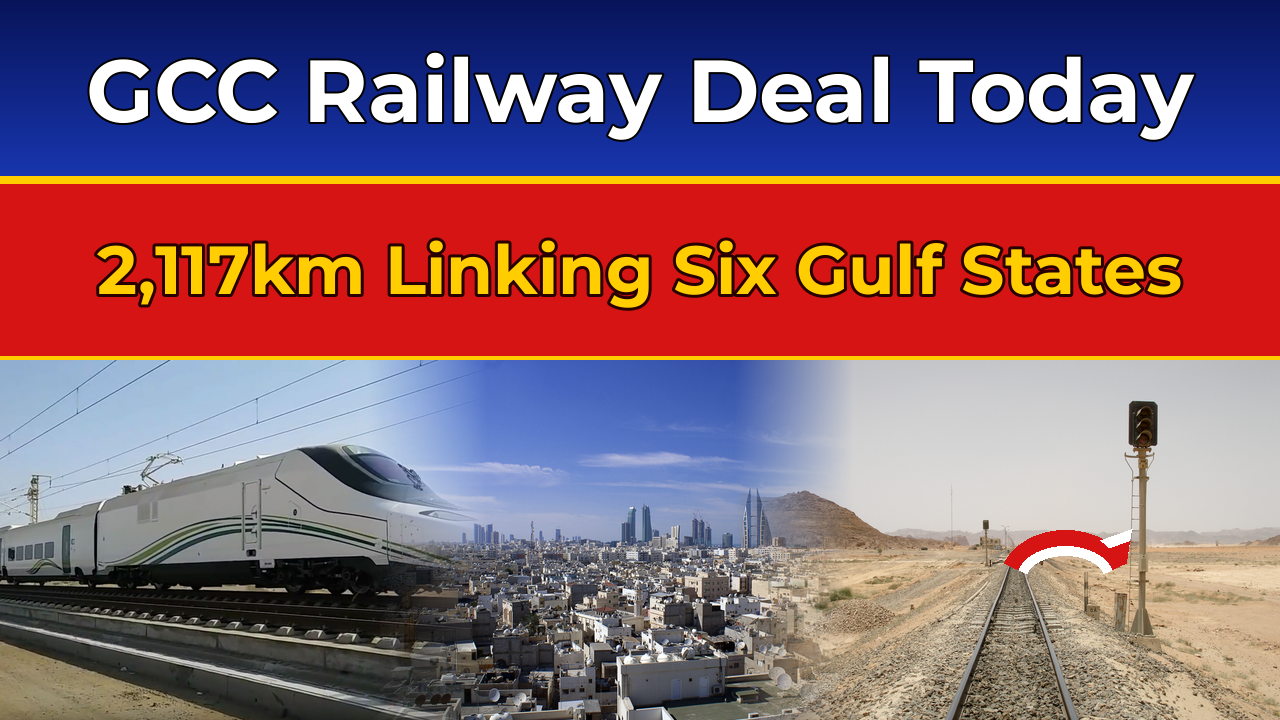
Manama, 8 November 2026 — A landmark agreement to build a single railway network linking all six Gulf Arab states was signed today in Manama, Bahrain. The deal covers a 2,117-kilometre integrated railway running from Kuwait in the north to Oman in the south, carrying both passengers and freight, with full operations targeted by December 2030. Transport and communications ministers from all six Gulf Cooperation Council (GCC) member states are attending the signing ceremony, alongside GCC Secretary General Jasem Albudaiwi, under the patronage of Bahrain’s Crown Prince and Prime Minister, Salman bin Hamad Al Khalifa.
By Fatima Raza | Updated: 8 November 2026
| Key fact | Detail |
|---|---|
| What | General Agreement on the GCC Railway project — the framework to build and operate a single integrated Gulf rail network |
| When | Sunday, 8 November 2026 — signing ceremony in Manama, Bahrain |
| Who is signing | Transport and communications ministers of the six GCC states, with GCC Secretary General Jasem Albudaiwi; under the patronage of Bahrain’s Crown Prince and Prime Minister Salman bin Hamad Al Khalifa |
| Network length | 2,117km (about 2,100km) linking Kuwait, Saudi Arabia, Bahrain, Qatar, UAE and Oman |
| Speed | Passenger trains up to 200 km/h; freight trains 80–120 km/h |
| Progress so far | About 50% complete, according to a PwC Middle East report published in June 2026 |
| Full operations | Targeted by December 2030; trial operations expected in 2027 |
| First cross-border link | Oman–UAE Hafeet Rail, 238km; trial operations from Q4 2027 |
What Is Being Signed in Manama Today
Today’s ceremony is the moment a project talked about for more than a decade finally gets its binding framework. The six states have been building their national sections at different speeds ever since — the UAE has already launched its national network, Saudi Arabia has begun procurement for its roughly 672km section, and Oman is pushing ahead with its cross-border link to the UAE. What has been missing, until today, is one agreed rulebook for the whole network.
That is what the General Agreement provides. Bahrain’s transport minister, Sheikh Abdulla bin Ahmed Al Khalifa, told The National the deal is the most important agreement reached at GCC level for the railway project, the result of intensive coordination between member states. “We have the GCC meeting of transport ministers in Bahrain on November 8 and there is a general agreement to connect GCC countries through a railway network. We hope that this agreement will be signed in Bahrain,” he said.
Bahrain is hosting because it currently holds the GCC presidency. The ceremony takes place in Manama, with the kingdom’s Crown Prince and Prime Minister as patron — a deliberate choice of stage for the smallest Gulf state to put its name on the region’s biggest connectivity project.
The Four Pillars of the Agreement
The agreement rests on four pillars, and each one answers a practical question that has held the project back.
First, implementation and operation. The project will be built and run according to a work plan and timeline agreed by all six member states. Without a shared timetable, each country builds at its own pace and the network never actually joins up.
Second, technical and operational compatibility. The six national networks must speak the same language — the same technical specifications and safety requirements — so that a train can cross a border without stopping to change systems. The GCC Railways Authority, headquartered in Riyadh, is working with member states to unify those specifications and keep the project on course.
Third, coordination and follow-up. The agreement defines the responsibilities of each member state and strengthens cooperation with the GCC Railways Authority to monitor progress and clear obstacles. This is the enforcement mechanism: someone has to notice when a section falls behind and do something about it.
Fourth, connectivity. The stated aim is a safe, economical and environmentally friendly way to move passengers and goods, supporting trade and economic and social exchange between the Gulf states. In plain terms, the railway is meant to make the six countries feel like one market rather than six neighbours.
A 2,117km Network in Numbers
The headline figure is the length: 2,117 kilometres of track, connecting Kuwait, Saudi Arabia, Bahrain, Qatar, the United Arab Emirates and Oman. Some reports round it to about 2,100km. Either way, it is one of the largest infrastructure projects the region has ever attempted, and it is designed to move people and freight on the same network.
Passenger trains are designed to run at up to 200 kilometres per hour, freight trains at 80 to 120. Those speeds change what a journey across the Gulf looks like: a trip that today means a flight, a long drive or a slow lorry convoy becomes a train ride measured in hours rather than days.
The project is already about halfway there: a PwC Middle East report from June 2026 put completion at approximately 50 per cent. Full operations are targeted by December 2030, and completed cross-border sections may open ahead of the full network, so the first international journeys could start well before then.
Hafeet Rail: The First Cross-Border Link
The most advanced piece of the network is the one between Oman and the UAE. Hafeet Rail, a 238km line, will connect the port city of Sohar in Oman with Abu Dhabi, running through Al Buraimi and Al Ain. Trial operations are expected to begin in the fourth quarter of 2027.
The numbers show what the wider network promises. Passenger trains will run at up to 200 km/h, covering Sohar to Abu Dhabi in 100 minutes and Sohar to Al Ain in 47 minutes. A single freight train journey is expected to carry more than 15,000 tonnes of cargo, roughly 270 standard containers, and the line will connect more than 12 passenger stations and cities across the two countries.
The sectors expected to benefit read like a list of the Gulf’s working economy: mining, iron and steel, agriculture and food, retail, e-commerce and petrochemicals. By taking heavy freight off the roads, the line should also cut the number of lorries on the highways between the two countries.
For Pakistan, this link is the closest part of the story. Oman sits across the Arabian Sea from Pakistan’s Makran coast, and Sohar is one of the ports Pakistani trade already uses. When the Omani foreign minister visited Islamabad in October for the eighth Pakistan-Oman Joint Ministerial Commission, labour, trade and consular affairs were all on the agenda — the same flows a railway makes faster and cheaper. Our report on Oman’s foreign minister’s visit to Pakistan explains why the relationship matters.
Why the Gulf Is in a Hurry Now
The timing is not an accident. The Gulf has been through one of its most difficult security environments in recent years, and the region’s reliance on shipping has been exposed. Nearly 20 per cent of global oil supplies pass through the Strait of Hormuz every day, along with a significant share of regional trade. When shipping through the strait was disrupted, Bahrain felt it directly: ship calls at Khalifa bin Salman Port fell, and the kingdom leaned more heavily on road transport and on alternative ports in Saudi Arabia, Oman and the UAE.
“Transport is the lifeline of any economy in any country in the world,” Sheikh Abdulla said. “Whether we are talking about logistical connectivity in general, or land, air or maritime transport, it is fundamental.”
The railway is the Gulf’s answer to that vulnerability: an alternative corridor that does not depend on any single strait or shipping lane. It is also an economic diversification project — the network is expected to reinforce trade connectivity and strengthen logistics security as the region tries to make its economy less dependent on oil exports and more dependent on moving goods, people and services between its own markets.
Bahrain’s Stake: A 57km Link to Saudi Arabia
Bahrain has been preparing on its own side as well. On 2 November 2026, its Cabinet approved a draft law ratifying the GCC railway agreement, in a session chaired by Crown Prince and Prime Minister Salman bin Hamad Al Khalifa. Days later, on 4 November, parliament’s Public Utilities and Environment Committee discussed Decree-Law No. 42 of 2026, which regulates railway operations in the kingdom.
For Bahrain, integration depends on one connection: a planned 57km rail link between Dammam in Saudi Arabia and the proposed King Hamad International Railway Station in Ramli, running across the planned King Hamad Causeway — a new fixed link carrying road and rail traffic alongside the existing King Fahd Causeway. Without it, Bahrain’s railway would be an island; with it, the kingdom plugs into the whole Gulf network.
What It Means for Pakistanis in the Gulf
For Pakistan, the railway is not a domestic project, but it touches millions of Pakistani lives. Pakistanis live and work in large numbers across all six GCC states — in construction, shipping, services, healthcare and the armed forces — and the network will connect the very markets they work in. A worker in Dammam, a driver in Dubai, a technician in Doha and a sailor in Sohar will, within a few years, be linked by a single railway line.
There are practical effects too. Cheaper, faster freight between Gulf ports and cities should lower the cost of moving goods around the region, and that matters for Pakistani exporters selling into Gulf markets as well as for families receiving goods from relatives working there. The same outward-looking pattern shows in Pakistan’s plan to raise $1 billion through privatisation and in the Turkish seismic vessel Oruç Reis arriving in Karachi for offshore exploration: Islamabad is looking to the Gulf and beyond for investment, energy and trade.
What Happens Next
Today’s signing is a regulatory milestone, not a ribbon-cutting. The hard work starts after the ceremony: each member state must keep to the agreed implementation schedule, integrate its border and operational systems, and turn six national railways into one Gulf transportation system. The milestones to watch are clear — trial operations on the Oman–UAE Hafeet Rail link in the fourth quarter of 2027, completed cross-border sections opening before the full network, and full operations across all six states by December 2030. A project first proposed more than a decade ago, already about half built, finally has its rulebook.
Frequently Asked Questions
When was the GCC railway agreement signed?
The agreement was signed on Sunday, 8 November 2026, at a ceremony in Manama, Bahrain, attended by the transport and communications ministers of the six GCC member states and GCC Secretary General Jasem Albudaiwi, under the patronage of Bahrain’s Crown Prince and Prime Minister Salman bin Hamad Al Khalifa.
How long is the GCC railway network?
The network will extend 2,117 kilometres (about 2,100km), linking Kuwait, Saudi Arabia, Bahrain, Qatar, the United Arab Emirates and Oman in a single integrated railway designed to carry both passengers and freight.
When will the GCC railway be fully operational?
Full operations are targeted by December 2030. The project is about 50 per cent complete, according to a PwC Middle East report from June 2026, and trial operations are expected in 2027. Completed cross-border sections between neighbouring countries may open ahead of the full network.
How fast will GCC railway trains run?
Passenger trains are designed to reach speeds of up to 200 kilometres per hour, while freight trains will operate at 80 to 120 kilometres per hour. On the Oman–UAE Hafeet Rail link, that means Sohar to Abu Dhabi in 100 minutes and Sohar to Al Ain in 47 minutes.
What is Hafeet Rail?
Hafeet Rail is the 238km railway linking Sohar in Oman with Abu Dhabi in the UAE, via Al Buraimi and Al Ain. It is the most advanced cross-border section of the GCC network, with trial operations expected to begin in the fourth quarter of 2027. A single freight train on the line is expected to carry more than 15,000 tonnes of cargo, about 270 standard containers.
How will Bahrain connect to the GCC railway?
Bahrain will connect through a planned 57km rail link from Dammam in Saudi Arabia to the proposed King Hamad International Railway Station in Ramli, running across the planned King Hamad Causeway. Bahrain’s Cabinet approved a draft law ratifying the GCC railway agreement on 2 November 2026.
What does the GCC railway mean for Pakistanis?
Millions of Pakistanis live and work across the six GCC states, and the network will connect the Gulf markets they work in, making travel and freight between those countries faster and cheaper. Oman, Pakistan’s maritime neighbour across the Arabian Sea, is the southern end of the network, and its port of Sohar is already a gateway for Pakistan’s Gulf trade.
Update — Signed: The general agreement on the GCC Railway was signed in Manama on Sunday, 8 November 2026, at a ceremony attended by the GCC transport ministers and Secretary-General Jasem Albudaiwi. Albudaiwi said the 2,117km network is now 55.9% complete, with full operations targeted for December 2030.