Punjab to Develop 120 Villages as Model Villages Under Khushhal Dehat Act 2026
Punjab to Develop 120 Villages as Model Villages Under Khushhal Dehat Act 2026 By Daniyal Sheikh | Wednesday, October 21, 2026 | TimelyUps News Desk Punjab Chief Minister Maryam Nawaz has approved the Punjab Khushhal Dehat (Prosperous Villages) Act 2026 along with a pilot project that will develop 120 villages across the province as model…
Punjab to Develop 120 Villages as Model Villages Under Khushhal Dehat Act 2026
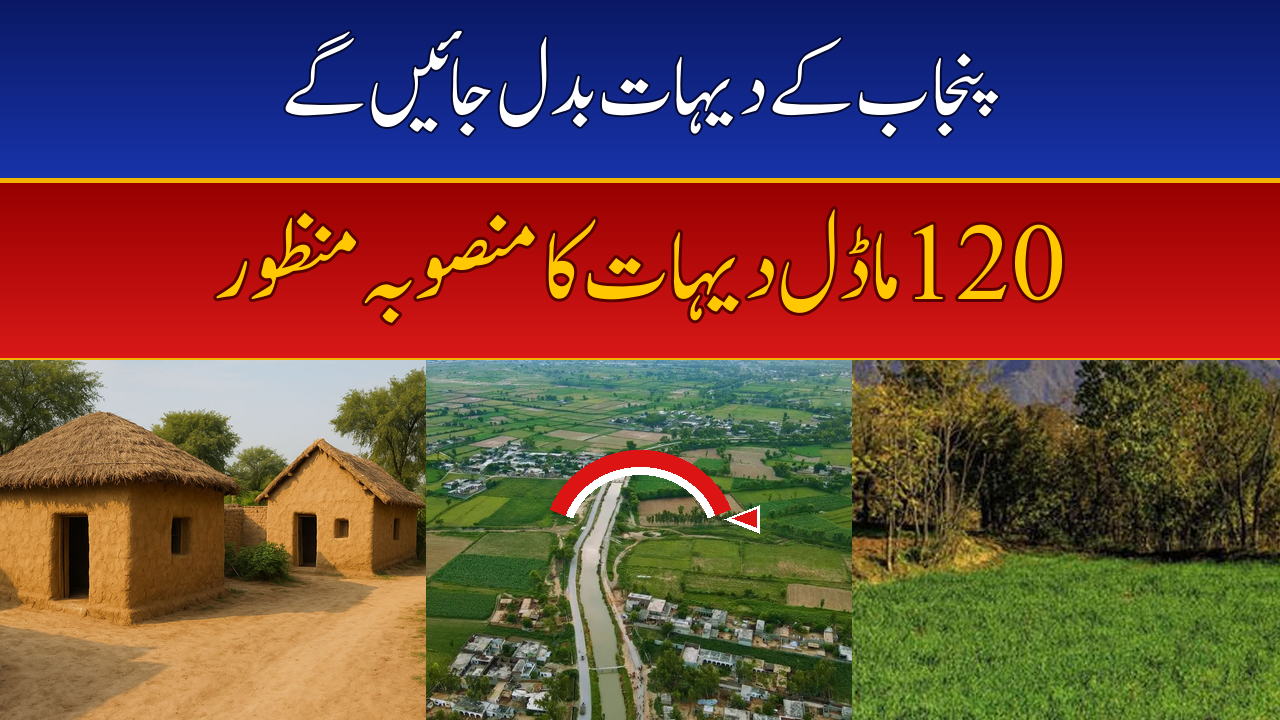
Punjab Chief Minister Maryam Nawaz has approved the Punjab Khushhal Dehat (Prosperous Villages) Act 2026 along with a pilot project that will develop 120 villages across the province as model villages. The decision came at a special meeting she chaired in Lahore on Tuesday, October 20, 2026, where she directed that the pilot begin immediately. Each model village will get proper sewerage, drainage, and paved streets, and a village committee led by the Assistant Commissioner will oversee the transformation.
If you have ever driven through a Punjab village after a night of rain, you know exactly why this announcement matters. The lanes turn to mud, stagnant water sits in the streets for days, and drainage — where it exists at all — is usually an open drain that floods first. Successive governments have promised to fix rural infrastructure, but the development budgets kept flowing to the big cities. This pilot is the first time the province has set a fixed number — 120 villages — with a dedicated committee structure for each one.
What the CM Approved in the Lahore Meeting
The special meeting at Lahore focused entirely on the new legislation and its pilot phase. Along with approving the Khushhal Dehat Act 2026, the chief minister green-lit immediate work on 120 villages that will be developed as model villages. The message from the meeting was unambiguous: this is not a plan that will sit on paper. Work is to start right away.
The CM’s own words at the meeting left little room for doubt about the intent behind the project. She said, “Our resolve to transform all villages into model villages remains unwavering.” The 120 villages are the pilot — the stated end goal is every village in the province.
In a line that is likely to define the political framing of this project, she added: “Development is no longer limited to big cities; its benefits will reach every village.” For the rural voter, that is the promise to remember when the pilot is reviewed.
How Each Model Village Will Be Managed
The administrative design is the most concrete part of what has been announced so far. A village committee will be formed in every one of the 120 villages. The Assistant Commissioner (AC) of the area will head the committee, and the Deputy Commissioner (DC) will oversee the work across all villages in the district.
Each committee will have eight members — four public representatives and four government representatives. The government side has been specified in detail:
| Government Representative | Role on the Committee |
|---|---|
| Headteacher of the village school | Education-side input and community link |
| Union Council (UC) secretary | Local administrative coordination |
| BHU / Maryam Nawaz Health Clinic doctor | Health-side input |
| Other government representatives | As notified by the government |
The mix is deliberate: by seating the school headteacher and the local doctor alongside the UC secretary, the committee brings the village’s own service providers into the decision room. The four public representatives give residents a direct voice — and the chief minister directed that residents must be consulted in the planning of development work, so this is not meant to be a top-down exercise run from the tehsil office.
What Each Village Gets: Sewerage, Drainage, Paved Streets
The pilot covers three headline infrastructure items for every village: a proper sewerage system, a drainage system, and paved streets. Anyone who has lived in a Punjab village knows these three are the difference between a settlement that grows and one that stagnates. Paved streets cut dust and mud; covered drainage ends the cycle of stagnant water and waterborne illness; a sewerage system is something most villages have simply never had.
The chief minister stressed quality and transparency in the execution of the work — a significant emphasis, given how rural development schemes have historically leaked money through overbilling and substandard material. She also assigned a clear political responsibility: Members of the Provincial Assembly (MPAs) and ticket-holders will act as custodians of the projects in their areas, tying their own credibility to the outcome.
This fits the pattern of recent Punjab government moves to push development spending outside Lahore and the other big cities. The province’s industrial planning is already running in parallel — Punjab’s Rs19.95 trillion PIVOT industrial plan targets 162,000 jobs — and the model-villages pilot extends the same outward push to the village level. For a government trying to keep its rural base engaged, model villages are a visible, door-to-door deliverable in a way that industrial zones are not. (Punjab’s festival calendar is also being managed actively — Basant returns to Lahore in March 2027 — but the village project is the one that changes daily life.)
What Has NOT Been Announced Yet
Honesty matters more than hype, so here is what is still missing from the announcement as of Wednesday, October 21, 2026:
- The list of the 120 villages — no district-wise or tehsil-wise list has been released yet. We do not know which villages are in the first phase.
- The budget — no allocation figure has been made public. Per-village cost and the total pilot envelope are unknown.
- The completion schedule — no start date for ground-breaking and no deadline for the pilot’s completion have been announced.
These are the three numbers that will determine whether this is a genuine transformation or another announcement. TimelyUps will update this story as soon as the village list, the budget, and the timeline are released.
Why 120 Villages Could Actually Work
There is a reason seasoned observers of Punjab politics are treating this differently from the usual development announcements. First, the number is small and fixed — 120 villages is a pilot that can be monitored, unlike the old habit of announcing development “across the province” with no measurable target. Second, the AC-DC committee structure gives it an administrative spine: someone is specifically answerable for each village. Third, the resident-consultation directive, if actually followed, would be a real break from the past, where schemes were designed in Lahore and imposed on villages.
The weak points are equally clear. Without a published budget, the quality pledge is just a pledge. Without a village list, no one can verify which areas are being favoured. And rural development in Pakistan has a long history of strong launches and fading follow-through — energy bills, power circular debt and utility pressures (circular debt just hit Rs5.454 trillion) show where the provincial finances are under strain.
For now, though, the facts are straightforward: the Act is approved, the pilot of 120 model villages is ordered to begin immediately, and each village gets a committee, a sewerage system, drainage, and paved streets. The clock starts now — and so does the public’s watch.
Frequently Asked Questions
TimelyUps will keep tracking this story — the village list, the budget, and the first ground-breaking dates. When a village near you makes the list, you’ll read it here first.