Pakistan New Auto Policy 2026: Cheaper Cars, Yearly Duty Cuts, 1% Tax on EVs
By Bilal Ahmed | Updated: 7 November 2026 Pakistan has formally unveiled its new Auto Policy 2026-31, and the headline promise is simple: cars will get cheaper, year after year. Information Minister Attaullah Tarar and Adviser to the Prime Minister on Industries and Production Haroon Akhtar Khan announced the policy at a press conference in…
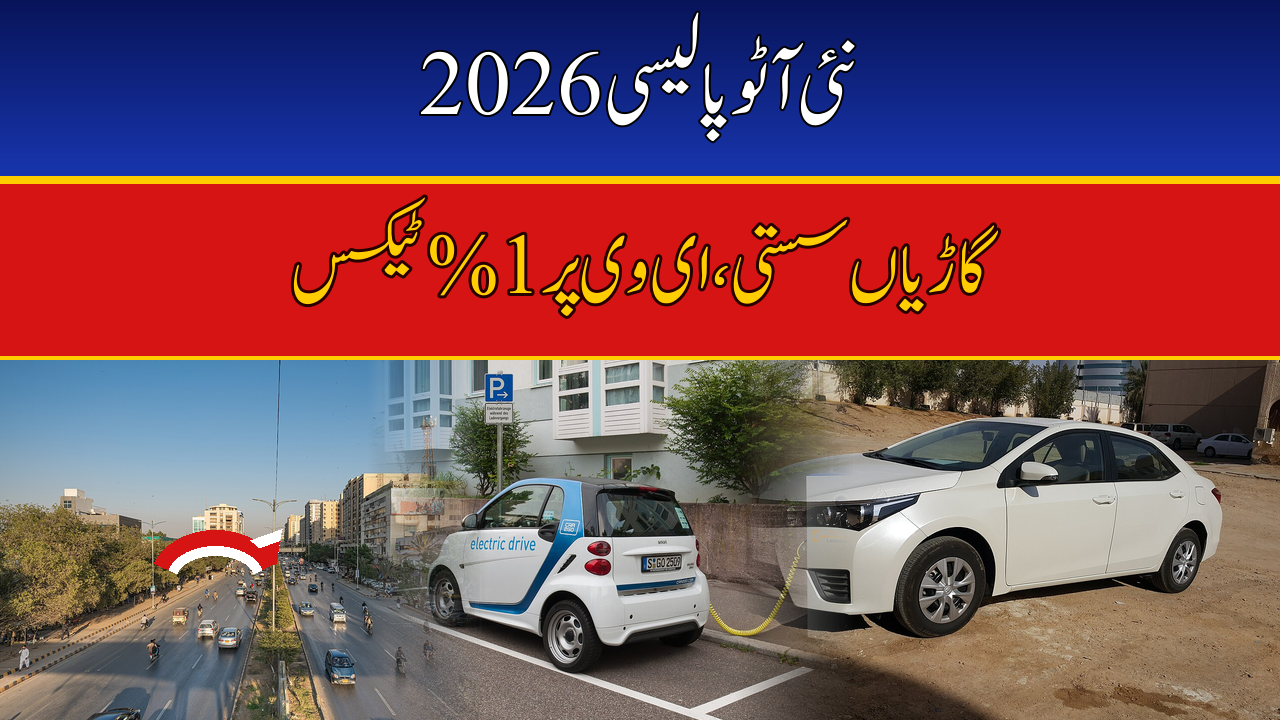
Pakistan has formally unveiled its new Auto Policy 2026-31, and the headline promise is simple: cars will get cheaper, year after year. Information Minister Attaullah Tarar and Adviser to the Prime Minister on Industries and Production Haroon Akhtar Khan announced the policy at a press conference in Islamabad on Saturday, 7 November 2026. Duties on fully built imported cars, assembly plants and components will be cut every year for five years, pure electric vehicles will face just 1% sales tax, and the State Bank’s car-financing limit for EVs jumps from Rs3 million to Rs10 million. But buyers should note one thing clearly: nothing changes at showrooms yet. Cabinet approval is still under way and the EV tax rates need IMF approval first, so the policy is announced, not yet law.
| Key fact | Detail |
|---|---|
| Announced | 7 November 2026, Islamabad — by Information Minister Attaullah Tarar and PM’s Adviser on Industries Haroon Akhtar Khan |
| Policy name | Auto Policy 2026-31 (five-year policy) |
| Six pillars | Cheaper vehicles, exports, localisation, vehicle safety, EVs, transparency |
| Duty cuts | Duties on CBUs, assembly plants and components cut every year for five years, ending at competitive tariffs |
| EV sales tax (proposed) | 1% pure electric, 6% range-extended EVs, 9% hybrids — subject to IMF approval |
| EVs up to $50,000 | No capital value tax, withholding tax or federal excise duty; costlier EVs taxed as luxury |
| EV car financing | SBP limit rises from Rs3 million to Rs10 million for all EVs; loan tenure extended from 3 to 5 years |
| EV target | 30% of new vehicles sold in Pakistan electric by 2030 |
| Safety | 45 safety standards in line with UN WP.29, for locally made and imported used cars |
| Export target | $6 billion in auto exports over five years |
| Status | Announced 7 Nov 2026; cabinet approval under way; EV tax rates subject to IMF approval — not yet in force |
What was announced today
The government presented the policy as a clean break from decades of protection. Tarar told reporters that past policies raised import duties and protected local industry, yet the industry never innovated and never added real value. This time, he said, the policy was drawn up after consultations with all stakeholders, analysis of technical data and a review of global models.
Haroon Akhtar Khan, who presented the main elements, said a lot of work went into drafting the policy and that Prime Minister Shehbaz Sharif had invested a lot of time in it. The process of cabinet approval began today, Tarar added, and the government chose to announce the policy now to end speculation before that approval was complete.
The policy rests on six pillars: cheaper vehicles, especially for the middle class and lower-middle class; encouraging exports; localisation; vehicle safety; promotion of EVs; and transparency. Everything else in the announcement hangs off those six points.
Cheaper cars: duties cut every year for five years
The most important promise for ordinary buyers is the duty path. Duties on completely built units (CBUs), on assembly plants and on components will be reduced each year, eventually reaching competitive tariffs after five years. As manufacturing costs fall, Akhtar said, car prices will follow.
“You will see that prices of cars will come down, the manufacturing cost of automakers will come down; these were the prime minister’s specific instructions. The prices of all vehicles, except luxury vehicles, will come down,” Akhtar said at the briefing.
Two details matter for small-car buyers. First, there is no change for petrol cars under 1,000cc, because many common citizens still use those. Second, lowering the prices of cars below 1,300cc is a special priority for the prime minister, according to the announcement. In other words, the relief is aimed squarely at the small cars most Pakistani families actually buy, not at luxury models.
The government also linked the policy to its wider tariff reform: the prime minister has introduced a tariff policy aimed at lowering the cost of production and the import bill of raw materials. Cheaper inputs mean cheaper locally assembled cars, and that is the mechanism the government is counting on.
The EV package: 1% sales tax, Rs10 million financing, no tax up to $50,000
The electric vehicle package is the most detailed part of the policy, and it is also the part with the biggest condition attached. Three categories of sales tax have been planned: 1% on purely electric vehicles, 6% on range-extended EVs and 9% on hybrid EVs. But Akhtar was explicit that this is subject to approval by the International Monetary Fund, because Pakistan is committed to an IMF programme and the incentives are meant to be revenue-neutral.
The second EV benefit has no such condition mentioned. No capital value tax, withholding tax or federal excise duty will apply to EVs priced up to $50,000. EVs above that price will be treated as luxury items and taxed normally. Buyers comparing electric models should also know the financing change: the State Bank’s car-financing limit, currently Rs3 million for ordinary cars, will be expanded to Rs10 million for all EVs, and the loan tenure will stretch from three years to five years.
The government set a clear target behind all this: 30% of all new vehicles sold in Pakistan should be electric by 2030. Akhtar said that target was “about to happen sooner than that”. The momentum is already visible in two-wheelers. After the New Energy Vehicle Policy 2025-30 was launched, sales of electric two-wheelers rose to 240,000 in FY25-26, up from 60,000 in FY2024-25.
Charging infrastructure gets its own incentives. Sales tax on charging-station equipment has been cut to 1% and customs duty on it removed. The government will also fund the viability gap for charging stations, because the business community sees too little demand to build them while consumers will not switch to EVs until the stations exist. Hybrids and range-extended EVs are meant to bridge that transition period until pure EVs take over.
If you are tracking the EV market, the timing is worth watching. New electric models are already reaching Pakistani showrooms, such as the Jaecoo J5 BEV, launched in Pakistan at Rs5,999,000, and the new policy would make that segment materially cheaper if the IMF signs off.
Exports and localisation: $6 billion target, with penalties
The policy makes localisation mandatory, with targets given to each manufacturer. A rewards-and-penalty system will push exports: carmakers that export will get a 5% Duty Drawback on Local Taxes and Levies (DLTL), with an additional 10% as exports grow. But there is a catch. Carmakers will not get the DLTL unless they achieve both their export target and their local manufacturing target, and if they miss the targets, a penalty will be imposed.
“But if you do not achieve the targets, a penalty will be imposed as well,” Akhtar warned. The government has set an overall target of $6 billion in automobile-related exports over the next five years. The logic, as Akhtar put it, is that the prime minister wants more jobs created in the country through increased plants, and export-linked manufacturing is how the policy tries to deliver that.
The export push also connects to the wider economy. Pakistan’s import bill is under constant pressure, and the government has repeatedly pointed to the need to cut oil imports. Encouraging EVs reduces both carbon emissions and the oil import bill, which feeds straight back into fuel prices for everyone. The trade picture remains tight: Pakistan’s trade deficit widened to $3.88 billion in October 2026, which is the backdrop against which any export target will be judged.
45 safety standards for every car, new or used
Vehicle safety is one of the six pillars, and the policy brings in 45 additional safety standards in line with the United Nations’ WP.29 vehicle regulations. They will apply to cars manufactured in Pakistan and to imported used cars alike.
Akhtar’s claim was bold: “When our vehicles will go through these safety codes, they will be considered the world’s safest vehicles, both manufactured and used.” Whether that holds up will depend on enforcement, but the standard itself is a real change. Pakistani buyers have long complained about locally assembled cars missing safety features that the same models carry abroad, and a WP.29-aligned baseline would close that gap if it is actually applied at the factory gate and at import.
Who pays for the incentives?
Because Pakistan is in an IMF programme, the government says the incentives must be revenue-neutral. The money will come from internal combustion engine vehicles above 1,000cc, with lower- and middle-income groups using cars under 1,000cc exempted. The revenue collected will also fund export rebates and research and development.
That design is deliberate. The people who buy small petrol cars, the group the policy says it wants to help most, are shielded twice: no change to their cars under 1,000cc, and the cost of the EV incentives falls on bigger petrol and diesel vehicles instead.
What does NOT change yet
This is the part buyers should not miss. The policy was announced today, but cabinet approval is still under way. The EV sales-tax rates of 1%, 6% and 9% are proposed and subject to IMF approval. Tarar said the government announced the policy before approval was complete to end speculation, which means the details could still change.
Nothing changes at showrooms yet. No duty has been cut, no tax rate has taken effect, and no financing limit has been raised until the cabinet approves the policy, the IMF clears the tax changes, and the relevant notifications are issued. Anyone planning a purchase should treat today’s announcement as a direction of travel, not a price list.
There is also background worth knowing. The prime minister approved the draft of the policy on 20 October 2026, and that draft proposed tariff caps of 15% by 2030-31. Today’s announcement is the formal public unveiling, and its figures are the ones that count now. In particular, the $50,000 exemption threshold for EVs announced today replaces the higher threshold discussed in the October draft.
What it means for car buyers
For a family planning to buy a small car, the honest answer is: wait and watch. If the duty cuts proceed as announced, prices of non-luxury cars should fall gradually over five years, with small cars under 1,300cc a stated priority. Buying today means paying today’s duties; buying after the first duty cut takes effect means paying less.
For EV buyers, the stakes are bigger and the uncertainty is higher. A 1% sales tax, no CVT, withholding tax or FED up to $50,000, and a Rs10 million loan over five years would transform the maths of owning an electric car. But all of that depends on approvals that have not yet happened. The smart move is to follow the cabinet decision and the IMF response before signing anything.
One more practical point: fuel costs still matter while you wait. Petrol prices move every fortnight, and the latest update is the petrol price for 7 November 2026 at Rs346. An EV saves on fuel, but only if the charging network and the tax package both arrive as promised. The policy tries to deliver both. Whether it does is now a question of approvals and execution, and the next milestone is the cabinet decision.
FAQs
When will car prices actually come down in Pakistan?
Gradually, over five years. Duties on fully built imported cars, assembly plants and components will be cut every year under the new Auto Policy 2026-31, ending at competitive tariffs after five years. Adviser Haroon Akhtar Khan said prices of all vehicles except luxury models will come down. Nothing changes at showrooms yet, because cabinet approval is still under way.
What is the sales tax on electric cars under the new auto policy?
The policy proposes 1% sales tax on pure electric vehicles, 6% on range-extended EVs and 9% on hybrids. This is not final yet. Haroon Akhtar Khan said the rates are subject to approval by the International Monetary Fund, because the incentives must be revenue-neutral under Pakistan’s IMF programme.
Will EVs up to $50,000 really pay no CVT, withholding tax or FED?
That is what the government announced on 7 November 2026: no capital value tax, withholding tax or federal excise duty on EVs priced up to $50,000. EVs above $50,000 will be treated as luxury items and taxed normally. The $50,000 figure is the one announced today, and it is the one that counts.
How much car loan can I get for an EV now?
Under the new policy, the State Bank’s car-financing limit rises from Rs3 million to Rs10 million for all EVs, and the loan tenure extends from three years to five years. This applies to EVs specifically, not to ordinary petrol cars. The change takes effect once the policy is approved and the State Bank issues its instructions.
What is the 30% EV target for 2030?
The government aims for 30% of all new vehicles sold in Pakistan to be electric by 2030. Haroon Akhtar Khan said the target was “about to happen sooner than that”. Electric two-wheeler sales already jumped to 240,000 in FY25-26 from 60,000 in FY2024-25 after the New Energy Vehicle Policy 2025-30.
Will prices of small petrol cars under 1,000cc change?
No. The government said there is no change for petrol cars under 1,000cc, because many common citizens still use those. Lowering prices of cars below 1,300cc is a special priority for the prime minister, and the duty cuts are aimed at non-luxury vehicles. The cost of the EV incentives will be recovered from petrol and diesel vehicles above 1,000cc.
Is the auto policy in force now, or still pending approval?
Pending. The policy was formally unveiled on 7 November 2026, but cabinet approval is still under way and the EV tax rates need IMF approval. Information Minister Attaullah Tarar said the government announced it early to end speculation before approval was complete. Until the cabinet approves it and the notifications are issued, no duty cut or tax change has taken effect.