Pakistan Auto Policy 2026-31 Gets IMF Clearance as PM Approves $6 Billion Export Plan
By Bilal Ahmed | 12 November 2026 Pakistan Auto Policy 2026-31 Gets IMF Clearance as PM Approves $6 Billion Export Plan Prime Minister Shehbaz Sharif has approved Pakistan’s new Autos and Auto Parts Manufacturing Policy 2026-31 after the International Monetary Fund raised no objections to the draft, according to reports published on Thursday, 12 November…
Pakistan Auto Policy 2026-31 Gets IMF Clearance as PM Approves $6 Billion Export Plan
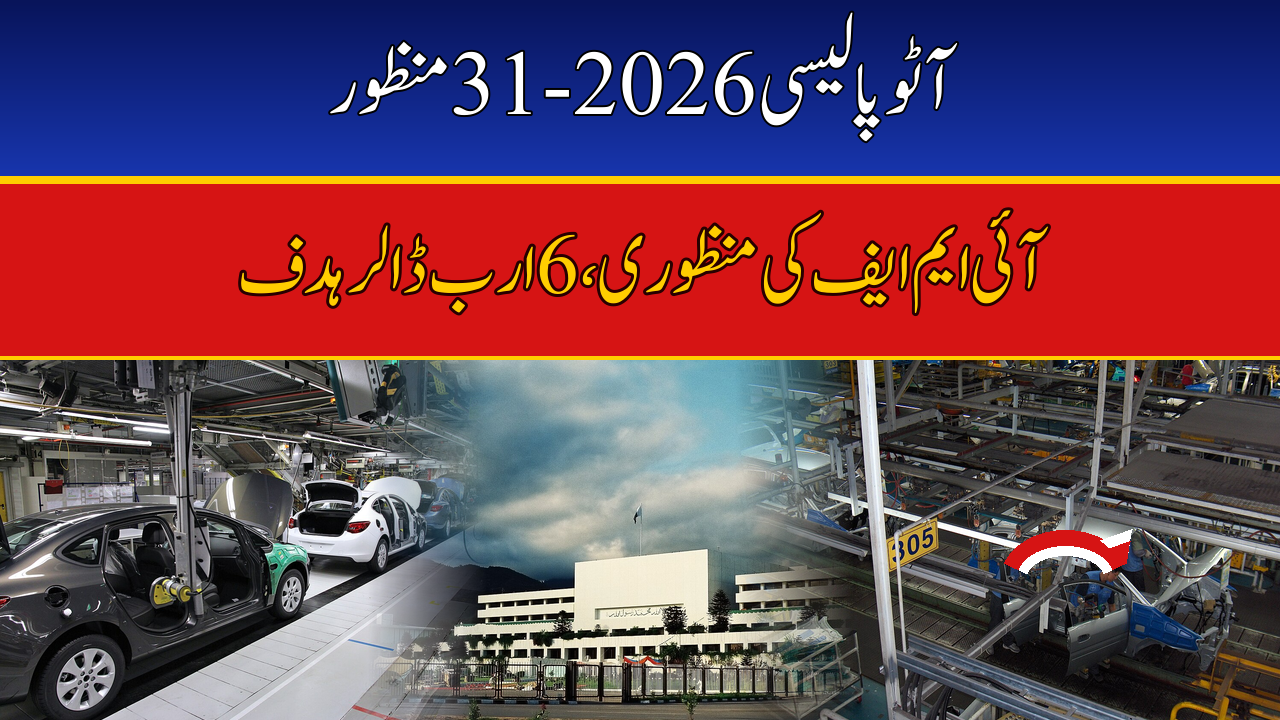
Prime Minister Shehbaz Sharif has approved Pakistan’s new Autos and Auto Parts Manufacturing Policy 2026-31 after the International Monetary Fund raised no objections to the draft, according to reports published on Thursday, 12 November 2026. The policy sets a cumulative export target of about $6 billion over five years, promises roughly $17.7 billion in foreign exchange savings, and will be taken to Parliament as a money bill — effectively a mini-budget — once the federal cabinet signs off.
The clearance removes the biggest hurdle in front of a policy that has been in the works since the previous framework expired on 30 June 2026. But it is not law yet: the draft still needs cabinet approval, and the tax and levy changes in it need Parliament to pass the money bill. For car buyers, that means no price change is coming immediately — the policy is a five-year industrial plan, not a price notification.
| Key Fact | Detail |
|---|---|
| Policy | Autos and Auto Parts Manufacturing Policy 2026-31 |
| Approved by | Prime Minister Shehbaz Sharif (reported 11-12 November 2026) |
| IMF position | No objections raised to the draft shared with the lender, per reports |
| Export target | About $6 billion cumulative, 2026-31 (about $6.01 billion) |
| Forex savings target | About $17.7 billion vs importing vehicles in CBU condition |
| Next steps | Federal cabinet approval, then a money bill in Parliament |
| Midterm review | 2028, with periodic monitoring and corrective measures |
| Replaces | Auto Industry Development and Export Policy 2021-26 (expired 30 June 2026) |
How the Policy Got Here
The government announced the framework at a joint press conference in Islamabad on 7 November, where Information Minister Attaullah Tarar and Adviser to the Prime Minister on Industries and Production Haroon Akhtar Khan presented it. The draft was then shared with the International Monetary Fund, which raised no objection, and the prime minister approved the final policy this week, according to The Express Tribune and ProPakistani, both citing sources familiar with the development.
One point of care is needed here. The clearance is reported on the basis of the government’s account and the reporting of the newspapers that broke the story — the IMF has not itself issued a statement on the policy, and the full policy text has not been published yet. The figures and conditions in this article are therefore the best current picture from reporting on the draft and the adviser’s public statements, not the final legal text.
That matters because the policy’s most consequential parts — the duty structure, the localisation schedules and the penalties — will only become binding when the money bill passes. Until then, the numbers below are what the reporting says the approved draft contains.
What the Policy Aims to Do
The core idea is a shift away from import-dependent assembly towards export-oriented manufacturing. Adviser Haroon Akhtar Khan has described the policy as a comprehensive change of direction: greater localisation, internationally competitive production, and mandatory export obligations for manufacturers instead of the old model of assembling imported kits for the domestic market alone.
The headline numbers explain why the government is pushing it. The policy projects about $6.01 billion in cumulative automotive exports between 2026 and 2031, with auto parts manufacturers expected to make the largest contribution. Against that, it projects cumulative foreign exchange savings of approximately $17.7 billion over the same period, measured against importing the equivalent vehicles in completely built-up (CBU) condition.
The policy also fits a wider commitment Pakistan has made under its National Tariff Policy to lower import tariffs across the economy. The draft describes a simpler duty structure with four slabs — zero, 5, 10 and 15 per cent — although the exact application of those slabs to different vehicle categories will only be clear when the money bill is tabled.
Localisation Targets and the Penalty for Missing Them
The toughest part of the policy for assemblers is the combination of mandatory localisation and export requirements. Manufacturers will have to raise the share of locally made parts in their vehicles on a set schedule, and they will have to meet export targets as well. The reporting on the draft says two consecutive years of failure to meet the export obligation may result in cancellation of the manufacturing certificate, except in cases of force majeure.
That is a deliberately sharp incentive. Under the old policy, assemblers could keep importing kits and selling into a protected domestic market with little pressure to export. The new framework ties the right to manufacture to export performance — and the government has built in periodic monitoring and a midterm review in 2028 to check whether manufacturers are meeting their investment, localisation and export commitments, with corrective interventions where they are not.
For the auto parts industry, the policy is the biggest opportunity in years. If assemblers must localise, parts makers get guaranteed demand; if assemblers must export, parts makers get a route into global supply chains. That is why the reporting expects parts manufacturers to account for the largest share of the $6 billion export target.
What Happens Next — and What It Means for Car Buyers
The sequence from here is straightforward but not instant. First the federal cabinet must approve the policy. Then the government will introduce a money bill in Parliament — described as a mini-budget — to give legal effect to the fiscal measures in it. Only after that bill passes do the duty changes and incentives take effect.
For anyone thinking of buying a car, the honest answer is patience. The policy has the prime minister’s approval and the IMF’s clearance, but it is not yet law, and the duty changes in the draft will take time to reach showroom prices even after the money bill passes. The next few weeks — cabinet, then Parliament — will show how smoothly the policy turns into law.
For the industry, the stakes are higher. Pakistan’s auto sector has spent years as an assembler of imported kits, vulnerable to every rupee slide and every import restriction. The 2026-31 policy is the government’s bet that the sector can instead become an exporter — and the two-year export test, with the manufacturing certificate on the line, is the mechanism meant to make that bet stick. We will update this article when the cabinet approves the policy and when the money bill is tabled in Parliament.
Frequently Asked Questions
Has Pakistan’s Auto Policy 2026-31 been approved?
Yes, in the sense that Prime Minister Shehbaz Sharif has approved the Autos and Auto Parts Manufacturing Policy 2026-31, and the IMF raised no objections to the draft, according to reports published on 12 November 2026. It still needs federal cabinet approval and a money bill in Parliament before it becomes law.
What is the export target of the new auto policy?
About $6 billion in cumulative automotive exports over the five years from 2026 to 2031 — about $6.01 billion in the reporting on the draft — with auto parts manufacturers expected to make the largest contribution.
How much foreign exchange will the auto policy save?
The government projects cumulative foreign exchange savings of approximately $17.7 billion during 2026-31, compared with importing the equivalent vehicles in completely built-up (CBU) condition.
What happens if carmakers miss their export targets?
According to reporting on the draft, two consecutive years of failure to meet export obligations may result in cancellation of the manufacturing certificate, except in cases of force majeure. The policy also provides for periodic monitoring and a midterm review in 2028.
Will car prices fall under the new auto policy?
Not immediately. The policy is not yet law — it needs cabinet approval and a money bill in Parliament first. The draft describes a simpler duty structure with slabs of zero, 5, 10 and 15 per cent, but the effect on showroom prices will only be clear once the money bill is tabled and passed.
What policy does the Auto Policy 2026-31 replace?
It replaces the Auto Industry Development and Export Policy 2021-26, which expired on 30 June 2026. The new framework was announced at a joint press conference in Islamabad on 7 November 2026 by Information Minister Attaullah Tarar and Adviser Haroon Akhtar Khan.
Related: Pakistan to raise over $1 billion from privatisation of five to six entities | Pakistan Minerals Investment Forum 2026 opens in Islamabad | Petrol and diesel prices for November 12, 2026