Government Raises Rs660 Billion in T-Bills Auction Against Rs2.52 Trillion Bids
By Bilal Ahmed | Business Desk | October 15, 2026 | Updated: October 15, 2026 The government raised Rs660.06 billion through the State Bank’s Market Treasury Bills auction on Wednesday, October 14, 2026 — and the headline number is not the raise but the demand. Banks and investors bid a staggering Rs2.52 trillion (Rs2.64 trillion…
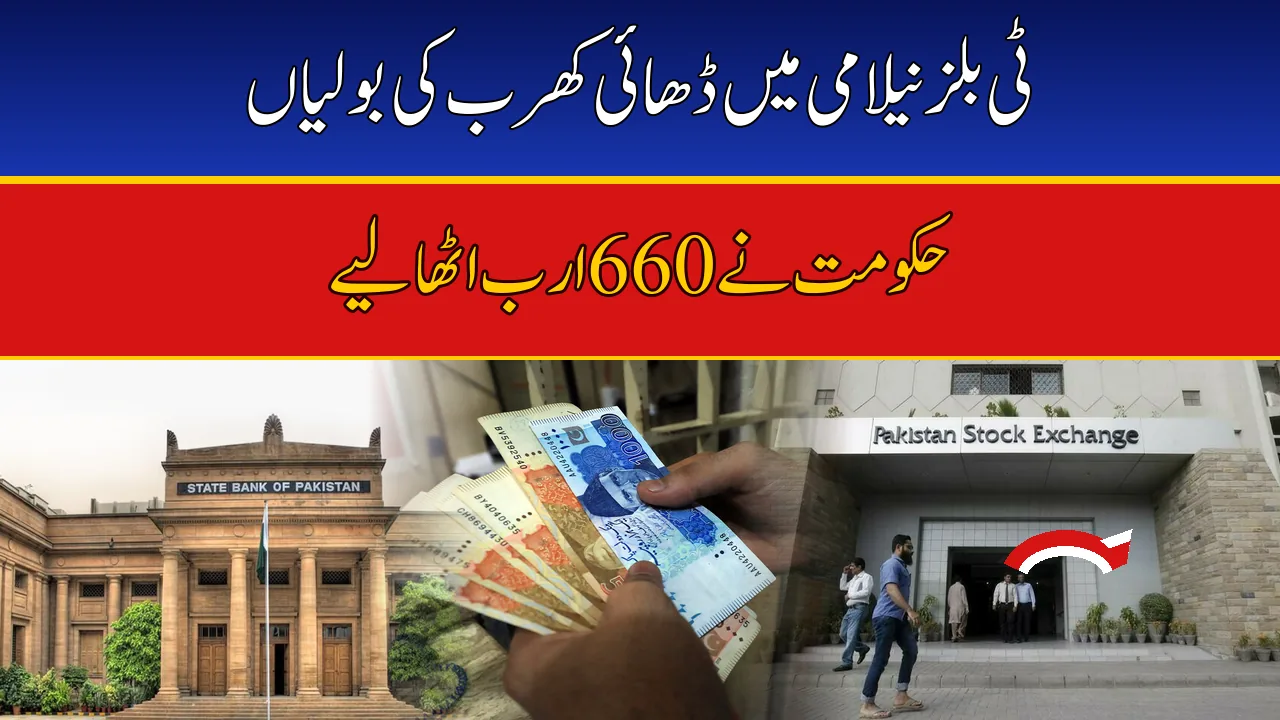
The government raised Rs660.06 billion through the State Bank’s Market Treasury Bills auction on Wednesday, October 14, 2026 — and the headline number is not the raise but the demand. Banks and investors bid a staggering Rs2.52 trillion (Rs2.64 trillion at face value), meaning the auction was oversubscribed nearly four times over. Settlement took place today, October 15.
In plain terms: the government wanted to borrow, and the banks were practically queuing up to lend. That tells you a lot about where Pakistan’s money markets are right now — and what investors expect from the monetary policy announcement due on October 26.
Auction at a Glance
- Raised: Rs660.06 billion (competitive Rs400.36bn realised + non-competitive Rs259.70bn)
- Bids received: Rs2.52 trillion realised (Rs2.64 trillion face) — ~4x oversubscribed
- Held: Wednesday, October 14, 2026 | Settled: October 15, 2026
- Cut-off yields: 1-month 11.5003% | 3-month 11.9999% | 6-month 12.3989% | 12-month 12.4999%
- Tenor split: 1-month Rs112.98bn | 3-month Rs301.86bn | 6-month Rs227.84bn | 12-month Rs17.37bn
- Weighted averages: 1m 11.4307% | 3m 11.8888% | 6m 12.3810% | 12m 12.4500%
- Provincial bids: Rs194.67bn, all in the 3-month tenor on a non-competitive basis
The Numbers in Detail
Of the competitive bids, the government accepted Rs400.36 billion realised (Rs417.61 billion at face value) against bids worth Rs2.52 trillion realised. On top of that came Rs259.70 billion in non-competitive bids — taking the total to Rs660.06 billion.
The 3-month paper was the crowd favourite, drawing Rs301.86 billion, followed by the 6-month tenor at Rs227.84 billion. The 1-month paper took Rs112.98 billion. The 12-month bill, tellingly, got only Rs17.37 billion — investors are not locking in for a full year right now.
One detail worth noting: provincial governments themselves bid Rs194.67 billion, all in the 3-month tenor on a non-competitive basis. When even provinces are parking cash in T-bills, liquidity is clearly sloshing around the system.
A small reporting note: Dawn’s figures put the total slightly higher at Rs685.5 billion (Rs417.6bn competitive plus Rs267.9bn non-competitive) — the difference is the realised-versus-face-value convention. The State Bank-derived realised total of Rs660.06 billion is the cleaner number, and that is what we use here.
Why Banks Are Lending This Much
This was the last T-bills auction before the monetary policy announcement on October 26, and that timing explains the stampede. With the policy rate at 11.5%, cut-off yields on the 3, 6 and 12-month papers all came in above the policy rate — 11.9999%, 12.3989% and 12.4999% respectively. In other words, banks are being paid more to park money with the government than the policy rate would suggest.
Why would banks demand more? Because they are parking liquidity amid uncertainty. When you are unsure which way rates move on October 26, you keep your money short — hence the dominance of the 1, 3 and 6-month tenors and the near-total avoidance of the 12-month paper. Short tenors mean you get your money back quickly if the policy picture changes.
There is also a bigger story here. T-bill yields rising above the policy rate is the market’s way of saying it expects tighter conditions, or at least does not expect rate cuts any time soon. Banks are demanding a premium for locking in government paper — and the government, which needs the borrowing, is paying it.
What This Means for Ordinary Savers
You are not bidding at T-bill auctions, but this auction still touches your pocket:
Bank deposit rates. When banks can earn 12%+ lending to the government risk-free, they have little incentive to pay you more on savings accounts. High T-bill yields are part of why your savings account still feels stingy.
National Savings Schemes. NSS profit rates track government borrowing costs. Persistent high yields at T-bill auctions are a signal, not a promise — but they shape the environment in which NSS rates get reviewed.
Business borrowing. Everything private borrowers pay is priced off government paper. If the government itself is paying 12%+, loans for businesses — and eventually consumers — do not get cheaper. That is the trade-off of heavy government borrowing: the state crowds out everyone else.
Your takeaway: if you have idle cash and a low risk appetite, this is a decent environment for short-term government instruments. Just understand you are lending to a government that is borrowing very, very heavily — and ask your bank or advisor about the exact products available to individuals.
The Crowding-Out Problem, Honestly
Let me say the quiet part out loud. A 4x oversubscribed auction sounds like a success — the government raised what it wanted. But it is also a symptom. Rs2.52 trillion of bids means the banking system has enormous liquidity and would rather lend it to the state at 12% than lend it to businesses, farmers and manufacturers.
That is rational for each individual bank and corrosive for the economy as a whole. Every rupee a bank puts in a T-bill is a rupee not financing a factory, a trader’s working capital or a new business. Pakistan has lived with this crowding-out for years, and auctions like Wednesday’s show it is not going away.
The October 26 monetary policy decision will tell us whether the State Bank sees the same picture the market sees. If rates hold or rise, expect more auctions exactly like this one.
Frequently Asked Questions
How much did the government raise in the October 14 T-bills auction?
The government raised Rs660.06 billion in total: Rs400.36 billion in competitive bids (realised value) plus Rs259.70 billion in non-competitive bids. Total bids received were worth Rs2.52 trillion realised, making the auction nearly four times oversubscribed. Settlement was October 15, 2026.
What were the cut-off yields in the latest T-bills auction?
The cut-off yields were 11.5003% for the 1-month bill, 11.9999% for the 3-month, 12.3989% for the 6-month and 12.4999% for the 12-month paper. Weighted average yields were slightly lower: 11.4307%, 11.8888%, 12.3810% and 12.4500% respectively.
Why are T-bill yields above the SBP policy rate of 11.5%?
Banks are demanding a premium to lock in government paper ahead of the October 26 monetary policy announcement. Yields above the policy rate signal that investors expect rates to stay elevated — or at least see enough uncertainty to want extra compensation for lending.
Why did investors prefer short-term T-bills?
The 3-month tenor drew the most (Rs301.86bn) while the 12-month paper got only Rs17.37bn. Before a policy announcement, investors park money short so they can redeploy quickly once the rate direction is clear. Short tenors are a classic uncertainty trade.
What are non-competitive bids in a T-bills auction?
Non-competitive bids are accepted at the auction’s weighted average yield rather than a bid yield. They are typically used by eligible investors — including provincial governments, which bid Rs194.67bn this time — who want guaranteed allocation without competing on price.
When is the next monetary policy announcement?
The State Bank of Pakistan’s next monetary policy announcement is scheduled for October 26, 2026. The October 14 T-bills auction was the last one before that decision, which is why its yields are being read as a market signal.
Do high T-bill yields affect my savings account?
Indirectly, yes. When banks earn 12%+ lending risk-free to the government, they feel little pressure to raise deposit rates for savers. High T-bill yields also influence National Savings Scheme profit rates and the cost of business borrowing across the economy.