Punjab Smog Crisis: Multan AQI 719, Lahore 530 as Hospitals Fill Up
Punjab is choking. Multan recorded an air quality index of 719 on Saturday, the worst reading anywhere in the province, while Lahore stood at a hazardous 530, and hospitals in Rawalpindi alone received 2,961 patients with smog-related illnesses in just 48 hours. With no rain expected for the next three days, officials fear the pollution…

Punjab is choking. Multan recorded an air quality index of 719 on Saturday, the worst reading anywhere in the province, while Lahore stood at a hazardous 530, and hospitals in Rawalpindi alone received 2,961 patients with smog-related illnesses in just 48 hours. With no rain expected for the next three days, officials fear the pollution will only get worse.
The smog has settled over Punjab’s five major cities, including the twin cities of Rawalpindi and Islamabad, and this time the numbers are not just bad, they are off the scale. Anything above 300 on the air quality index is classed as hazardous. Multan, at 719, is more than twice that threshold, and Lahore, Gujranwala and Jhang are all in the same dangerous territory. Even Islamabad, usually the cleanest of the big cities, is breathing unhealthy air.
Doctors are seeing the damage in real time. Elderly patients, people with asthma and anyone with weak lungs are turning up at hospitals in large numbers, and the queues at outpatient departments and emergency wards are growing longer. Health experts are asking everyone in Punjab, especially the elderly and children, to wear masks outdoors and stay inside as much as possible until the air clears.
| City | AQI reading | Level |
|---|---|---|
| Multan | 719 | Extremely alarming |
| Jhang | 678 | Hazardous |
| Gujranwala | 600–660 | Hazardous |
| Lahore | 530 | Hazardous |
| Faisalabad | 371 | Hazardous |
| Islamabad | 187 | Unhealthy |
| Rawalpindi | 179 | Unhealthy |
| Murree | 123 | Unhealthy for sensitive groups |
Multan 719: the worst air in Punjab
Multan’s reading of 719 is the single most alarming figure in this smog episode. It is not a one-day spike, either. A day earlier, on November 6, Multan had already recorded 719, which means the city has now spent two straight days at a level of pollution that is more than double the hazardous threshold.
At these levels the air is dangerous for everyone, not just for people with breathing problems. Healthy adults are advised to avoid outdoor exercise entirely, and any time spent outside should be kept as short as possible. For a city the size of Multan, where millions of people live, work and travel outdoors every day, that is a near-impossible instruction, and it is why hospitals are already feeling the strain. Jhang recorded 678, Gujranwala sat between 600 and 660, and Faisalabad, at 371, is the lowest of the badly hit cities, yet still well past the hazardous mark. Taken together, the readings show a blanket of pollution covering central and southern Punjab, with no city in the region escaping it.
Lahore 530: world’s most polluted city again
Lahore’s air quality index stood at 530, a figure that once again put the city at the top of the global pollution rankings. According to IQAir, Lahore was ranked the world’s most polluted major city on November 6 with an AQI of 458. The latest reading of 530 is worse still.
The picture inside the city is just as grim. On November 6, several Lahore neighbourhoods recorded readings around 500, including Kahna Nau, Multan Road and Safari Park, while Gulberg III stood at 483. Provincial monitoring data showed Lahore at 430 at 7am on November 6, a jump of 70 points in a single day, with Kasur close behind at 462.
Lahore has been here before, topping the same global rankings during another severe smog spell only last month. You can read our earlier report on Lahore topping the world’s most polluted city list in October to see how the crisis has built up over the past few weeks.
What makes this episode different is the spread. In previous years the worst of the smog was concentrated in Lahore and its surroundings. This time Multan, Jhang and Gujranwala are recording even higher numbers than the provincial capital, which tells us the problem has grown into a province-wide emergency.
Hospitals fill up: 2,961 patients in 48 hours in Rawalpindi
The human cost of the smog is now showing up in hospital wards. In the past 48 hours, 2,961 patients suffering from smog-related ailments visited the outpatient departments and emergency wards of Rawalpindi’s three allied hospitals, according to a report in The Express Tribune.
The patients came in with respiratory problems, asthma attacks, sore throats, eye irritation, cold and cough, the classic set of complaints that follow heavy smog exposure. Most of them were elderly residents, the group doctors worry about most when the air turns toxic.
The figure covers just three hospitals in one city, over only two days. It does not include patients who visited private clinics or pharmacies, nor Lahore, Multan, Gujranwala or Faisalabad, where the air is considerably worse than in Rawalpindi. The true number of people made ill across Punjab is almost certainly far higher.
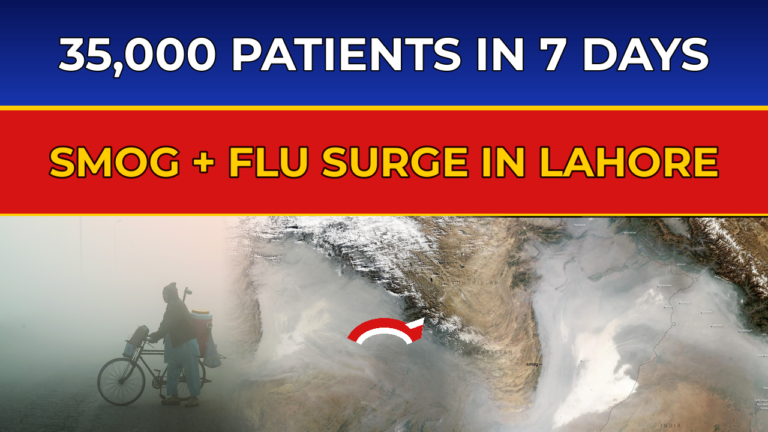
Hospitals in Lahore have been under similar pressure in recent smog spells. Earlier this season, Lahore hospitals reported 35,000 flu-like patients as smog tightened its grip, a reminder that the health system is dealing with a recurring seasonal surge, not a one-off event.
Doctors say the pattern is predictable. The first wave is sore throats, irritated eyes and coughs. Then come the asthma attacks and breathing emergencies, mostly among the elderly and children. If the smog drags on for a week or more, the wards start to see patients with chest infections and aggravated heart conditions.
What is causing the smog?
The Environmental Protection Department has pointed to a familiar list of culprits behind the crisis. Brick kilns, stone crushers and industrial emissions are pumping pollutants into the air around the clock. Vehicle exhaust adds to the load on every major road in the province. Crop-residue burning in the fields sends up thick smoke that drifts across cities. And in some places, black oil is being extracted by burning discarded tyres, one of the dirtiest practices on the list.
None of these is new, and that is part of the problem. The same sources are named every smog season, and every season the readings climb a little higher. Brick kilns operate around Lahore, Multan and Faisalabad. Industrial units cluster along the same corridors. Stubble burning peaks in exactly these weeks, as the harvest season ends and farmers clear their fields. The result is a cocktail of smoke, dust and chemical pollutants that hangs over the plains because the winter air is still and cold, trapping everything close to the ground. Enforcement against kilns, crushers and tyre-burning remains the most direct lever the authorities have.
No rain for three days, and it could get worse
The most worrying part of the forecast is what is not in it. Authorities fear the pollution could rise further if there is no rainfall in the next three days, and at the moment no rain is expected. Without rain to wash the pollutants out of the air, and without wind to disperse them, the smog will simply keep building on itself.
Each dry, still day adds another layer of smoke and dust to the air, and the readings climb a little higher. The jump in Lahore’s AQI by 70 points in a single day shows how quickly things can deteriorate when the weather offers no relief.
For the latest outlook on the weekend weather, including whether any rain is on the way, see our Pakistan weather forecast for Sunday, November 8. If the dry spell continues, expect the AQI numbers to stay in the hazardous range, and expect hospital visits to keep climbing.
How to protect yourself during the smog
Health experts are giving the same advice they give every smog season, and it is worth following carefully while the readings stay this high. Wear a mask whenever you step outside, and if you have an N95 mask, use it, since ordinary cloth masks offer limited protection against the fine particles in smog. Limit outdoor exposure as much as you can, especially in the morning and evening when the haze is thickest.
Children and elderly people should stay indoors as far as possible, and anyone with asthma or another respiratory condition should keep their inhaler or medicine close at hand and avoid outdoor exercise entirely. If you develop a persistent cough, wheezing, chest tightness or eye irritation that does not clear up indoors, see a doctor rather than waiting it out.
At home, keep windows and doors closed during the worst hours. People who travel by motorcycle are exposed to the worst of the air, so a mask and, if possible, eye protection are essential for them.
What happens next
The next three days will decide how bad this smog episode gets. If rain arrives, the air will clear quickly, as it has in past years. If the dry spell continues, the readings in Multan, Lahore, Jhang and Gujranwala are likely to climb further, and hospitals will see more patients. The coming days will show whether enforcement against the sources named by the Environmental Protection Department makes a difference this time. For now, the advice for everyone in Punjab is simple: stay indoors when you can, wear a mask when you cannot, and watch out for the elderly and children around you.
We will keep updating this story as new AQI readings and hospital figures come in.
FAQs
What is the AQI in Multan today?
Multan recorded an AQI of 719, the highest reading in Punjab and more than double the hazardous threshold of 300. Multan had already recorded 719 the previous day, on November 6, making it two consecutive days at that extreme level.
What is the AQI in Lahore today?
Lahore’s AQI stood at 530, in the hazardous range. A day earlier, on November 6, Lahore was ranked the world’s most polluted major city by IQAir with an AQI of 458, and some neighbourhoods including Kahna Nau, Multan Road and Safari Park recorded readings of 500.
How many people have fallen ill because of the smog?
In the past 48 hours, 2,961 patients with smog-related ailments visited the outpatient and emergency departments of Rawalpindi’s three allied hospitals. They suffered from respiratory problems, asthma, sore throats, eye irritation, cold and cough, and most of them were elderly.
Why is Punjab’s smog so bad right now?
According to the Environmental Protection Department, the main causes are brick kilns, stone crushers, industrial emissions, vehicle exhaust, crop-residue burning, and the extraction of black oil by burning discarded tyres. Cold, still winter air traps the pollutants close to the ground, and with no rain expected, the smog keeps building up.
Will it rain in Punjab in the next three days?
No rainfall is expected in the next three days, and authorities fear the pollution could rise further without rain to wash the pollutants out of the air. Check our latest weather forecast for updates on when rain may arrive.
Is it safe to go outside during the smog?
Health experts advise wearing a mask outdoors and limiting outdoor exposure as much as possible, especially for children, the elderly and people with asthma or breathing problems. Avoid outdoor exercise while AQI readings stay above 300, and see a doctor if you develop a persistent cough, wheezing or chest tightness.
Which cities in Punjab have the worst air quality?
Multan is the worst at 719, followed by Jhang at 678, Gujranwala at 600 to 660, Lahore at 530 and Faisalabad at 371. Islamabad recorded 187, Rawalpindi 179 and Murree 123, which are lower but still unhealthy.
By Daniyal Sheikh | Updated: 7 November 2026