PEMRA Bars Live Coverage of Blasts, Firing and Terrorist Attacks — Verified Info and Time Delay Only
By Fatima Raza · Pakistan Desk · Updated October 15, 2026 Pakistan’s media regulator has told every satellite television channel in the country to stop the broadcast, re-broadcast and live coverage of explosions, blasts, firing incidents and terrorist attacks. The Pakistan Electronic Media Regulatory Authority (PEMRA) issued the notification on October 13, 2026, directing channels…
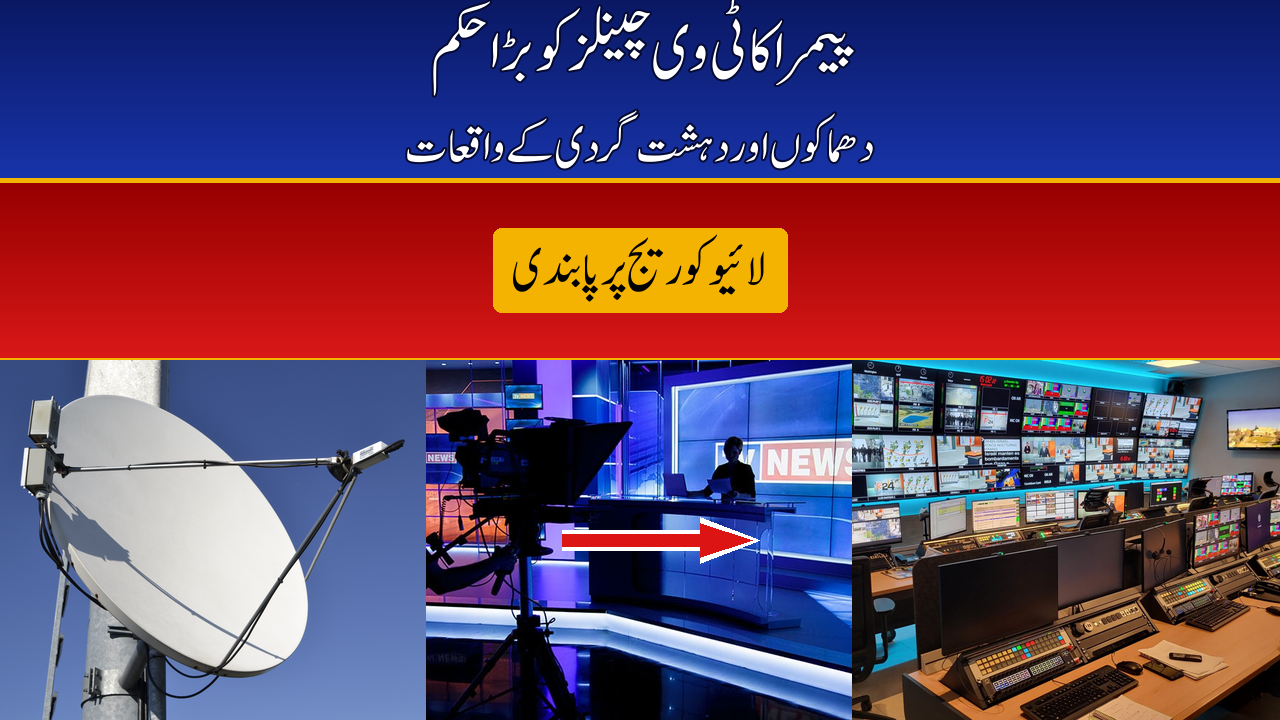
Pakistan’s media regulator has told every satellite television channel in the country to stop the broadcast, re-broadcast and live coverage of explosions, blasts, firing incidents and terrorist attacks. The Pakistan Electronic Media Regulatory Authority (PEMRA) issued the notification on October 13, 2026, directing channels to air only verified information warranted by the concerned department or law enforcement agency, to use a time-delay mechanism effectively, and warning that violations will invite legal action under Sections 29-A, 30 and 33 of the PEMRA Ordinance 2002.
Quick facts
- Order date: October 13, 2026 (reported October 14, 2026)
- Issued by: Pakistan Electronic Media Regulatory Authority (PEMRA)
- Applies to: All satellite TV channel licensees — news, current affairs and regional-language channels
- Bans: Broadcast, re-broadcast and live coverage of any “unfortunate/unpleasant incident such as explosion, blast, firing, terrorist attack etc.”
- Also requires: Verified information only, effective time-delay mechanism, independent editorial board
- Penalty reference: Sections 29-A, 30 and 33 of the PEMRA Ordinance, 2002 (as amended)
What the PEMRA order actually says
The notification, a copy of which was seen by Dawn, is addressed to all satellite TV channel licensees. Its central directive is blunt: channels must “refrain from broadcast, re-broadcast and live coverage of any unfortunate/unpleasant incident such as explosion, blast, firing, terrorist attack etc.”
That one line is doing several things at once. It covers the initial live transmission, any repeat of it, and the practice of rolling live coverage — the marathon breaking-news broadcasts that run for hours after an incident. In their place, the regulator wants restraint: “satellite TV channels must broadcast only such verified information, warranted by the concerned department/law enforcement agency.”
In other words, the story can still be reported. But it should be reported once facts are confirmed by the authorities actually dealing with the incident — the police, the counter-terrorism departments, the rescue services — rather than on the basis of unverified eyewitness claims or speculation aired in real time.

The time-delay mechanism and the editorial board
The order also pushes channels to “effectively use time delay mechanism.” This is the broadcast delay — typically a matter of seconds to a few minutes — that lets a control room cut away from live footage before anything graphic or unverified reaches the audience. PEMRA has been asking for this for years; the new notification frames it as an obligation, not a suggestion.
Equally significant is the instruction to constitute an independent editorial board. The order ties this to three things: the provisions of PEMRA laws, the Supreme Court’s judgment in the 2018 suo motu case, and the Islamabad High Court’s order of September 5, 2022 on the proper utilisation of the prescribed procedure regarding the delay mechanism.
The February 20, 2023 directive — a similar prohibition on live coverage of such incidents — is explicitly reiterated, which tells you the regulator believes the earlier order was not fully complied with. The October 13 notification is, in effect, the reminder with teeth.
Why this order is coming now
The notification lands at a moment of acute security pressure. Days earlier, on October 11, the federal government imposed emergency and governor’s rule in Khyber-Pakhtunkhwa, citing a sharp rise in terrorist incidents and violent activities in the province. The presidential proclamation said attacks on infrastructure, government installations and law-enforcement agencies had increased, and described the provincial government’s response as inadequate.
Security reports presented to the federal cabinet put numbers to the deterioration: terrorist incidents in K-P increased by 195 per cent between March 1, 2024 and September 23, 2026, with 73 per cent of the attacks recorded in 2026 targeting police and security personnel. Balochistan has also seen a sharp escalation — violence-linked fatalities there rose from 265 to 829 in the third quarter of 2026, according to the Centre for Research and Security Studies, while K-P recorded 186 violent incidents in the same quarter, about 48 per cent of all attacks nationwide.
Regulators in Pakistan have long argued that live coverage of terror incidents creates its own problems — unverified casualty figures, the broadcast of graphic scenes, and, critically, the possibility that attackers themselves are watching the coverage and adjusting their actions in real time. Whether the industry accepts the full logic or not, the pattern is familiar: a security crisis is followed by a reminder to the media to keep its distance from the blast site, at least in live mode.
What it means for newsrooms, in practice
For channel editors, the order raises three practical questions that will matter more than the press release does.
First, what counts as verified? The notification says information “warranted by the concerned department/law enforcement agency.” In practice that means the official version — the police spokesperson, the ISPR statement, the rescue authority’s casualty figures. Reports from stringers, citizen video and eyewitness accounts will need to be cross-checked against those sources before airing, which slows the news cycle by design.
Second, how real is the time delay? Most Pakistani channels already run some form of delay on live transmissions, but its enforcement has been patchy. The explicit reference to the Supreme Court and Islamabad High Court orders suggests the regulator expects documented, functional delay systems — and can now point to court backing if a channel claims otherwise.
Third, who sits on the editorial board? The requirement for an independent editorial board has been in PEMRA’s rulebook for years without consistent compliance. Repeating it in this notification puts it back on the compliance checklist, and channels that have treated it as optional may now find it enforced.
What viewers will notice
If you are someone who switches on the news when something happens, the change will be subtle but real. You will see fewer shaky live feeds from cordoned-off blast sites, fewer anchors narrating events they can only half-see, and slower casualty figures — which, in the early minutes of an incident, is usually a sign that the numbers are being verified rather than invented.
That is not a bad trade. The early minutes of any attack are when misinformation moves fastest, and a screen full of speculation has never helped anyone. What matters now is whether channels follow the verification discipline the order demands, and whether the regulator applies its own penalty clause consistently — because a rule that is enforced selectively is no rule at all.
Also read on TimelyUps
- Pakistan Stops Issuing Machine-Readable Passports From Today — E-Passports Only From October 15, 2026 — another major regulatory change taking effect this week.
- More Pakistan news — the latest policy, security and governance stories from across the country.
Frequently asked questions
Has PEMRA banned all coverage of terrorist attacks?
No. The October 13, 2026 notification bans the broadcast, re-broadcast and live coverage of explosions, blasts, firing and terrorist attacks — but channels can still report such incidents using verified information from the concerned department or law enforcement agency.
Which channels does the order apply to?
All satellite TV channel licensees, including news, current affairs and regional-language channels. The notification explicitly reiterates PEMRA’s earlier prohibition order of February 20, 2023.
What happens if a channel violates the order?
PEMRA has warned that legal action will be taken under Sections 29-A, 30 and 33 of the PEMRA Ordinance, 2002 (as amended) in case of any violation.
What is the time-delay mechanism PEMRA is asking for?
A short broadcast delay — typically seconds to a few minutes — between what a channel’s cameras capture and what goes on air, so the control room can cut away from graphic or unverified material. The order cites the Supreme Court’s 2018 suo motu judgment and the Islamabad High Court’s September 5, 2022 order on its proper use.
Does the order require channels to set up an editorial board?
Yes. It directs channels to ensure the constitution of an independent editorial board in accordance with PEMRA laws, the Supreme Court judgment in suo motu case No 28 of 2018, and the Islamabad High Court order of September 5, 2022.