Pakistan’s Satellite Internet Framework Nears Completion — Starlink’s Door Opens
Pakistan is in the final phases of completing its satellite internet licensing framework, the federal IT minister announced on October 13 — a move that opens the door for operators like SpaceX’s Starlink, Eutelsat OneWeb and Amazon’s Project Kuiper. One thing to be absolutely clear about: Starlink has NOT been licensed yet. The framework has…
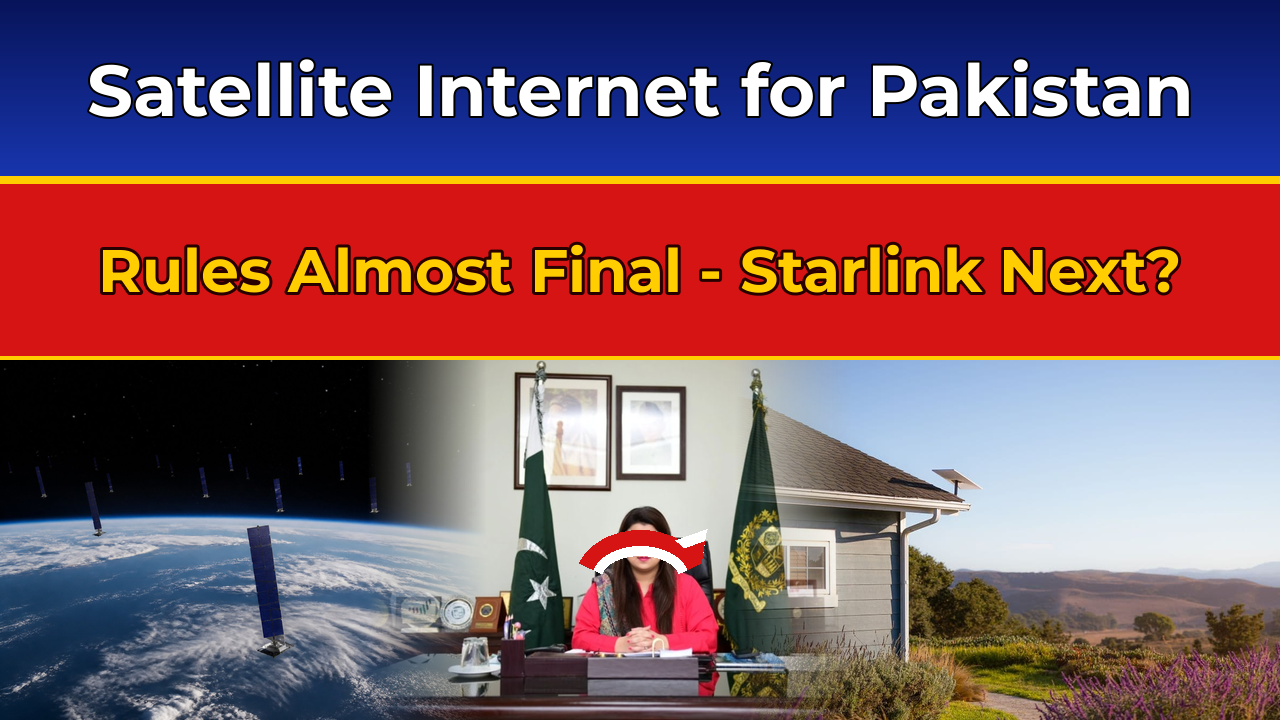
Pakistan is in the final phases of completing its satellite internet licensing framework, the federal IT minister announced on October 13 — a move that opens the door for operators like SpaceX’s Starlink, Eutelsat OneWeb and Amazon’s Project Kuiper. One thing to be absolutely clear about: Starlink has NOT been licensed yet. The framework has to be finished first. But the door, which has been shut for years, is now visibly ajar.

What the minister actually announced
Federal IT and Telecommunication Minister Shaza Fatima Khawaja made the announcement at the Asia-Pacific Telecommunity (APT) Symposium on Digital Transformation and the Universal Service Fund, held in Islamabad on October 13, 2026. Her message was that Pakistan is finalising the regulatory regime for low-earth-orbit satellite internet services, and that the government’s posture is deliberately business-friendly — the goal, in her words, is frictionless entry for global operators.
The centrepiece is the Fixed Satellite Services (FSS) licensing framework, which is now almost complete. If you’ve followed Pakistan’s telecom licensing history, you’ll know that getting a licence here used to mean knocking on multiple doors at multiple agencies. The new FSS route is designed as a single window, replacing the tangle of separate licences that made satellite entry a bureaucratic marathon. For companies like Starlink, which have been circling Pakistan for years, that is the single biggest change in the game.
Who could come in — and under what terms
The framework is technology-neutral: it covers LEO, MEO and GEO operators. The names on everyone’s lips are SpaceX Starlink, Eutelsat OneWeb, Amazon Project Kuiper and Shanghai Spacecom Satellite Technology — all are in the government’s sights as potential entrants. Licences are proposed as 15-year, non-exclusive permits, which means more than one operator can hold one at the same time. Competition from day one, in other words.
There are strings attached, and they are the ones that matter most in Islamabad. Operators will have to comply with data-sovereignty requirements, set up local gateways, and meet national-security conditions. This is standard practice in most countries — satellite operators route traffic through local ground stations so that regulators can enforce lawful intercept and data localisation rules. For Pakistani users, the practical effect is that the service will be fast but not unmonitored. Anyone hoping for internet beyond the reach of the PTA will be disappointed.
What it could mean for people stuck on slow connections
Here’s where it gets interesting for ordinary Pakistanis. Roughly half the country still has poor or no broadband, and fibre reaches a shockingly small number of homes. Fibre broadband home passes were under 3 million in 2024 and have only recently crossed 5 million. Fibre-connected mobile towers have inched from 15% to 19%, with a government target of 60%. Those numbers tell you why satellite matters: in mountain valleys, deserts and remote villages, stringing fibre or building towers often doesn’t add up economically. A satellite dish does.
Think of a school in a remote district of Balochistan, or a small business in upper Khyber Pakhtunkhwa, suddenly able to get high-speed connectivity without waiting years for a tower. That’s the promise. Starlink’s experience in other developing markets suggests the service typically costs more than mobile data, so it won’t replace everyone’s 4G plan — but for the unserved, it fills a gap nothing else can fill quickly.
Why the timing makes sense
The announcement didn’t come out of nowhere. Pakistan’s digital-infrastructure story has quietly picked up speed. Three new submarine cables have landed in the last two and a half years, the Universal Service Fund has laid more than 17,000 kilometres of optical fibre, and the 5G auction of 480 MHz of spectrum went through in March 2026. On the demand side, there’s a genuinely striking number: the gender gap in mobile internet use has collapsed from 38% to 8%, which the GSMA calls the fastest improvement anywhere in the world in two years.
So the satellite framework is the missing piece of a bigger jigsaw — international cables, fibre backbone, 5G spectrum, and now, finally, a regulated route for space-based connectivity. Whether you care about the tech or not, it’s hard to argue the sequencing is wrong.

The part everyone should read twice: not approved yet
Let’s be careful, because hype is already running ahead of reality. Starlink is not licensed in Pakistan. No satellite internet operator is licensed in Pakistan. What the minister announced is that the framework — the rules of the game — is nearing completion. Licensing comes after. Regulatory processes in Pakistan have a habit of stretching, and the national-security compliance requirements are exactly the kind of thing that can add months of negotiation with an operator like SpaceX.
My honest read: this is real progress, not a photo op. The FSS single-window structure addresses the specific bottleneck that kept operators out. But nobody should buy a dish online just yet, and anyone selling “pre-booked Starlink connections” in Pakistan right now is selling you something that doesn’t exist. Wait for the framework to be notified and the licences to be issued — that is the actual finish line.

What happens next
The next milestone is the formal notification of the completed FSS framework, after which operators can apply and the PTA can begin issuing licences. The realistic timeline, given past regulatory practice, is measured in months rather than weeks.
For a country where the digital divide still maps almost perfectly onto the geographic map, this is one of the more consequential telecom announcements of the year. The rules are nearly done. The satellites are already overhead. Now it’s a question of paperwork catching up with physics.
Frequently asked questions
Is Starlink approved in Pakistan?
No. Starlink has NOT been licensed in Pakistan. IT Minister Shaza Fatima Khawaja announced on October 13, 2026 that the satellite internet licensing framework is in its final phases. Only after the framework is completed can operators like Starlink apply for licences.
What is the FSS licensing framework?
The Fixed Satellite Services (FSS) framework is a proposed single-window licensing route for satellite internet operators in Pakistan, replacing the previous system that required multiple separate licences. It covers LEO, MEO and GEO operators with proposed 15-year non-exclusive licences.
Which companies could offer satellite internet in Pakistan?
The framework is designed for operators including SpaceX Starlink, Eutelsat OneWeb, Amazon Project Kuiper and Shanghai Spacecom Satellite Technology. All would need data-sovereignty, local-gateway and national-security compliance before receiving licences.
Why does Pakistan need satellite internet?
Fibre broadband reaches only about 5 million homes and just 19% of mobile towers are fibre-connected, leaving remote areas with poor connectivity. Satellite internet can reach mountain valleys, deserts and villages where building towers or laying fibre is not economically viable.
When will satellite internet be available in Pakistan?
There is no confirmed date. The framework is in its final phases; formal notification must follow, then operators apply and the PTA issues licences. The realistic timeline is months rather than weeks, given national-security compliance requirements.
Will satellite internet replace mobile data?
Unlikely for most urban users, since satellite service typically costs more than 4G mobile data. It is best suited for unserved and underserved areas — remote schools, businesses and homes where fibre and reliable mobile coverage don’t reach.