NADRA CNIC Without Birth Certificate: How Unregistered Women and Men Can Apply Before 31 December 2026
By Daniyal Sheikh | 13 November 2026 NADRA CNIC Without Birth Certificate: How Unregistered Women and Men Can Apply Before 31 December 2026 NADRA has opened a special facility that lets Pakistanis who never got a computerised national identity card because they have no birth certificate apply for their first CNIC anyway. Women aged 18…
NADRA CNIC Without Birth Certificate: How Unregistered Women and Men Can Apply Before 31 December 2026
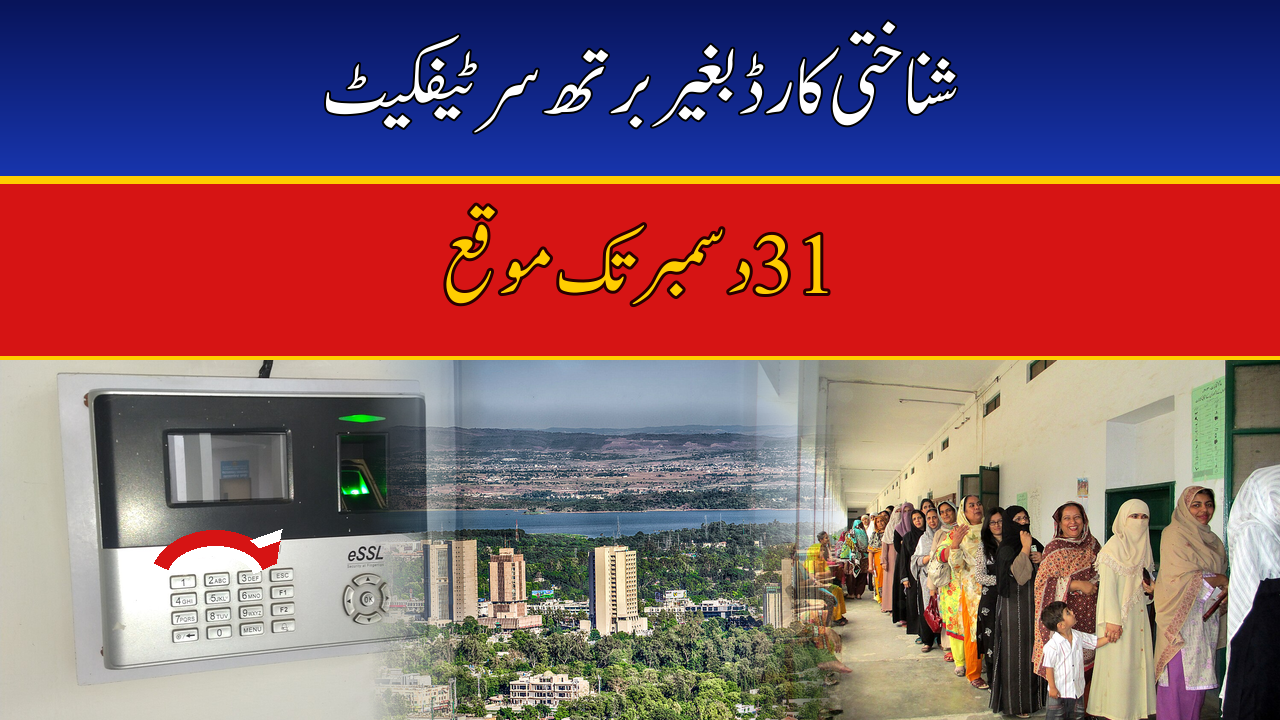
NADRA has opened a special facility that lets Pakistanis who never got a computerised national identity card because they have no birth certificate apply for their first CNIC anyway. Women aged 18 and above and men over 24 can register through family verification and biometrics at a NADRA centre — but the window closes on 31 December 2026, and the details recorded in this process can never be changed later.
The National Database and Registration Authority announced the temporary arrangement on 12 November 2026, and it was reported the same day by ARY News, Pakistan Times, Suno News and other outlets. It is aimed at people who have lived without an identity card for years — often because their birth was never registered — and who have therefore been locked out of bank accounts, mobile SIMs, passports, government jobs and welfare schemes that all ask for a CNIC number.
Until now, a birth certificate was the standard starting point for a first CNIC. Under this facility, NADRA will accept alternative proof instead: the identity records of the applicant’s family, held in NADRA’s own database, plus biometric verification at the registration centre. The arrangement is strictly temporary, and NADRA has been clear that it will not be extended beyond the end of the year.
Who can apply: women aged 18 and above
The facility covers women aged 18 and above who have been unable to obtain an identity card because they lack a birth certificate. NADRA’s announcement, as reported by ARY News, sets different requirements for married and unmarried women.
A married woman must have a computerised marriage certificate issued by her local Union Council. She must then visit a NADRA registration centre with her husband and either her father or her mother — both of whom must hold a CNIC or a National Identity Card for Overseas Pakistanis (NICOP) — for biometric verification. The family members’ presence is what lets NADRA confirm her identity without a birth certificate.
If the applicant’s husband or either parent has died, the application can still be accepted, provided their records are available in NADRA’s database and the applicant gives satisfactory answers to the questions officials ask. For unmarried women aged 18 and above, the requirement involving a husband does not apply.
Men over 24 who never got a CNIC
NADRA has announced a similar facility for men aged over 24 who have never obtained a CNIC. The conditions are built around the family, not documents the applicant may never have had.
A male applicant must have at least one parent and one sibling whose identity details are already registered with NADRA. He must visit a registration centre accompanied by his father or mother. If both parents are deceased, he must be accompanied by a brother or sister who holds a valid CNIC or NICOP. As with women applicants, the family members present are biometrically verified so NADRA can establish the applicant’s identity from its own records.
The age cut-offs matter. The facility is only for first-time applicants — women 18 and above, men over 24 — who have never been issued a CNIC. It is not a route to a duplicate card, a renewal, or a correction to an existing record.
What happens at the registration centre
Applicants must apply in person at a NADRA registration centre. There is no online application for this facility: the whole point is biometric verification of the applicant and the accompanying family members, which can only happen at a centre.
At the centre, officials will check the family records already in NADRA’s database, verify the accompanying relatives biometrically, and ask the applicant questions to confirm the details being recorded. NADRA has warned applicants to take this part seriously. The information given during registration will be used to record the applicant’s parents’ details, date of birth and place of birth on the identity card — and the authority has said these details cannot be changed at any point in the future.
That makes it worth getting the facts right before the visit. Anyone unsure of a parent’s exact name spelling, date of birth or place of birth as recorded in NADRA’s system should check with the family first, because a mistake entered now becomes permanent.

The deadline: 31 December 2026
The facility will remain available only until 31 December 2026. After that date, the normal rules return, and a birth certificate will again be the expected starting document for a first CNIC. NADRA has given no indication that the window will be extended, so anyone who qualifies should plan the visit well before the end of December — registration centres are typically busiest in the final days of any deadline.
The timing also matters for families. Because the application depends on accompanying relatives — a husband and a parent for married women, a parent or sibling for men — the visit needs everyone free on the same day, with their own CNICs or NICOPs in hand. Sorting that out early avoids a wasted trip.
Why this matters
A CNIC is the key to almost everything official in Pakistan. Without one, a person cannot open a bank account, get a mobile SIM in their own name, apply for a passport, register to vote, take a government job or claim benefits under schemes such as BISP. People who were never registered at birth — often in rural areas, or in families where daughters’ births went unrecorded — can spend their whole adult lives outside that system.
This facility does not solve every case. It covers only first-time adult applicants who can produce registered family members to vouch for them, and it demands in-person visits that may be difficult for people in remote areas. But for the families it does reach, it removes the single document that has blocked them for years, and it does so through NADRA’s own records rather than a new pile of paperwork. For anyone who qualifies, the next seven weeks are the chance to fix it.
Frequently Asked Questions
Can I get a CNIC without a birth certificate in Pakistan?
Yes, under NADRA’s special facility announced on 12 November 2026. Women aged 18 and above and men over 24 who have never held a CNIC can apply without a birth certificate, using family records and biometric verification instead. The facility is available only until 31 December 2026.
What does a married woman need to apply without a birth certificate?
A computerised marriage certificate from her local Union Council, and a visit to a NADRA registration centre with her husband and either her father or mother, both of whom must hold a CNIC or NICOP, for biometric verification. If the husband or a parent has died, the application can still be accepted if their records are in NADRA’s database and her answers satisfy officials.
What does a man over 24 need to apply?
At least one parent and one sibling whose identity details are registered with NADRA, and a visit to a registration centre accompanied by his father or mother. If both parents are deceased, he must be accompanied by a brother or sister who holds a valid CNIC or NICOP.
Can I apply for this CNIC facility online?
No. Applicants must visit a NADRA registration centre in person with the required family members, because biometric verification of the applicant and the accompanying relatives is part of the process.
What is the last date to apply?
31 December 2026. NADRA has said the special facility will remain available until that date and has given no indication of an extension, so eligible applicants should apply well before the deadline.
Can I correct my date of birth or parents’ details later if I make a mistake?
No. NADRA has warned that the parents’ details, date of birth and place of birth recorded during this registration cannot be changed at any point in the future, so applicants should confirm every detail with their family before the visit.
Related: NADRA CNIC Renewal Online 2026 — step by step tarika | 8171 PMT Score Check 2026 by CNIC — BISP eligibility status | Pakistan Post revises pensioners’ proof-of-life SOP — NADRA verification every six months