ICC Plans Four-Overseas-Player Cap for T20 Leagues: What the Bali Proposals Mean for ILT20, MLC and the PSL
By Imran Javed | 13 November 2026 ICC Plans Four-Overseas-Player Cap for T20 Leagues: What the Bali Proposals Mean for ILT20, MLC and the PSL The International Cricket Council is planning tighter control over T20 franchise leagues worldwide, including a four-overseas-player cap in the playing XI, restrictions on betting sponsorship and stronger powers to approve…
ICC Plans Four-Overseas-Player Cap for T20 Leagues: What the Bali Proposals Mean for ILT20, MLC and the PSL
The International Cricket Council is planning tighter control over T20 franchise leagues worldwide, including a four-overseas-player cap in the playing XI, restrictions on betting sponsorship and stronger powers to approve — or reject — leagues. The proposals from the ICC’s franchise leagues review group go before board heads and chief executives at the governing body’s quarterly meetings in Bali this weekend, and if approved they could rewrite the rules for competitions such as the UAE’s ILT20 and Major League Cricket in the United States.

The recommendations, first reported by ESPNcricinfo and covered on 12–13 November by Outlook India, the Jamaica Star, News24 and other outlets, cover league sanctions, overseas player participation, sponsorship and anti-corruption rules. The review group was formed in July 2026, and its findings are being presented at the ICC’s quarterly meetings in Bali, which run from 11 to 15 November.
For Pakistan, the proposals matter directly. The Pakistan Super League is one of the franchise competitions whose sanctioning framework would fall under the tighter ICC oversight, and the meetings are also deciding the shape of international cricket’s calendar for 2032–2035 — including a plan for one global event every year.
The four-overseas-player cap
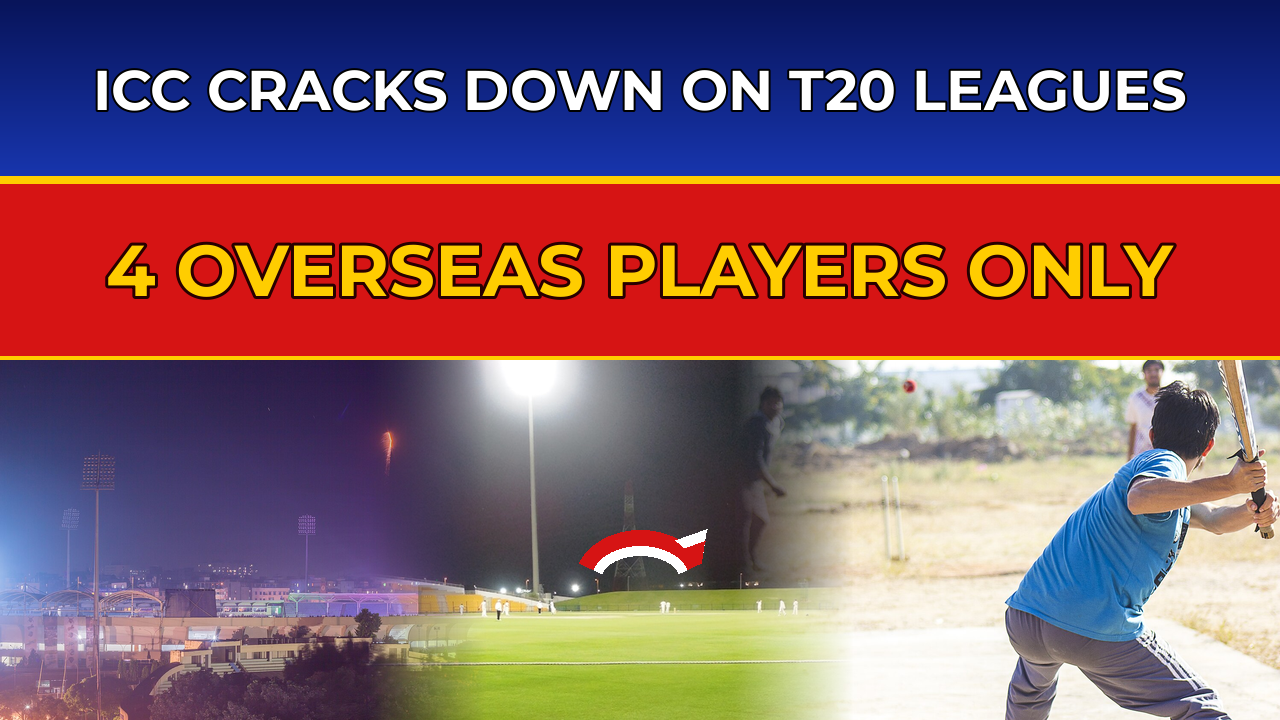
The sharpest proposed change is on team composition. The review group wants the ICC to enforce existing overseas player restrictions more strictly by limiting teams to four overseas players in a playing XI — the cap already written into the ICC’s regulations, but not enforced evenly across leagues.
ILT20 and MLC would feel the squeeze most. The ICC gave both leagues exemptions when it brought in player-capping rules in 2023. ILT20 can field as many as nine overseas players in its XI, with at least one from an Associate Member nation, while MLC allows six. A cap of four would push both leagues to depend more on players developed in the UAE and the United States, which could change their competitive balance and commercial appeal — both leagues have sold themselves partly on the strength of imported talent.
The Indian links are extensive. Five of the six ILT20 franchises have owners tied to IPL or WPL teams, while four MLC franchises sit within IPL ownership groups. That is part of why the proposals are being watched so closely: the leagues most affected are also the ones with the deepest pockets behind them.
Stronger sanctioning powers for the ICC
The ICC also wants more authority over league approvals. Under the current system, Full Members can sanction domestic leagues in their own territories, while leagues run by Associate Members need extra ICC approval. The proposal would let the ICC review or audit sanctions granted by Full Member boards, and step in if a Full Member fails to meet its obligations while approving a league.
The governing body could go further still. It would be able to reject an application or withdraw an existing sanction if serious integrity concerns emerge. The review group says the current approval system is uneven and needs tighter rules before any league gets domestic sanction. “At the moment, the Regulations do not provide any detailed conditions which must be satisfied by a domestic league and different approaches are therefore taken in the various Member territories,” the paper says. “A more detailed structure should be put in place (through the Regulations) setting out the conditions that a franchise league would need to satisfy before it could obtain a domestic sanction.”
The group has also proposed a fee for sanctioning franchise leagues. That money could help fund due diligence checks and corruption investigations — a response to wider concerns over integrity issues, ownership changes and payment disputes across the growing franchise cricket circuit.
Betting sponsorship and anti-corruption
Betting sponsorship is another target. The review group has recommended restricting deals involving betting companies or their surrogate brands, especially where those arrangements could enable betting in countries where gambling is illegal.
The proposal spells out the concern in direct terms. “This would address the threat posed by the growth of illegal betting (namely betting on unregulated markets or in countries where betting is illegal). Such sponsorship exposes host Members to the risk of facilitating illegal betting in cricket, which carries the potential for increased corruption, and raises clear ethical and governance questions for the sport,” the proposal states.
The bar gets higher for riskier events. For competitions seen as carrying a high corruption risk, the ICC’s Anti-Corruption Unit could be engaged, with the league organisers paying the costs on a not-for-profit basis. If adequate safeguards cannot be put in place, the application could be rejected.
The group has also flagged solidarity payments for further discussion — payments made by leagues to the cricket boards of overseas players who take part in their competitions. Right now the amount is negotiated between the boards involved, a process that has at times led to disputes. The paper suggests exploring a uniform fee across leagues and players, possibly set as a fixed percentage. It also raises the status of legends leagues, pointing to concerns over tournaments featuring retired players and possible overlap with approved cricket involving active players.
What happens next in Bali — and the 2032–2035 calendar
The ICC’s chief executives’ committee will consider the proposals and pass the relevant ones to the ICC Board for approval. The review group also wants to examine whether ICC members should be capped on the number of franchise leagues they host, saying the aim is to protect international cricket’s role in developing and promoting the sport worldwide. External legal advice obtained by the group is reported to have confirmed that members would have no good legal basis to challenge the changes.
The Bali meetings are deciding more than league rules. According to Crictracker, the headline agenda item is a proposal to stage one global cricket event every year throughout the 2032–2035 cycle — six events across four years, so no calendar year is left without a major ICC tournament. The 2031 ODI World Cup, jointly hosted by India and Bangladesh, would close out the preceding cycle before the new framework takes effect. Under the plan, the 2032 T20 World Cup in an October–November window would open the new era, with two events pencilled in for 2033: a World Test Championship final in June and a Champions Trophy in October. A revenue pool of about USD 650 million is also on the agenda for discussion, and the board is expected to consider the recommendations before the Bali programme concludes on 15 November.
The World Test Championship itself is also up for discussion. According to a Cricinfo report carried by Asianet, the proposed expansion of the WTC to all 12 Full Members is on the table, but the next cycle is likely to retain the existing nine-team format. The Future Tours Programme for 2027–31 and a strategic review of international cricket formats, including the future of ODIs, are on the agenda too.
None of this is decided yet. The proposals are recommendations, not regulations — but if the chief executives and the board back them this weekend, franchise cricket’s free-for-all era is about to get a rulebook.
Frequently Asked Questions
What is the ICC proposing for T20 franchise leagues?
A four-overseas-player cap in the playing XI, stronger ICC powers to review, audit, reject or withdraw league sanctions, restrictions on betting sponsorship, mandatory anti-corruption safeguards for high-risk events, and a sanctioning fee. The proposals come from the ICC’s franchise leagues review group and are being considered at the Bali meetings.
Which leagues would the four-player cap hit hardest?
The UAE’s ILT20, which can currently field up to nine overseas players in its XI, and Major League Cricket in the United States, which allows six. Both received exemptions when the ICC brought in player-capping rules in 2023.
Who is on the ICC review group?
Former Bangladesh opener and current Bangladesh Cricket Board president Tamim Iqbal chairs it, joined by England and Wales Cricket Board chief executive Richard Gould, Cricket Australia chief executive Todd Greenberg and BCCI secretary Devajit Saikia.
What is the ICC’s plan for global events in 2032–2035?
One global event every year across the 2032–2035 cycle — six events in four years. The 2032 T20 World Cup in October–November would open the cycle, with a World Test Championship final in June 2033 and a Champions Trophy in October 2033. The plan is under discussion at the Bali meetings and is not yet approved.
How does this affect the PSL?
The PSL is a franchise league, so it falls under the same ICC sanctioning framework the proposals would tighten. The review group’s rules would apply to all franchise leagues worldwide, and the 2032–2035 global calendar being decided in Bali also shapes Pakistan’s international scheduling.
When will the ICC decide?
The chief executives’ committee will consider the proposals first and pass the relevant ones to the ICC Board for approval. The ICC’s quarterly meetings in Bali run from 11 to 15 November 2026, with the board expected to consider the recommendations before the programme concludes.
Related: New Zealand vs India 4th ODI: Shreyas Iyer’s captaincy debut at Bay Oval | Pakistan vs Bangladesh SAFF semi-final: time, preview and squads | Nations League results: Italy beat France, England edge Croatia