Global EV Sales Jump 8% in October to 2.09 Million as Europe Surges and China Exports Hit Record
By Fatima Raza | November 12, 2026 Drivers around the world bought 2.09 million electric vehicles in October 2026, an 8% rise on a year earlier, according to new data from Benchmark Mineral Intelligence published on Thursday. It is the first month of year-on-year growth after a soft stretch for the global EV market, and…
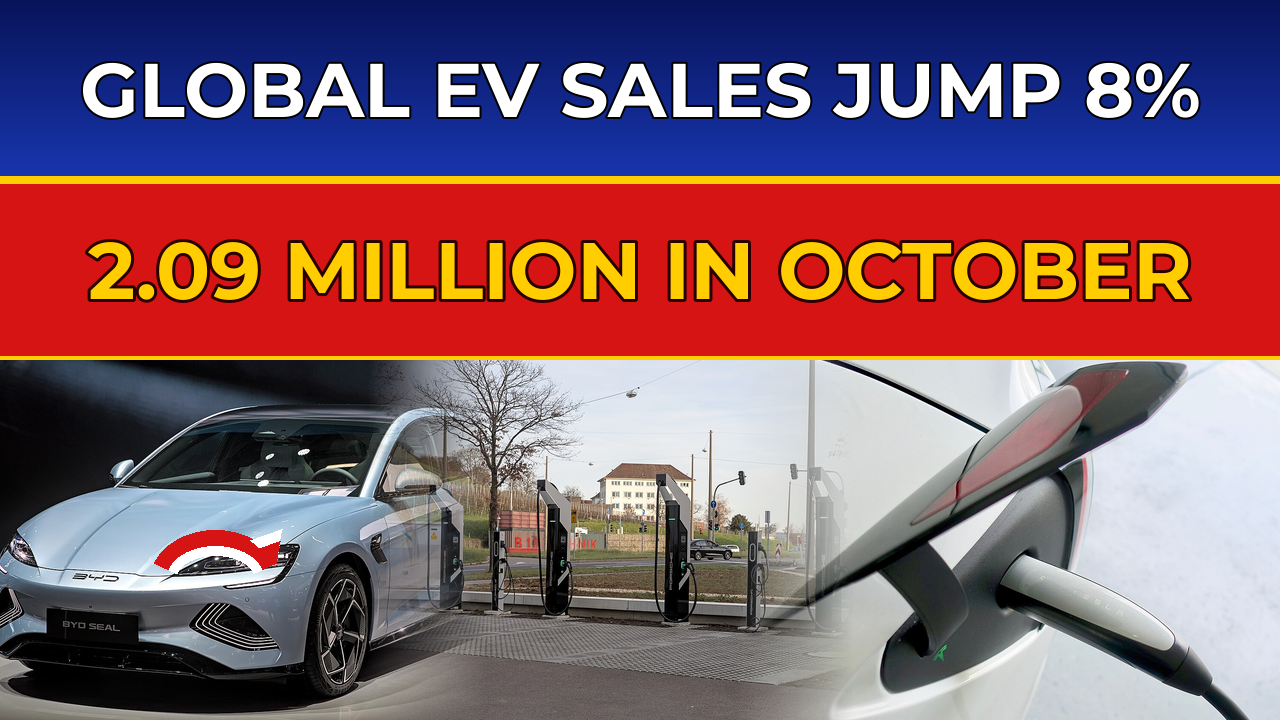
Drivers around the world bought 2.09 million electric vehicles in October 2026, an 8% rise on a year earlier, according to new data from Benchmark Mineral Intelligence published on Thursday. It is the first month of year-on-year growth after a soft stretch for the global EV market, and the rebound was led by Europe, where sales jumped 36%, while China pushed exports to a new monthly record. The headline number needs one honest caveat, though: part of the growth comes from a weak comparison in the United States, where the federal EV tax credit had just expired a year ago.
Key Facts
| Fact | Detail |
|---|---|
| Global EV sales, October 2026 | 2.09 million vehicles, up 8% year on year, down 3% on September |
| Sales in 2026 so far | 17.5 million (January–October), up 5% year on year |
| Data source | Benchmark Mineral Intelligence, reported by Reuters and Electrek on 12 November 2026 |
| What counts as an EV | Battery-electric (BEV) and plug-in hybrid (PHEV) passenger cars and light-duty vehicles |
| Europe, October | 510,000 sold, up 36% year on year; BEVs up 49%, plug-in hybrids up 7% |
| China, October | 1.14 million sold, down 12% year on year but up 5% on September; 54.5% of the global total |
| China NEV exports, October | Almost 600,000 passenger cars, another monthly record (558,000 in September) |
| North America, October | 130,000 sold, up 24% year on year — the region’s first annual rise of 2026; flat on September |
| United States, October | About 110,000 sold; year-to-date sales 1.3 million for North America, down 21% |
| Rest of the world, October | 300,000 sold, up 85% year on year; 2.6 million in 2026 so far, up 93% |
Europe Leads the Rebound
Europe sold 510,000 EVs in October, up 36% on a year earlier, and fully electric cars did most of the work: battery-electric sales rose 49%, while plug-in hybrids grew 7%. That puts October’s growth ahead of the region’s 31% increase for the year so far, and Europe has now sold 4.5 million EVs in 2026. Sales did fall 17% from September, but September was flattered by the UK’s twice-yearly registration plate change, so the year-on-year comparison is the cleaner read on how fast the market is growing.
Germany set the pace. EVs took more than 45% of new car sales there, the highest share since December 2022, when buyers rushed to beat subsidy cuts. Fully electric car sales in Germany rose almost 80% from a year earlier to more than 95,000. UK EV sales increased 30%, which is notable because the Electric Car Grant was already available in October 2025, so this growth came against a market that was already receiving government support. In Portugal, EVs accounted for 55% of new car sales in October. Reuters credits the European surge to subsidies, rising fuel prices, EU emissions legislation and a growing number of models on sale.
China Sells Fewer at Home, Exports More Than Ever
China remains the world’s largest EV market by a wide margin, but its domestic sales are still falling. Chinese buyers took 1.14 million EVs in October, down 12% year on year, although that decline was smaller than September’s 18% drop, and sales rose 5% on the month. Through October, China has sold 9.1 million EVs in 2026, down 11% on the year. Even with fewer cars sold, EVs reached a fresh high as a share of China’s new car market, because the wider passenger car market is shrinking faster than EV sales.
The more striking Chinese number is exports. Passenger car exports of new energy vehicles — China’s category covering battery-electric and plug-in hybrid cars — reached almost 600,000 in October, another monthly record, up from 558,000 in September. “Even though the Chinese market is down domestically, that has then in turn resulted in a lot of OEMs pushing the exports and contributing significantly to the rest of the world,” Benchmark data manager Charles Lester told Reuters. China accounted for 54.5% of global EV sales in October, and its exports are now the engine of growth in markets outside the big three regions.
That export push faces more pressure ahead. The EU has agreed to cap imports of Chinese-built hybrids, and China will reduce its EV export VAT rebate from 13% to 9% starting on 1 April 2027.
North America’s Rebound Needs a Caveat
North American EV sales rose 24% year on year to 130,000 in October, the region’s first annual increase of 2026, and the United States accounted for about 110,000 of those. On the surface that looks like a recovery. It is not quite one, and the reason is the calendar.
October 2025 was the first month after the US federal EV tax credit expired — the credit ended for vehicles acquired after 30 September 2025, and sales dropped sharply afterward. October 2026 is therefore being compared with a month when sales had already plummeted. “October is the first month compared against a period without the US federal tax credit, and the US market has stabilized at a lower level rather than recovered,” Lester told Reuters. Sales were flat on September, which tells the same story: the market has steadied, but it is operating from a lower base. Year-to-date, North America has sold 1.3 million EVs, still down 21% on 2025.
The Rest of the World Is Growing Fastest
Outside China, Europe and North America, EV sales rose 85% year on year to 300,000 in October. Those markets have bought 2.6 million EVs so far in 2026, up 93% on the same period last year, and their monthly total is now larger than North America’s, largely because of Chinese exports.
Australia’s sales jumped more than 200% in October, and EVs have gained market share sharply there this year, although Benchmark notes that has not translated into healthy dealer profits: more brands, many of them Chinese, are competing for buyers and squeezing margins. Brazil’s growth has also been huge, but Benchmark cautions that some of its drivers are temporary — importers brought vehicles in ahead of phased tariff increases, a fuel crisis pushed more buyers toward EVs, and BYD increased production at its Brazilian factory. As the tariff increases take full effect and fuel price pressure eases, Benchmark expects those boosts to fade, with BYD’s local production — which will also supply Argentina and Mexico — becoming the main remaining support for that growth.
What It Means for Buyers in Pakistan
Pakistan is a small market in this global picture, but the same forces are arriving here. Chinese brands are the ones driving the global export wave, and they are also the ones entering Pakistan: BYD’s premium brand Denza is launching its N8 in Pakistan today, as covered in our report on the Denza N8 launch, with 1,193hp and a 1,003km range. When the world’s biggest EV makers are pushing cars abroad because home demand is soft, export markets like Pakistan get more models, sooner, and often at sharper prices.
The running-cost case is strengthening too. Petrol in Pakistan now costs Rs335 a litre after the latest cut, with diesel at Rs364, as our report on the November 12 fuel prices explains, and fuel costs remain one of the main reasons buyers look at electric cars. The direction of travel is the same one Pakistan’s government is betting on at COP31, where it has told the world it needs $188 billion for clean energy by 2035, as covered in our report on Pakistan’s $188bn clean-energy ask. October’s numbers do not mean EVs have won everywhere yet — the US market is still below its old level and China’s home market is still shrinking — but they do show the global EV market growing again, and growing fastest where Chinese cars are landing.
What Happens Next
Three things will decide whether October’s growth holds. First, Europe has to keep its momentum once the UK plate-change effect washes out and subsidy rules change. Second, China’s export machine has to absorb the EU’s cap on Chinese-built hybrids and the VAT rebate cut coming in April 2027. Third, the United States has to show growth against a normal comparison month, not just against the post-subsidy slump. November’s figures, due in mid-December, will show whether the rebound is real or just a favourable calendar.
Frequently Asked Questions
How many electric vehicles were sold worldwide in October 2026?
2.09 million battery-electric and plug-in hybrid vehicles were sold in October 2026, up 8% on October 2025 but down 3% on September 2026, according to Benchmark Mineral Intelligence data reported by Reuters and Electrek on 12 November 2026.
Which region grew fastest in October 2026?
Markets outside China, Europe and North America grew fastest, up 85% year on year to 300,000 vehicles. Among the big three regions, Europe grew fastest at 36%, with battery-electric sales up 49%.
Why did US electric vehicle sales rise 24% — is demand back?
Not yet. October 2025 was the first month after the US federal EV tax credit expired, so sales had already dropped sharply. Benchmark’s Charles Lester says the US market has “stabilized at a lower level rather than recovered”, and sales were flat on September.
How many electric vehicles did China export in October 2026?
China exported almost 600,000 new energy passenger vehicles in October 2026, another monthly record, up from 558,000 in September. China sold 1.14 million EVs at home, down 12% year on year, and accounted for 54.5% of global EV sales.
How many EVs have been sold in 2026 so far?
17.5 million EVs were sold worldwide in the first ten months of 2026, up 5% on the same period in 2025. China accounts for 9.1 million of those, Europe 4.5 million, North America 1.3 million and the rest of the world 2.6 million.
What does the global EV rebound mean for buyers in Pakistan?
Chinese brands are driving the global export wave and are also the ones entering Pakistan — BYD’s premium brand Denza is launching its N8 here today. With petrol at Rs335 a litre, the running-cost case for EVs keeps strengthening, and more Chinese models are likely to reach Pakistan as exporters look abroad.