Diesel Crosses Rs400 a Litre for the First Time at Rs400.67, Petrol Unchanged at Rs377.91
Islamabad, Oct 30, 2026 — Diesel has crossed Rs400 a litre in Pakistan for the first time, after the federal government raised the price of high-speed diesel (HSD) by 85 paisas to Rs400.67 per litre for October 30, while keeping petrol unchanged at Rs377.91 per litre. The revision, notified by the Petroleum Division under the…
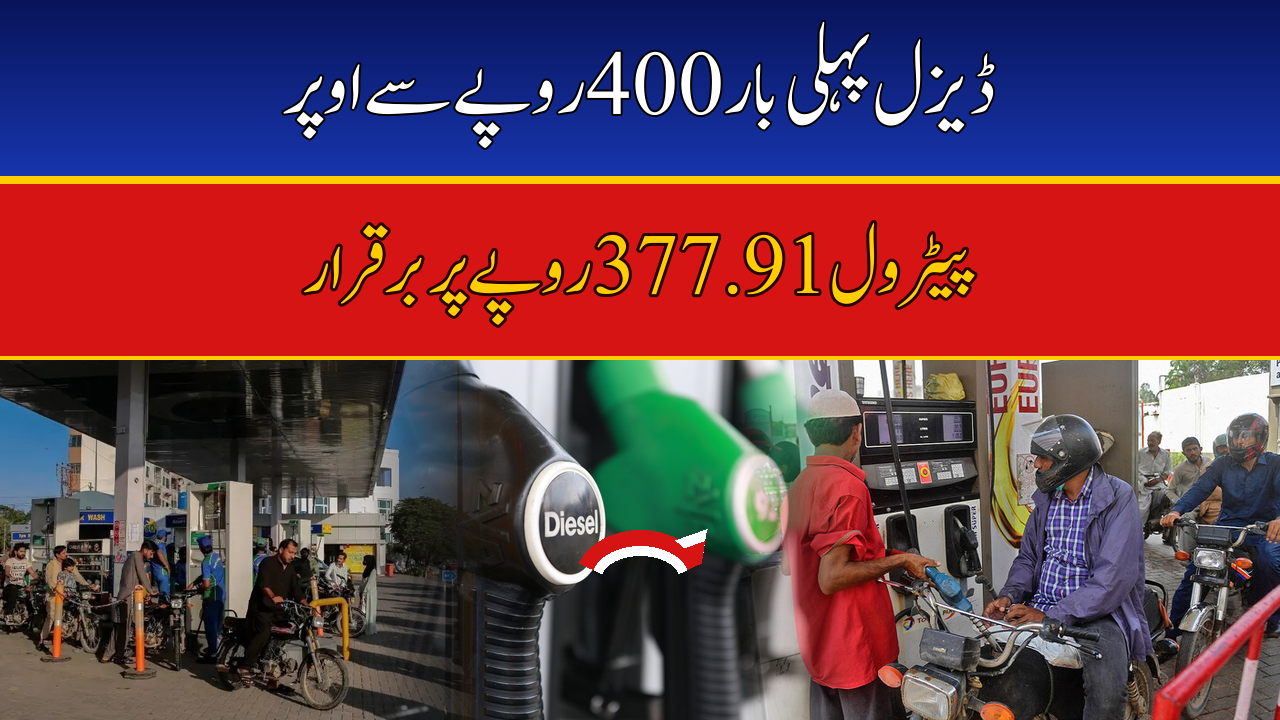
Islamabad, Oct 30, 2026 — Diesel has crossed Rs400 a litre in Pakistan for the first time, after the federal government raised the price of high-speed diesel (HSD) by 85 paisas to Rs400.67 per litre for October 30, while keeping petrol unchanged at Rs377.91 per litre. The revision, notified by the Petroleum Division under the daily price mechanism, pushes diesel past a round-number threshold that matters far beyond the forecourt — diesel powers the trucks that move the country’s goods and the tractors that work its fields.
Key facts: new fuel prices for October 30, 2026
| Detail | Confirmed figure |
|---|---|
| New diesel (HSD) price | Rs400.67 per litre, up Rs0.85 from Rs399.82 |
| New petrol price | Rs377.91 per litre, unchanged |
| Effective date | Friday, October 30, 2026 (Petroleum Division notification) |
| Previous revision (Oct 29) | Petrol up Rs1.85, diesel up Rs1.75 |
| Diesel’s run | From Rs389.27 on October 20 to Rs400.67 today — a rise of Rs11.40 per litre in ten days |
| Petrol–diesel gap | Rs22.76 per litre (400.67 − 377.91) |
| Taxes and duties | Rs114 per litre on petrol, Rs100 per litre on diesel |
| Petroleum levy | Rs80 per litre, plus Rs5 climate support levy, unchanged |
| Dealer and OMC margins | Rs9.98 per litre for dealers, Rs7.87 for oil marketing companies, unchanged |
| Pricing mechanism | Daily revision since July 2026, replacing the weekly mechanism; OGRA now publishes daily prices |
Why diesel crossing Rs400 matters more than the 85 paisas suggest
On its own, 85 paisas looks small. In context, it is not. Diesel has now risen at every revision since October 20, when it stood at Rs389.27. Yesterday’s revision took it to Rs399.82 — just 18 paisas short of the mark — and today’s nudge carries it over. The cumulative increase in ten days is Rs11.40 per litre, and it lands on the fuel that drives freight, public transport and agriculture rather than the private car.
That is why transporters watch diesel more closely than petrol. A truck running hundreds of kilometres a day absorbs a diesel hike in a way no private motorist does, and those costs eventually surface in freight rates and, with a lag, in the prices of goods moved by road. Transporters had already warned earlier in October that sustained fuel-price pressure would force fare revisions; a diesel price above Rs400 strengthens that case, even though the single-day increase is modest.
What actually moved: the official breakdown
Business Recorder’s account of the notification gives the mechanics behind the 85 paisas. The HSD crack spread — the refining margin that feeds into the import price — fell from USD 41.89 to USD 38 per barrel, yet the HSD benchmark price rose to USD 114.65 per barrel from USD 114.15, and the import cost of diesel climbed to Rs293.12 per litre from Rs292.27. Petrol moved the other way at the refinery gate: its ex-refinery price eased to Rs267.13 per litre from Rs267.15, and its benchmark stood at USD 121.28 per barrel — enough for petrol to stay put at Rs377.91.
What did not move is the government’s take. The petroleum levy stays at Rs80 per litre, the climate support levy at Rs5, and dealer and oil-marketing-company margins at Rs9.98 and Rs7.87 respectively. In total, taxes and duties amount to Rs114 per litre on petrol and Rs100 per litre on diesel, according to Dawn’s report of the notification. So of today’s Rs400.67 diesel litre, roughly a quarter is tax and duty before a single drop is refined, shipped or pumped.
How the daily pricing mechanism works
Since July 2026, Pakistan has reviewed fuel prices daily instead of fortnightly or weekly. Petroleum Minister Ali Pervaiz Malik has said the daily prices are calculated using a seven-day average of international market rates, so that movements in global prices reach consumers immediately rather than building up into a large fortnightly jump. OGRA has also begun publishing the daily prices on its website as part of the same transparency push.
The backdrop this week is familiar: volatility in global oil markets driven by tensions between the United States and Iran, and the supply-disruption fears that have accompanied them. Oil prices actually fell on Thursday in choppy trading as hopes for peace talks offset some of those supply concerns, with Brent crude down 40 cents to USD 114.92 a barrel — but the seven-day averaging means a single day’s dip does not immediately reverse the trend baked into today’s notification.
Petrol unchanged — but not cheap
Petrol holding at Rs377.91 is better news for motorists than another increase, but it is worth keeping in perspective. Petrol stood at Rs387.40 on October 1, spiked to Rs398.96 on October 9, then retreated through the middle of the month before yesterday’s Rs1.85 increase brought it to today’s level. Even after holding steady today, petrol remains Rs9.49 per litre cheaper than on October 1 — while diesel, over the same period, has gone the other way entirely.
One relief measure still cushions the lowest-income motorists: the fuel relief scheme announced on September 13 offers Rs100 per litre off petrol for motorcycles, three-wheeler rickshaws and cars with engines of up to 800cc. That scheme is separate from the headline price and does not change today’s notification, but for eligible small-vehicle owners it remains the difference between the pump price and what they actually pay.
What to watch in the next revision
Under the daily mechanism, the next notification is never far away, and three things will decide whether diesel stays above Rs400 or retreats. First, the international benchmarks — if the HSD benchmark keeps rising, the import cost follows. Second, the rupee and the crack spread, which moved in opposite directions in today’s notification. And third, the levy question: with Rs80 of petroleum levy plus Rs5 of climate levy embedded in every litre, any future decision on levies would move the pump price far more than an 85-paisa benchmark adjustment. For now, though, the number that matters is simple: diesel, Rs400.67; petrol, Rs377.91.
Related reading: the previous revision took diesel to within 18 paisas of Rs400 — see Petrol Diesel Price October 24–26, 2026: Diesel Up Rs1.91 to Rs393.66, Petrol Unchanged at Rs377.71 and Petrol Diesel Price October 23, 2026: New Rates in Pakistan. For the jobs market, the Punjab Enforcement & Regulatory Authority’s 110 posts closed on October 29 — see PERA Jobs 2026: 110 Posts, Last Date 29 October.
Frequently Asked Questions
What is the new diesel price in Pakistan from October 30, 2026?
High-speed diesel costs Rs400.67 per litre from October 30, 2026, up 85 paisas from Rs399.82. It is the first time diesel has crossed the Rs400 mark.
What is the petrol price in Pakistan today, October 30, 2026?
Petrol is unchanged at Rs377.91 per litre. The Petroleum Division notification kept petrol flat while raising diesel by 85 paisas.
Why did diesel cross Rs400 while petrol stayed unchanged?
The HSD benchmark price rose to USD 114.65 per barrel from USD 114.15 and the diesel import cost climbed to Rs293.12 per litre from Rs292.27, while petrol’s ex-refinery price eased slightly to Rs267.13. Taxes, levies and margins were unchanged for both fuels.
How much tax is included in a litre of fuel?
Taxes and duties total Rs114 per litre on petrol and Rs100 per litre on diesel. That includes the Rs80 petroleum levy and Rs5 climate support levy, plus dealer margins of Rs9.98 and oil-marketing-company margins of Rs7.87 per litre.
How often do fuel prices change in Pakistan now?
Prices are reviewed daily under the mechanism introduced in July 2026, replacing the weekly system. The minister has said daily prices use a seven-day average of international market rates, and OGRA publishes the daily prices on its website.
Does the Rs100 petrol relief scheme still apply?
Yes — the scheme announced on September 13 offers Rs100 per litre off petrol for motorcycles, three-wheeler rickshaws and cars with engines up to 800cc. It is separate from the headline pump price and is unchanged by today’s notification.
By Bilal Ahmed | October 30, 2026