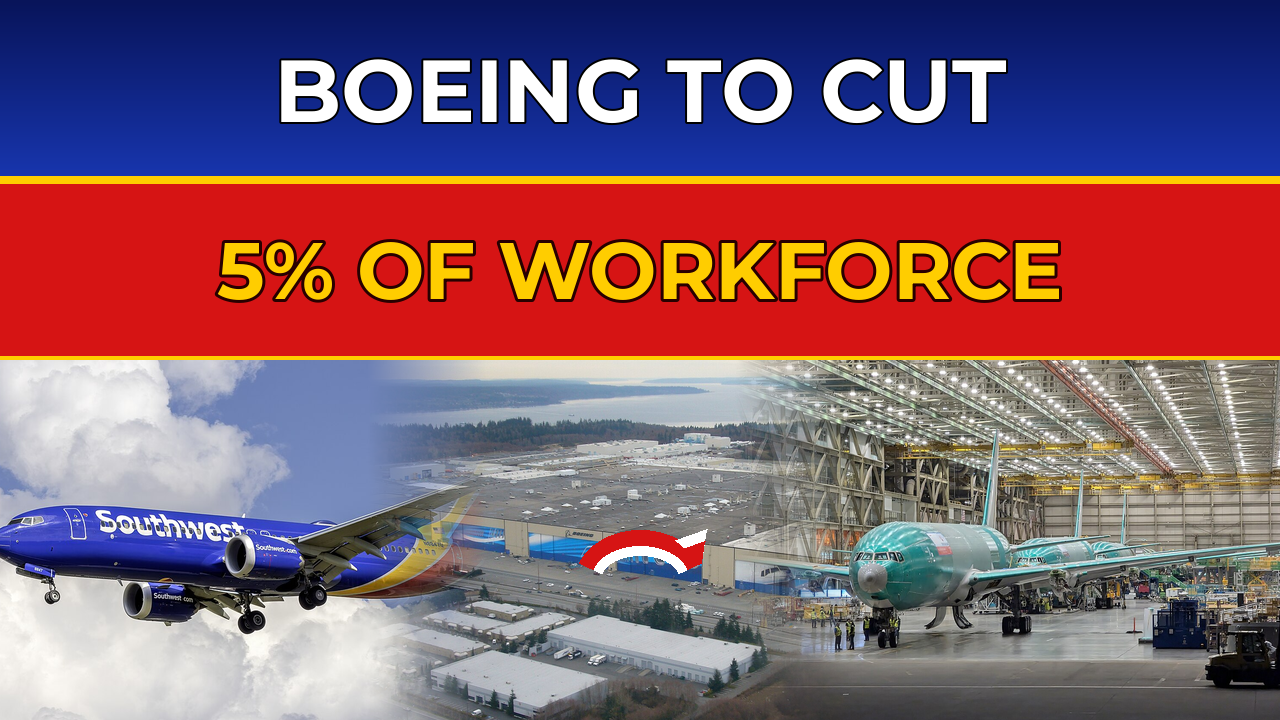
Boeing to Cut 5% of Commercial Airplane Workforce as 737 Production Ramp Slows
Boeing to Cut 5% of Commercial Airplane Workforce as 737 Production Ramp Slows By Bilal Ahmed | Published: 10 November 2026 | Updated: 10 November 2026 | Category: Business Boeing will cut about 5 percent of the workforce in its Commercial Airplanes division, the company announced on Monday, 9 November 2026, as it slows the…
Boeing to Cut 5% of Commercial Airplane Workforce as 737 Production Ramp Slows
Boeing will cut about 5 percent of the workforce in its Commercial Airplanes division, the company announced on Monday, 9 November 2026, as it slows the ramp-up of 737 production. The decision was communicated to staff in an internal memo from Stephanie Pope, president and chief executive of Boeing Commercial Airplanes. The company has not confirmed an exact number of jobs affected, but the division employed 50,494 people as of December 2025, according to Boeing’s own website, which puts the implied figure at roughly 2,500 positions.
The reason, in Pope’s own words, is that Boeing needs to give its factories and suppliers more breathing room. “We need to reset the pace of our production rate ramps to provide our factories and supply chain partners additional time to achieve stability,” she wrote in the memo, as reported by Reuters and the New Straits Times. It is a deliberate slowdown rather than a sudden stop: Boeing still plans to raise 737 output, just later than it had hoped, and it is trimming the workforce to match that slower timetable.
Key Facts
| Detail | What we know |
|---|---|
| Workforce cut announced | About 5% of the Boeing Commercial Airplanes division workforce |
| Announced | Monday, 9 November 2026, in an internal memo from Stephanie Pope, president and CEO of Boeing Commercial Airplanes |
| Implied number of positions | About 2,500 — the arithmetic implication of 5% of the division’s 50,494 employees (December 2025, per Boeing’s website). Boeing has NOT confirmed this number. |
| Division headcount | 50,494 employees as of December 2025 (Boeing website, via New Straits Times) |
| Company-wide headcount | Nearly 182,000 employees as of December 2025, including about 50,500 in the commercial airplanes division |
| How the cuts will happen | A combination of attrition and involuntary layoffs |
| When workers will be told | Notices to affected employees from December 2026 at the earliest; Boeing is required in many US states to give 60 days’ notice |
| 737 production rate | Boeing now expects to reach 47 jets per month in early 2027, after previously projecting that pace by summer 2026 |
| 2026 delivery target | Boeing will miss its target of delivering 500 737 MAX aircraft in 2026 |
| Shares reaction | Down less than 1% in afternoon trading on 9 November (New Straits Times); Bloomberg Law reported a 0.4% drop after the report |
| Reason given | To “reset the pace of our production rate ramps” and give factories and supply chain partners time to achieve stability (Pope memo) |
What Boeing Announced on Monday
The news reached employees first, in a memo from the head of the division, and reached the public when the Seattle Times reported it on Monday. Reuters picked up the story the same day, and it was carried by the New Straits Times, Hürriyet Daily News, Leeham News and Bloomberg Law. The announcement was short on detail and long on intent: the Commercial Airplanes division will shrink by about 5 percent, and the cuts will come through a mix of attrition — roles left unfilled as people leave — and involuntary layoffs.
No one has been told yet whether their job is affected. Notices to affected employees will go out from December at the earliest, and in many US states Boeing is legally required to give workers 60 days’ notice before a layoff takes effect. That means the practical impact of Monday’s announcement will land in the new year, even though the decision itself is already made.
What Boeing has not said is just as important as what it has. The company has not confirmed how many jobs will go, and the “about 2,500” figure circulating in coverage is arithmetic, not a company number: 5 percent of 50,494 is roughly 2,525. Nor has Boeing said which factories, locations or job categories will be affected. No source reporting the announcement names them, and until the company does, any claim about specific sites would be guesswork.
Why the 737 Ramp Is Slowing
The cut is tied directly to the 737, the single-aisle jet that anchors Boeing’s commercial production. Boeing had planned to reach a production rate of 47 of the jets per month by the summer of 2026. That timetable has now slipped: the company expects to hit 47 a month in early 2027 instead. The delay is measured in months, but in an industry where production rates are planned years ahead, it is a significant reset.
The warning signs were already public. Chief executive Kelly Ortberg told analysts last month that the company would miss its 2026 production and delivery targets for the 737, and it will now miss its target of delivering 500 737 MAX aircraft this year. The problem is not demand for the aircraft. It is the pace at which Boeing’s factories and suppliers can build them reliably. According to Leeham News, wing production is the pacing item holding back the 737 rate ramp — the part of the build that sets the speed for everything else.
That is the context for Pope’s memo. Rather than pushing the ramp and risking the quality and stability problems that come with it, Boeing is choosing to slow down and let the factories and the supply chain catch up. The workforce cut follows the same logic: if the ramp is slower, the division needs fewer people to run it. It is a decision about the pace of production, and the jobs follow from that.
What It Means for Workers — and for Boeing
For the roughly 50,500 people in the division, the announcement brings weeks of uncertainty. The December notice window means affected employees will not know their position until close to the end of the year, and the 60-day notice requirement in many states stretches the process into early 2027. Attrition will soften the blow for some — natural departures mean fewer forced exits — but involuntary layoffs are explicitly part of the plan, so some workers will lose their jobs outright.
Investors, for their part, took the news calmly. Boeing shares were down less than 1 percent in afternoon trading on Monday, and Bloomberg Law reported a drop of 0.4 percent after the report emerged. The muted reaction suggests the market had already priced in a slower ramp: Ortberg’s warning last month that the 2026 targets would be missed had set expectations, and Monday’s announcement confirmed the direction rather than changing it.
The cut is one of several big corporate moves making headlines this month. In technology, Anthropic’s Claude launch ahead of a possible IPO has put the AI race back in the spotlight, while in entertainment the leadership change at DC Studios shows how quickly even the biggest studios reshape their teams. Closer to home for regulators, the PTA’s new draft rules for IoT networks are another reminder that large organisations, public and private, are rewriting their plans for 2026. Boeing’s announcement belongs in that same pattern: a major company adjusting its ambitions to what it can actually deliver.
Boeing’s Year in Context
The scale of the division puts the cut in perspective. Commercial Airplanes employs about 50,500 people out of Boeing’s total workforce of nearly 182,000 — a little more than a quarter of the company. A 5 percent reduction in that division is a meaningful number of jobs, but it is a targeted adjustment to one part of the business, not a company-wide retrenchment. The announcement was specific to Commercial Airplanes, and nothing in the reporting suggests cuts elsewhere in the company.
It is also worth noting what the announcement does not do. It does not change Boeing’s plan to reach 47 737s a month — it moves the date. It does not cancel the ramp; it resets its pace. And it does not suggest the 737 MAX delivery shortfall is a demand problem. The orders are there. The constraint, as Pope’s memo frames it, is stability: factories and suppliers need time to build at a steady, reliable rate before Boeing pushes the number higher.
What happens next will be watched in two stages. First, December, when the first notices go out and the affected roles and locations finally become clear. Then early 2027, when Boeing aims to reach the 47-a-month rate it had originally targeted for the summer of 2026. If the factories and the supply chain hit that pace on the new timetable, Monday’s cut will look like the price of a more realistic plan. If the ramp slips again, the questions will get harder — about the supply chain, about wing production, and about how much further the timetable can stretch.
FAQs
How many jobs is Boeing cutting?
About 5 percent of the workforce in its Commercial Airplanes division. That implies roughly 2,500 positions, based on the division’s 50,494 employees as of December 2025 — but Boeing has not confirmed an exact number, and “about 2,500” is the arithmetic implication of the 5 percent figure, not a company announcement.
When will affected Boeing workers be told?
Notices to affected employees will go out from December 2026 at the earliest. Boeing is required in many US states to give 60 days’ notice before a layoff, so the process will run into early 2027.
Why is Boeing cutting jobs?
Because it is slowing the ramp-up of 737 production. In her memo, division chief Stephanie Pope said Boeing needs to “reset the pace of our production rate ramps to provide our factories and supply chain partners additional time to achieve stability.” Fewer planes built per month means fewer people needed to build them.
What is happening with 737 production?
Boeing now expects to reach a production rate of 47 737 jets per month in early 2027, after previously projecting that pace by summer 2026. It will also miss its target of delivering 500 737 MAX aircraft in 2026. According to Leeham News, wing production is the pacing item holding back the rate ramp.
Who announced the cuts, and which factories or roles are affected?
The cuts were announced on Monday, 9 November 2026, by Stephanie Pope, president and CEO of Boeing Commercial Airplanes, in an internal memo to employees. Boeing has not said which factories, locations or job categories will be affected, and no source reporting the announcement names them.
How did Boeing shares react to the news?
Shares were down less than 1 percent in afternoon trading on Monday, 9 November, according to the New Straits Times. Bloomberg Law reported a 0.4 percent drop after the report emerged — a muted reaction, since chief executive Kelly Ortberg had already warned analysts last month that Boeing would miss its 2026 737 production and delivery targets.
The number to remember is 5 percent — roughly 2,500 jobs in a division of about 50,500 people — and the reason behind it: a production ramp that needs more time than Boeing planned. The company is not retreating from the 737. It is slowing down to build it properly, and the workforce is being sized to that slower pace. December will bring the first notices, and early 2027 will show whether the reset worked. Until then, the story is a reminder that in aviation, the pace of the factory floor decides everything — including how many people the factory needs.