Saqib Khan’s Seven Wickets on Test Debut: The Record, the Spell and the Long Road
By Imran Javed | Updated 17 November 2026 Debutant fast bowler Saqib Khan took seven wickets for 130 runs against Sri Lanka in Rawalpindi on Thursday, 12 November 2026, becoming only the fourth Pakistani bowler ever to take seven wickets in an innings on Test debut. The 31-year-old’s devastating eight-over burst of five wickets for…
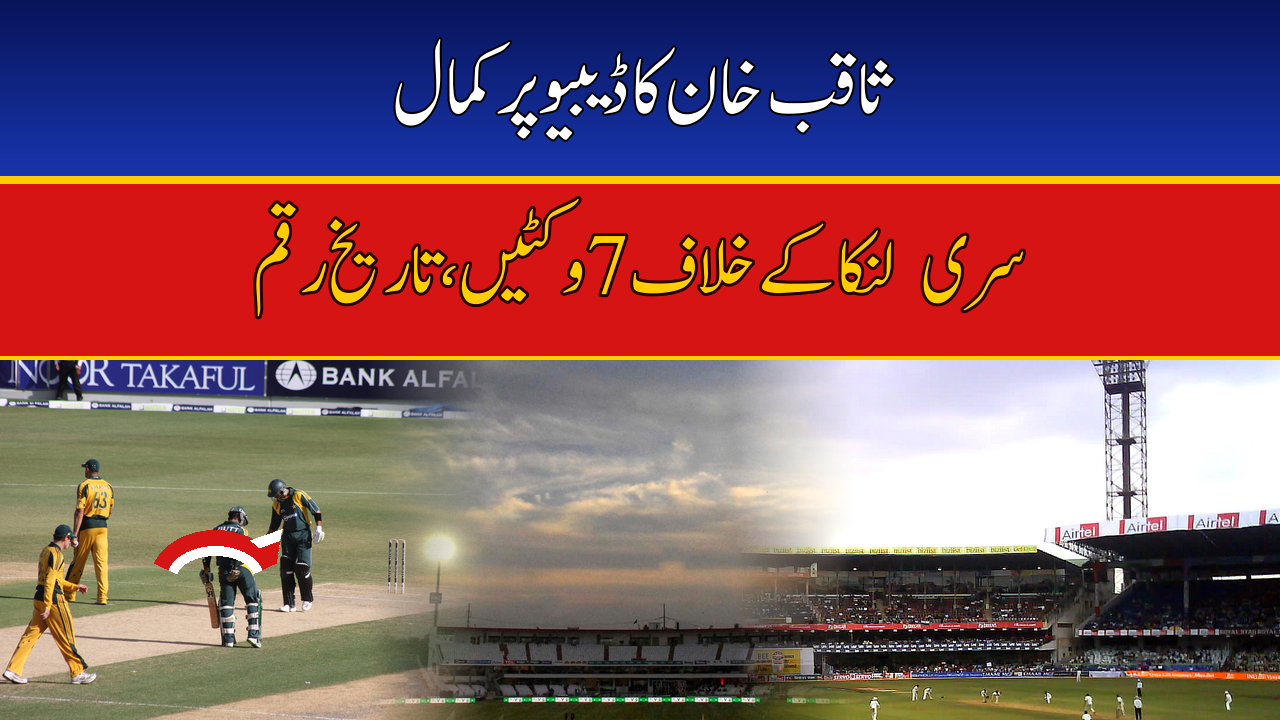
By Imran Javed | Updated 17 November 2026
Debutant fast bowler Saqib Khan took seven wickets for 130 runs against Sri Lanka in Rawalpindi on Thursday, 12 November 2026, becoming only the fourth Pakistani bowler ever to take seven wickets in an innings on Test debut. The 31-year-old’s devastating eight-over burst of five wickets for 25 runs turned a Test Sri Lanka had controlled for three days, bowling the visitors out for 446 after they had resumed on 404 for 4, and he was named Player of the Match in the drawn first Test.
It was a debut nobody in Pakistan cricket will forget in a hurry. Saqib had waited years in domestic cricket for this chance, and on an overcast fourth morning in Rawalpindi, he took it with both hands.
| Key facts | Detail |
|---|---|
| Bowler | Saqib Khan, right-arm fast-medium, age 31 |
| Match | 1st Test, Pakistan vs Sri Lanka, Rawalpindi Cricket Stadium, 9–13 November 2026 |
| Debut figures | 7 wickets for 130 runs in 34 overs (5 maidens) |
| The spell | Five wickets for 25 runs in an eight-over burst on Day 4 |
| Sri Lanka | 404 for 4 overnight to 446 all out — last six wickets for 42 runs |
| First wicket | Dinesh Chandimal, nine deliveries into his Test career |
| Record | Fourth Pakistani with seven wickets on Test debut; second Pakistani fast bowler after Mohammad Zahid |
| Player of the Match | Saqib Khan |
| Match result | Drawn — Pakistan 434/9 declared and 284/8; Sri Lanka 446 |
| Born | 9 September 1995, Karachi |
The morning that changed the Test
For three days, the first Test had belonged to Sri Lanka’s batsmen. Pakistan had declared their first innings on 434 for 9, built around Saud Shakeel’s 93 and half-centuries from three debutants, but Sri Lanka’s reply had been dominated by a mammoth fifth-wicket partnership. Dhananjaya de Silva and captain Kusal Mendis had added an unbeaten 249, and when the visitors resumed on the fourth morning at 404 for 4, they were only 30 runs behind Pakistan with six wickets in hand. A big first-innings lead looked almost certain.
Then the clouds gathered over Rawalpindi, the ball started to swing, and Saqib Khan produced one of the great mornings in Pakistan’s Test history. He struck in the very first over of the day.
The two centurions gone, the lower order folded. Saqib claimed his fifth wicket when Sonal Dinusha edged to the slip cordon for 20, then returned to finish the tail, dismissing Lahiru Kumara for a duck and Asitha Fernando for four. In all, he took five wickets for 25 runs in a devastating eight-over spell. Sri Lanka lost their last six wickets for just 42 runs and were bowled out for 446 in 117.2 overs, a lead of only 12 runs.
Mohammad Abbas, the senior seamer sharing the new ball with the debutant, took two for 68, and Razaullah claimed one for 140. But the day belonged to one man. Pakistan reached 57 for 1 in their second innings by the close, with Azan Awais unbeaten on 22 and Mohammad Taha on 24, an overall lead of 45, before rain and bad light brought an early end to play. Tayyab Arif was the only wicket to fall, trapped lbw by Asitha Fernando for 11 shortly before lunch.
Seven wickets, one by one
Saqib’s first Test wicket had actually come much earlier. Just nine deliveries into his Test career, he dismissed the experienced Dinesh Chandimal, forcing an edge to the slip cordon with a disciplined line outside off stump. By the end of Day 2 he had also removed Lahiru Udara for 42. The full list of his seven victims shows how completely he dismantled Sri Lanka’s batting:
| Batter | Score | Dismissal |
|---|---|---|
| Dinesh Chandimal | 1 | Caught in the slips off Saqib — his first Test wicket, nine balls into his career |
| Lahiru Udara | 42 | Caught behind by Ghazi Ghori off Saqib |
| Dhananjaya de Silva | 167 | Caught behind by Ghazi Ghori off Saqib, first over of Day 4 |
| Kusal Mendis | 119 | Caught behind by Ghazi Ghori off Saqib |
| Sonal Dinusha | 20 | Caught in the slips off Saqib — his fifth wicket |
| Lahiru Kumara | 0 | Lbw to Saqib |
| Asitha Fernando | 4 | Caught behind by Ghazi Ghori off Saqib — completing the seven-for |
Six of the seven dismissals were catches behind the wicket or in the slips: a disciplined line around off stump, swing under the overcast Rawalpindi sky, and the ball carrying to the cordon. Old-fashioned seam bowling, and Sri Lanka had no answer to it.

The record books: an elite list of four
Saqib’s seven for 130 put him alongside only three other Pakistan bowlers who have taken seven wickets in an innings on Test debut. No Pakistani bowler has ever taken more than seven wickets in a debut innings.
| Batter | Figures | Opposition and venue |
|---|---|---|
| Mohammad Zahid | 7 for 66 | vs New Zealand, Rawalpindi, 1996 |
| Mohammad Nazir | 7 for 99 | vs New Zealand, Karachi, 1969 |
| Abrar Ahmed | 7 for 114 | vs England, Multan, 2022 |
| Saqib Khan | 7 for 130 | vs Sri Lanka, Rawalpindi, 2026 |
The context makes the feat even more remarkable. Saqib is only the second Pakistani fast bowler, after Mohammad Zahid, to take a seven-wicket haul on Test debut, and he is the only Pakistani fast bowler to do it in this century. Zahid’s 7 for 66 against New Zealand in Rawalpindi in 1996 remains the best debut figures by a Pakistani, but Zahid is the only man ahead of Saqib among the quicks.
Abrar Ahmed’s 7 for 114 against England in Multan in 2022 was the most recent entry on the list before Saqib, and before him the names went back more than half a century to Mohammad Nazir in 1969. Seven-wicket hauls on debut are rare in any era of Test cricket. For a 31-year-old debutant to produce one, in his first match, against a side that had just put on 249 for the fifth wicket, is the stuff of which careers are defined.
Four debutants, one historic day
Saqib was not the only newcomer making history in Rawalpindi. Pakistan handed Test debuts to four players in the first Test: Tayyab Arif, Muhammad Taha, Arafat Minhas and Saqib Khan. And the debutants did not just make up the numbers.
In Pakistan’s first innings of 434 for 9 declared, three of the debutants scored half-centuries: Tayyab Arif made 57, Arafat Minhas made 52, and Mohammad Taha made 51, alongside Saud Shakeel’s 93 at the top of the order. Add Saqib’s seven-wicket haul with the ball, and the first Test became the first instance in the history of Test cricket in which three debutants scored half-centuries and a fourth claimed a five-wicket haul in the same match.
That is a record no team, in nearly 150 years of Test cricket, had produced before. It says something about the scale of the change in this Pakistan side, which went into the series with a new-look squad under captain Babar Azam. You can read about how that squad was put together in our report on the Pakistan Test squad for the Sri Lanka series. Four debutants in one Test is a gamble; four debutants producing four match-defining performances is something else entirely.
When the match ended, it was Saqib who took the individual honour. He was named Player of the Match for his seven-wicket haul, a rare award for a bowler in a drawn Test, and a fitting recognition of the spell that had saved the game for Pakistan.

The long road to Rawalpindi
What makes Saqib’s debut so compelling is how long it took to arrive. Born on 9 September 1995 in Karachi, he comes from Mingora in Swat and grew up playing tape-ball cricket in the streets of Karachi. His formal cricket education began at Karachi’s Future Stars Cricket Academy under coach Sir Liaquat, and he spent years grinding through Pakistan’s domestic circuit before the national selectors came calling.
The season that changed everything was the 2025-26 Quaid-e-Azam Trophy. Playing for Karachi Blues, Saqib finished as the tournament’s leading fast bowler, and the numbers explain why the selectors could no longer ignore him.
| Domestic season | Saqib Khan’s return |
|---|---|
| Quaid-e-Azam Trophy 2025-26 | 47 wickets in nine matches at an average of 20.60, best figures 7 for 34 |
| QeA Trophy final | Match figures of 9 for 165 against Sialkot, including 5 for 86 in the second innings, as Karachi Blues won by 218 runs |
| Tournament standing | Second-highest wicket-taker overall, one behind Ali Usman (48), and the leading fast bowler |
| President’s Trophy 2026 | 10 wickets including a five-wicket haul (5 for 37 for KRL against PTV) |
| Pakistan Super League | Part of the Quetta Gladiators squad for the 2026 season |
A five-wicket haul in the final itself, at the Gaddafi Stadium in Lahore, where his 5 for 86 in the second innings sealed Karachi Blues’ title win over Sialkot. He carried the form into the President’s Trophy Grade-I, where his 5 for 37 for Khan Research Laboratories against Pakistan Television was part of a 10-wicket tournament return that earned him his maiden Test call-up.
Speaking after play on Day 4, Saqib was open about the wait. He urged young players to remain patient and work hard, saying he had got his opportunity late and started late as well, but that it was better late than never. It is a message that will resonate with every club cricketer in Pakistan who has wondered whether the door has closed.
What Saqib said after the day of his life
The most revealing detail of the debut came from Saqib himself. The night before the fourth morning, sitting in his room with a pen and a piece of paper on the side table, he had written down his target for the innings: six wickets. He ended up with seven.
He credited head coach Mike Hesson for the plan. After a difficult third day, when Pakistan’s bowlers had struggled to contain De Silva and Kusal, Hesson told the attack to bowl in the right areas the next morning, mostly around off stump, so the ball would swing and carry towards the slips. Saqib followed the plan and was rewarded.
He was honest about the conditions, too: the overcast weather helped the fast bowlers find rhythm, but discipline was still essential. He thanked the senior players around him, naming Mohammad Abbas, Saud Shakeel and Babar Azam, and identified England’s James Anderson as a bowler whose seam-bowling skills he admired.
The match ends in a draw, and the story continues
Despite Saqib’s heroics, the weather had the final say in the first Test. More than 100 overs had already been lost to rain and bad light across the match, and the fifth day followed the same pattern. Saud Shakeel’s fighting 97 rescued Pakistan from a difficult position in the second innings, and the hosts finished on 284 for 8, a lead of 272, when the captains shook hands on Friday, 13 November. The match was drawn, with four World Test Championship points going to each side.
For the points picture and what the draw means for the standings, see our report on the WTC points position after the first Test.
But the story did not stop there. The second and final Test began at the same Rawalpindi ground on Tuesday, 17 November, and Saqib picked up exactly where he had left off. In the fourth over of the match, he drew an edge off Pasindu Sooriyabandara, on two, with wicketkeeper Ghazi Ghori taking the catch, to give Pakistan the first wicket of the Test. Sri Lanka were bowled out for just 98, and Saqib finished with one for 29 in eight overs, ending the day as nightwatchman on two as Pakistan reached 121 for 3. Full coverage of the second Test is in our second Test preview and Day 1 report.
A debut seven-for, a Player of the Match award, a place in the record books, and a wicket in the fourth over of the very next Test. At 31, after years of domestic toil, Saqib Khan has announced himself, and on the evidence of one extraordinary morning in Rawalpindi, the wait was worth it.
Frequently asked questions
How many wickets did Saqib Khan take on his Test debut?
Saqib Khan took seven wickets for 130 runs in 34 overs on his Test debut against Sri Lanka in Rawalpindi. His figures included five wickets for 25 runs in an eight-over spell on Day 4, Thursday 12 November 2026, as Sri Lanka collapsed from 404 for 4 to 446 all out.
Who are the Pakistan bowlers with seven wickets on Test debut?
Only four Pakistan bowlers have taken seven wickets in an innings on Test debut: Mohammad Zahid (7 for 66 vs New Zealand, Rawalpindi, 1996), Mohammad Nazir (7 for 99 vs New Zealand, Karachi, 1969), Abrar Ahmed (7 for 114 vs England, Multan, 2022) and Saqib Khan (7 for 130 vs Sri Lanka, Rawalpindi, 2026).
Was Saqib Khan named Player of the Match on debut?
Yes. Saqib Khan was named Player of the Match in the drawn first Test against Sri Lanka in Rawalpindi, for his seven-wicket haul of 7 for 130 that restricted Sri Lanka to a first-innings lead of only 12 runs.
How old is Saqib Khan and where is he from?
Saqib Khan is 31 years old. He was born on 9 September 1995 in Karachi, and he comes from Mingora in Swat. He grew up playing tape-ball cricket in Karachi and came through the Future Stars Cricket Academy before a long domestic career with Karachi Blues.
How many wickets did Saqib Khan take in the Quaid-e-Azam Trophy 2025-26?
Saqib Khan took 47 wickets in nine matches at an average of 20.60 in the 2025-26 Quaid-e-Azam Trophy, finishing as the tournament’s leading fast bowler and second-highest wicket-taker overall. He took 5 for 86 in the second innings of the final as Karachi Blues beat Sialkot by 218 runs to win the title.
What was the result of the first Test between Pakistan and Sri Lanka?
The first Test in Rawalpindi ended in a draw on Friday, 13 November 2026. Pakistan scored 434 for 9 declared and 284 for 8, while Sri Lanka made 446 in their only innings. More than 100 overs were lost to rain and bad light across the five days.