Punjab Six Universities Name Change: GCU Lahore VCs Seek Repeal
By Daniyal Sheikh | Updated: 7 November 2026 The vice chancellors of six public universities in Punjab have asked the provincial government to repeal the law that strips the word “University” from their names. The heads of the six institutions met Higher Education Department (HED) Secretary Ghulam Fareed on Friday, 6 November, and submitted a…
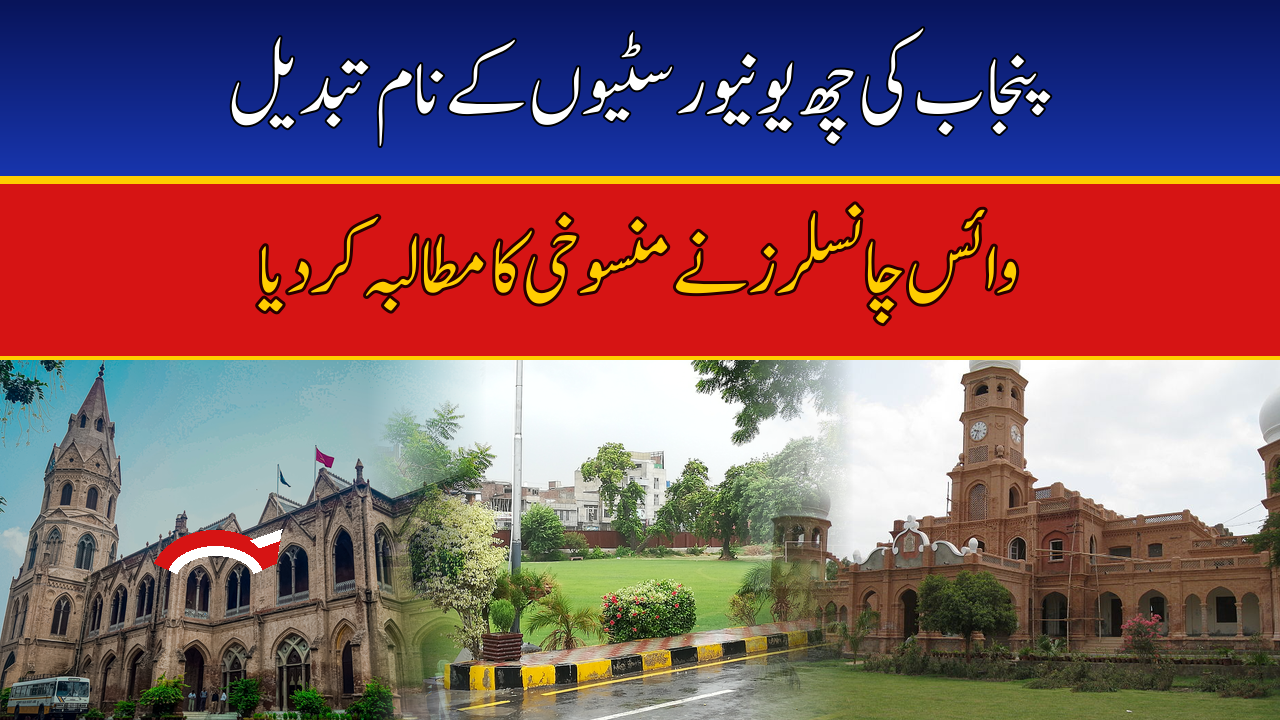
By Daniyal Sheikh | Updated: 7 November 2026
The vice chancellors of six public universities in Punjab have asked the provincial government to repeal the law that strips the word “University” from their names. The heads of the six institutions met Higher Education Department (HED) Secretary Ghulam Fareed on Friday, 6 November, and submitted a formal representation to the Speaker’s office seeking the immediate repeal of the Public Sector Universities (Amendment) Act, 2026. Their warning is blunt: the renaming could damage the universities’ international academic recognition, split their research records across global databases, and create problems for graduates trying to get their degrees verified abroad.
In this article: the six institutions and their new names, why the vice chancellors object, what the government says, what it means for students and graduates, and what happens next.
What happened on Friday
On Friday, 6 November, the vice chancellors of the six affected universities met HED Secretary Ghulam Fareed in Lahore and handed over a joint representation. A copy was submitted to the Speaker’s office, asking for the immediate repeal of the Public Sector Universities (Amendment) Act, 2026. Copies also went to the chief minister, the Punjab governor, the Higher Education Commission (HEC) of Pakistan and the Punjab Higher Education Commission.
Signed by the vice chancellors of the six institutions: Government College University Lahore, Lahore College for Women University, Government College University Faisalabad, Government College Women University Faisalabad, Government College Women University Sialkot and Government Sadiq College Women University Bahawalpur. Six institutions in four cities have chosen to speak with one voice.
The vice chancellors say the change was introduced without consulting the universities or their stakeholders, and that it will cause academic, legal and reputational complications without offering any tangible benefit. They also say that, to their knowledge, the Higher Education Commission of Pakistan was not consulted about the implications before the legislation was passed.
The six universities and their new names
Under the HED notification issued on 23 October 2026, the six institutions must drop the word “University” from their titles and revert to their former college names. The notification was issued under the Public Sector Universities (Amendment) Act, 2026 (Act XXIII of 2026), published in the Punjab Gazette on 6 May 2026.
| Old name (since 2002) | New name under the notification | City |
|---|---|---|
| Government College University Lahore | Government College Lahore | Lahore |
| Lahore College for Women University | Lahore College for Women Lahore | Lahore |
| Government College University Faisalabad | Government College Faisalabad | Faisalabad |
| Government College Women University Faisalabad | Government College for Women Faisalabad | Faisalabad |
| Government College Women University Sialkot | Government College for Women Sialkot | Sialkot |
| Government Sadiq College Women University Bahawalpur | Government Sadiq College, Bahawalpur | Bahawalpur |
The notification directs the institutions to take the necessary action under the Act, but it sets no completion deadline. That leaves the universities in a strange middle ground: legally renamed on paper, but with no date by which signboards, websites, letterheads and degree formats must change.
Why the vice chancellors are objecting
The core of the vice chancellors’ case is identity. When these colleges were upgraded and reconstituted as universities in 2002, the names they adopted deliberately kept their historical association while recognising their new status. In the 24 years since, those names have become the identity under which the institutions publish research, sign international collaborations, run doctoral programmes, win research grants and appear in international university rankings.
The representation warns that changing the names now could fragment the institutions’ academic records across international databases, including Scopus, Web of Science, Google Scholar, ORCID and Crossref. Publications, citations, rankings and collaborations are all recorded under the existing names, and the vice chancellors say those records would not automatically transfer to the revised nomenclature.
The second warning concerns graduates. The vice chancellors say the change could create difficulties in the verification and recognition of degrees by foreign regulators, employers and immigration authorities, including organisations such as World Education Services (WES) and ECCTIS.
To be clear about what is and is not being claimed: nobody has said that degrees already issued have become invalid. The vice chancellors are warning about a risk, not announcing a fact. The concern is practical rather than legal. When a graduate abroad sends a degree for verification and the name on the paper no longer matches the name in the verifying body’s database, the process slows down and questions multiply. For a student applying for a foreign scholarship or a job with a deadline, a delay can cost the opportunity itself.
What the Punjab government says
The Punjab government’s position, stated in the notification and repeated in official briefings, is that the change is about names only. The institutions’ higher education mandate and functions will remain unchanged, and their authority to conduct higher education and carry out academic and administrative responsibilities stays intact. In other words, the government says nothing about what these institutions do is changing, only what they are called.
There is also a sentimental case for the renaming. Government College Lahore is one of the oldest educational institutions in the region, and for many of its old graduates the return of the historic name is welcome. One alumnus, Nadeem Malek, told The Express Tribune that restoring the old name was the wish of thousands of old graduates, while adding that the government should also focus on restoring the historic standard of the college.
But the vice chancellors’ answer to the names-only argument is that in higher education, a name is not decoration. It is the key that links an institution to its own record. Change the key, and every database, ranking and verification system holding the old key has to be updated, or the link breaks. The government has not yet explained how that updating would happen, or who would pay for it.
A 160-year history behind the name
The dispute is sharpest around Government College University Lahore, because its history is longest and its name best known. The institution was established on 1 January 1864 with an initial enrolment of just nine students, attained degree-awarding status in 1997, and was elevated to university status in 2002 after more than 100 years as Government College Lahore.
Its history is associated with distinguished personalities, including the philosopher and educationist Dr G. W. Leitner, national poet Allama Iqbal and Nobel laureate Dr Abdus Salam. That is why the name carries weight far beyond Lahore: when a GCU graduate applies for a PhD abroad, the admissions committee recognises the name. The vice chancellors argue that 24 years of building that recognition as a university cannot simply be folded back into a college name without cost.
The other five institutions face the same problem at a smaller scale. Lahore College for Women University, for example, is one of the largest women’s universities in the country, and its graduates apply for jobs and scholarships under that name at home and abroad.
What it means for current students and graduates
The practical effects are still unclear. Here is what is known, and what is not.
What is known: the institutions keep their degree-awarding powers, mandates and functions. No notification has said existing degrees are invalid, and no university has announced a change to the degrees it is issuing.
What is not known: how the transition will appear on the certificates of current students and graduates. Will future degrees carry the new college name? Will graduates need an equivalence letter explaining that Government College Lahore and Government College University Lahore are the same institution? None of these questions has a public answer yet.
For students and recent graduates, the sensible steps are simple and cost nothing. Keep copies of every document linking you to the institution under its current name: admission letter, fee receipts, transcripts, student card and any HEC attestation already done. If you are applying abroad, apply early. Follow official announcements from your own university rather than rumours on social media, where this story is already being shared with claims far beyond what any official source has said.
Education news travels fast in Punjab, and wrong information spreads just as quickly. A fake school holiday notice recently caused confusion before being debunked, as reported in our piece on Punjab schools open today after a fake holiday notice was debunked.
What happens next
The vice chancellors have asked for two things. Their first demand is that the Punjab Assembly repeal the amendment and restore the statutory names under which the institutions have operated since their upgrade in 2002. Their fallback request, if repeal does not happen immediately, is the suspension of the amendment and an independent assessment of its legal, academic and reputational consequences, along with hearings involving vice chancellors, students, alumni and faculty members.
The Speaker’s office and the provincial government have not yet publicly responded. The Assembly could repeal the amendment, suspend it while an assessment is carried out, or let the notification stand, in which case the universities would have to implement the new names and deal with the verification and records problems as they arise.
The HEC’s involvement matters. The vice chancellors say the HEC was not consulted before the legislation was passed, and the representation has been forwarded to the HEC for necessary action. As the body that recognises universities and attests degrees, the HEC’s view will carry weight with the Assembly and with foreign verification bodies. Students planning foreign study should also note the HEC’s support programmes, including free GRE training for the US-Pak Knowledge Corridor PhD scholarships.
The timing matters for the academic calendar too. The Punjab boards’ 11th class result 2026 has already been announced, and the next admission cycle will bring a new wave of students into these very institutions. Those students will want to know, before they apply, which name will appear on their degree.
For now, the names on the signboards have not changed, the degrees have not changed, and the law has not been repealed. The vice chancellors have made their case in writing. The next move belongs to the Punjab government.
Frequently Asked Questions
Which six Punjab universities are being renamed?
Government College University Lahore, Lahore College for Women University, Government College University Faisalabad, Government College Women University Faisalabad, Government College Women University Sialkot and Government Sadiq College Women University Bahawalpur. Under the HED notification of 23 October 2026, all six must drop the word “University” from their names and revert to their former college names.
What is the new name of GCU Lahore?
Government College University Lahore will be known as Government College Lahore under the notification. The institution operated under that name for more than a century before being elevated to university status in 2002.
Why are the vice chancellors asking for the law to be repealed?
They warn the renaming could affect the universities’ international academic recognition, fragment their research records across databases such as Scopus, Web of Science, Google Scholar, ORCID and Crossref, and create difficulties in degree verification by foreign regulators, employers and immigration authorities, including WES and ECCTIS. They also say the change was made without consulting the universities or the Higher Education Commission.
Are degrees from these universities still valid?
Yes. Nothing in the notification says existing degrees are invalid, and the institutions keep their degree-awarding powers, mandates and functions. The vice chancellors have warned about a risk to future verification, not announced that degrees have lost validity. How the name change will appear on future certificates has not yet been clarified.
What law is behind the renaming?
The Public Sector Universities (Amendment) Act, 2026 (Act XXIII of 2026), published in the Punjab Gazette on 6 May 2026. The Higher Education Department issued the implementation notification on 23 October 2026, directing the six institutions to adopt their former college names.
When did the vice chancellors meet the government?
On Friday, 6 November 2026, the six vice chancellors met Higher Education Department Secretary Ghulam Fareed and submitted a joint representation to the Speaker’s office requesting the immediate repeal of the amendment. Copies were also sent to the chief minister, the Punjab governor, the HEC and the Punjab Higher Education Commission.
What happens next in this dispute?
The vice chancellors want the Punjab Assembly to repeal the amendment and restore the university names used since 2002. Alternatively, they have asked for the amendment to be suspended while an independent assessment of its legal, academic and reputational consequences is carried out, with hearings involving vice chancellors, students, alumni and faculty. The Speaker’s office and the provincial government have not yet publicly responded.