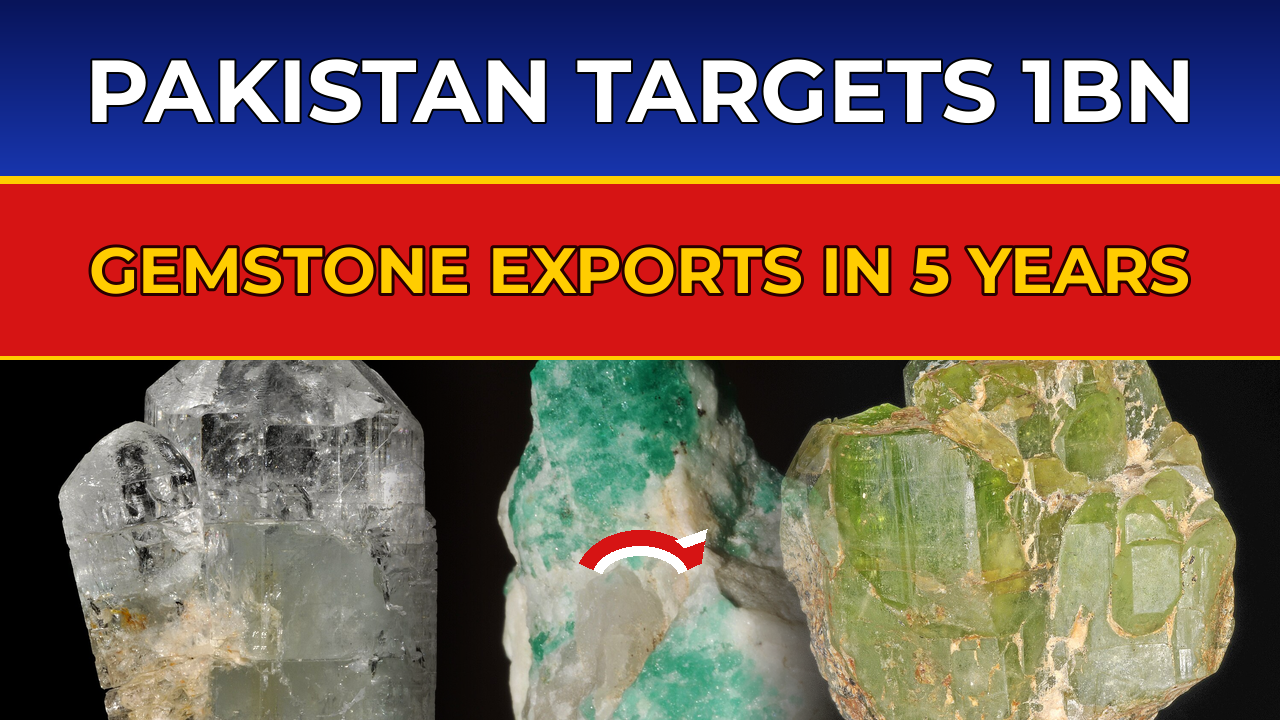
Pakistan Targets $1 Billion Gemstone Exports in 5 Years as Reserves Estimated at $450 Billion
By Bilal Ahmed | 18 November 2026 Pakistan will raise its gemstone exports to $1 billion within five years, the government announced on Tuesday, tapping into gemstone reserves estimated at about $450 billion that today earn the country only $5.8 million a year in formal exports. The plan rests on four things: cutting and polishing…
By Bilal Ahmed | 18 November 2026
Pakistan will raise its gemstone exports to $1 billion within five years, the government announced on Tuesday, tapping into gemstone reserves estimated at about $450 billion that today earn the country only $5.8 million a year in formal exports. The plan rests on four things: cutting and polishing stones at home instead of shipping them raw, internationally recognised certification, modern mining, and selling the world a new label — Brand Pakistan.
The announcement came from Special Assistant to the Prime Minister on Energy, Lt Gen (retd) Muhammad Zafar Iqbal, as he opened a four-day international workshop in Islamabad titled “Unlocking the Value of Indigenous Gemstones”. The workshop runs from 17 to 20 November and brings together the Asian Productivity Organization, Pakistan’s National Productivity Organization and the Pakistan Gems and Jewellery Development Company.

The numbers at a glance
The gap between what Pakistan owns and what it earns is the whole story. The figures below are the ones the government itself put on the table this week.
| Fact | Figure |
|---|---|
| Export target | $1 billion within five years |
| Estimated gemstone reserves | About $450 billion |
| Current formal exports | Only $5.8 million a year |
| Companies in the sector | More than 5,000 |
| Gemstone varieties processed | Over 30, including emerald, peridot, ruby, topaz and aquamarine |
| Policy | National Policy to Realise Pakistan’s Gemstone Potential 2026–2030 |
| Workshop | “Unlocking the Value of Indigenous Gemstones”, Islamabad, 17–20 November 2026 |
Put simply, Pakistan is sitting on an estimated $450 billion of stones and officially selling less than $6 million of them a year. That is the gap the new target is meant to close — and it explains why the government is talking about this sector now.
Where Pakistan’s gemstones come from
Pakistan’s gemstone reserves are concentrated in Gilgit-Baltistan, Khyber Pakhtunkhwa and Azad Jammu and Kashmir, with considerable untapped potential in Balochistan, according to the Special Assistant. These northern valleys have produced fine emerald, peridot, ruby, topaz and aquamarine for decades — stones that dealers around the world already know by name, even if few buyers know they came from Pakistan.

The problem has never been the quality of the stone. It has been everything that happens after the stone leaves the ground.
Why exports are only $5.8 million today
More than 5,000 companies work with gemstones in Pakistan, processing over 30 varieties. Yet the sector remains underdeveloped, the government concedes, because mining is still largely done the traditional way, very little value is added inside the country, and there is no proper standardisation or certification system that foreign buyers trust.
Most of the trade still moves through informal channels rather than documented export routes, the Ministry of Industries and Production has said — which is why the official export figure looks so small next to the size of the reserves. Stones leave the country rough and uncut, and the real money — the cutting, polishing, grading and branding — is made somewhere else.
This is the same trap other export sectors have faced: sell the raw material cheap, buy back the finished product dear. Breaking it is what the new policy is for. For context, Pakistan’s IT exports earned $435 million in a single month — September 2026 — showing what a documented, value-added export sector can deliver; read our report on Pakistan’s record IT exports.
What the government plans to do
Under the National Policy to Realise Pakistan’s Gemstone Potential 2026–2030, the government is working on a package of reforms:
- Internationally recognised certification — so a Pakistani emerald or peridot carries paperwork a buyer in Bangkok, Jaipur or New York will accept without question.
- A dedicated authority for sector development and investment, plus a National Warranty Office to standardise inspection, valuation, certification and sealing of export consignments.
- Geological mapping and modern mining technologies to replace the blasting and digging methods that damage stones before they ever reach a market.
- Specialised training and Centres of Excellence for cutting, polishing and processing, so finishing work happens in Pakistan.
- Brand Pakistan — promoting Pakistani stones as a named, trusted origin in world markets rather than as anonymous rough material.
The Islamabad workshop itself is focused on exactly these gaps: global gemstone market trends, standardisation, formal trade compliance, modern cutting and processing, value addition, public-private partnerships and business-to-business links with other Asian economies. A one-day exhibition of indigenous precious and semi-precious stones was also held alongside the workshop, according to Business Recorder.

How Pakistan compares with India and Thailand
The comparison is stark, and it is the government’s own. According to the policy document, Pakistan’s documented gemstone exports stood at $5.78 million in 2025. In the same comparison, India exported $16.25 billion worth of gems and jewellery in 2024 and Thailand $3.49 billion — Thailand despite having largely depleted natural reserves of its own, and India with comparatively modest reserves.
| Country | Gem exports | Natural reserves |
|---|---|---|
| Pakistan | $5.78 million (2025) | Estimated $450 billion |
| India | $16.25 billion (2024) | Comparatively modest |
| Thailand | $3.49 billion (2024) | Largely depleted |
Thailand’s example is the one Pakistani policymakers keep returning to: a country with few stones of its own that became a world cutting and trading hub on skill, certification and branding. That is the model behind Brand Pakistan and the planned Centres of Excellence. The policy was approved in principle by Prime Minister Shehbaz Sharif in January 2026, and the $1 billion target announced this week raises the ambition further — an earlier version of the plan had aimed for around $500 million by 2030.

What this means for miners, traders and exporters
For the thousands of small miners and traders in the north, the promise is straightforward: if cutting, certification and proper pricing happen in Pakistan, more of each stone’s value stays with the people who dug it out. Formalisation also means access to finance, insurance and proper export channels that informal trade cannot offer.
For the wider economy, gemstones are a small but telling piece of the export puzzle. Like gold — whose daily rates we track on our gold rate in Pakistan page — gemstones are a high-value, low-volume product: a little weight carries a lot of foreign exchange. Export growth in any sector also feeds market confidence; follow the broader picture on our Pakistan Stock Exchange page.

The test, as ever, will be delivery. A $1 billion target is easy to announce; certification labs, trained cutters and trusted branding take years to build. The workshop that opened on Tuesday is a start — but the next milestone to watch is the first certified, cut-in-Pakistan shipment sold abroad under the Brand Pakistan name. When that happens, the $5.8 million figure will finally start to move.
FAQs
What is Pakistan’s gemstone export target?
Pakistan aims to increase gemstone exports to $1 billion within five years, up from only $5.8 million in formal exports today. The target was announced on 17 November 2026 by Special Assistant to the Prime Minister on Energy, Lt Gen (retd) Muhammad Zafar Iqbal.
How much are Pakistan’s gemstone reserves worth?
The country’s gemstone resources are estimated at about $450 billion, according to the government. The reserves are concentrated in Gilgit-Baltistan, Khyber Pakhtunkhwa and Azad Jammu and Kashmir, with considerable untapped potential in Balochistan.
Why are Pakistan’s gemstone exports only $5.8 million?
Because most stones are exported rough and uncut, mining still uses traditional methods, and there is no internationally recognised certification system. Much of the trade also flows through informal channels, so it never appears in official export figures. More than 5,000 companies work in the sector, but value addition inside Pakistan remains very limited.
Which gemstones does Pakistan produce?
Over 30 varieties are processed in Pakistan, including emerald, peridot, ruby, topaz and aquamarine. Swat is famous for emerald, while peridot is mined in areas such as Mansehra in Khyber Pakhtunkhwa.
What is Brand Pakistan in gemstones?
Brand Pakistan is the government’s plan to market Pakistani gemstones as a named, certified origin in world markets — cut, polished and graded in Pakistan — instead of selling anonymous rough stones that other countries finish and brand as their own.
What is the National Policy to Realise Pakistan’s Gemstone Potential 2026–2030?
It is the government’s reform programme for the sector, approved in principle in January 2026. It covers an internationally recognised certification system, a dedicated sector authority, a National Warranty Office, geological mapping, modern mining technology, specialised training and Centres of Excellence for cutting and polishing.
Updated: 18 November 2026. This article will be updated as the workshop concludes and the government releases further details.