Pakistan Considers Putting Its Eurobond Debt on the Blockchain — Cabinet Approval First
Pakistan is reviewing a plan to put its existing Eurobond debt on a blockchain, Finance Minister Muhammad Aurangzeb said on Monday, November 2, 2026 — a move that would make the country one of the first sovereign borrowers to tokenise its international bonds. The proposal is not yet approved: the government will seek cabinet approval…
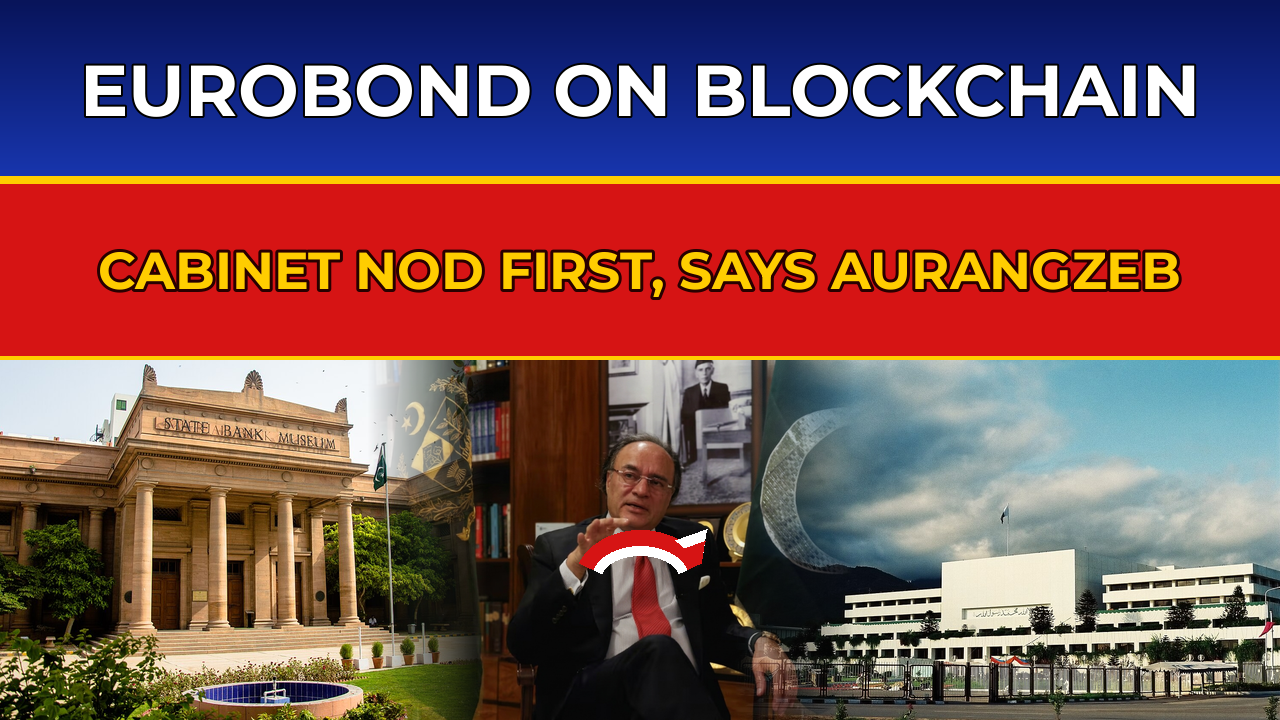
Pakistan is reviewing a plan to put its existing Eurobond debt on a blockchain, Finance Minister Muhammad Aurangzeb said on Monday, November 2, 2026 — a move that would make the country one of the first sovereign borrowers to tokenise its international bonds. The proposal is not yet approved: the government will seek cabinet approval first, and only then invite formal proposals from the market.
Aurangzeb made the announcement in a virtual keynote address to the “Dialogue on Digital Assets and the Future of Banking”, organised by the Pakistan Banks’ Association in collaboration with Lahore University of Management Sciences (LUMS). His message was deliberately practical: digital assets must earn their place in Pakistan’s financial system by cutting costs for ordinary people and businesses, not by chasing novelty.
Key facts
| Proposal | Tokenise Pakistan’s existing Eurobond debt on a blockchain |
|---|---|
| Status | Under government review — cabinet approval required before any RFP |
| Announced by | Finance Minister Muhammad Aurangzeb, November 2, 2026 |
| Forum | PBA–LUMS “Dialogue on Digital Assets and the Future of Banking” (virtual keynote) |
| Second use case | Tokenised remittances, including Roshan Digital Account flows |
| Remittances last fiscal year | $41.6 billion; first-quarter trend points above $44 billion this year |
| Recent Eurobond issue | $3 billion dual-tranche issue, September 2026 (5.5-year and 10-year maturities) |
| Earlier tokenisation step | December 2025 MoU with Binance to explore tokenising up to $2 billion of government assets |
| Legal framework | Virtual Assets Act 2026; Pakistan Virtual Assets Regulatory Authority (PVARA) licenses and supervises providers |
| Bank guardrail | Banks may serve licensed virtual-asset firms conditionally, but may NOT invest in, trade or hold virtual assets with their own funds or customer deposits |
What tokenising a Eurobond actually means
Tokenisation means creating a digital representation of a bond on a blockchain, so that ownership can be recorded and potentially transferred digitally rather than only through conventional clearing systems. The model under consideration — often called a digitally native note issued through a regulated market infrastructure — would create the bond on a regulated blockchain platform at the moment of issuance, with same-day settlement, before integrating with the international clearing systems that already serve Pakistan’s Eurobond programme.
For a sovereign borrower, the pitch is speed and cost: faster settlement, lower friction in cross-border payments, and a wider potential investor base, including overseas Pakistanis. Aurangzeb framed the test in household terms — whether a family can receive money from abroad at a lower cost, whether a business gets paid sooner, and whether an entrepreneur can obtain financing on reasonable terms — while financial stability is protected.
Why remittances are the second half of the story
Remittances are the use case that makes the proposal matter beyond capital markets. Pakistan received $41.6 billion in workers’ remittances last fiscal year, and first-quarter trends suggest inflows could exceed $44 billion this year. If tokenised rails can move that money more cheaply and quickly — including through Roshan Digital Accounts, which Aurangzeb named explicitly — the savings would land directly with millions of families.
That is also why the banking establishment was in the room. The dialogue brought together the Finance Ministry, PVARA, the State Bank of Pakistan, the Securities and Exchange Commission of Pakistan and banking leaders, alongside international experts. State Bank Deputy Governor Saleem Ullah stressed practical use cases over technology itself, identifying blockchain-enabled remittances and Roshan Digital Accounts as areas worth exploring in a sandbox. SECP Commissioner Imtiaz Haider called for a clear, value-driven approach to tokenisation.
The framework that makes it possible — and its limits
Pakistan has moved fast from prohibition to a statutory framework. The Virtual Assets Act 2026 created PVARA to license and supervise virtual-asset service providers, and the licensing system was launched in August 2026, according to trade-press reporting. The State Bank has introduced a conditional mechanism allowing banks to provide services to licensed virtual-asset entities, subject to due diligence and segregation of client funds.
But the guardrails are explicit and remain in place: banks are still barred from investing in, trading or holding virtual assets using their own funds or customer deposits. Aurangzeb also stressed that innovation must come with appropriate safeguards, regulatory oversight and cybersecurity measures, and that the task now is making the framework effective through capable supervision and clear coordination between institutions.
The international templates cited are established ones, not experiments: JPMorgan’s use of deposit tokens for transfers between institutional clients, and the Bank for International Settlements’ Project Agora, which is examining tokenised deposits and central bank reserves for cross-border settlement. Pakistan also co-convened a dialogue on blockchain and the tokenised future with the UN Office for Digital and Emerging Technologies in New York in late September.
What is decided — and what is not
It is important to be precise about where this stands. What is confirmed: the government is reviewing tokenisation of existing Eurobond debt, cabinet approval is the next step, and an RFP will follow only after that approval. What is not confirmed: no timetable has been announced, no size for a tokenised tranche has been stated, and no decision has been taken on which existing bonds would be included.
The proposal also sits alongside a much larger debt picture: Pakistan’s public and guaranteed debt reached Rs90.98 trillion by June 2026, though the debt-to-GDP ratio fell to 71.7%. Tokenisation would change how some of that debt is recorded and traded — it would not, on its own, reduce the amount owed. And with October inflation easing to 9.61%, the government has some breathing room to pursue structural reforms rather than emergency measures.
The December 2025 memorandum of understanding with Binance — to explore tokenising up to $2 billion of government assets including sovereign bonds, treasury bills and commodity reserves — shows this idea has been developing for nearly a year. The cabinet decision, when it comes, will show whether it moves from exploration to execution.
Frequently asked questions
Is Pakistan tokenising its Eurobonds now?
Not yet. Finance Minister Muhammad Aurangzeb said on November 2, 2026 that the government is reviewing the possibility of tokenising existing Eurobond debt. Cabinet approval must come first, and a formal Request for Proposals (RFP) will only be issued after that approval.
What does tokenising a bond mean?
It means creating a digital representation of the bond on a blockchain, so ownership can be recorded and potentially transferred digitally, with same-day settlement in the model under consideration, before integrating with conventional international clearing systems.
Why is the government considering this?
To cut the cost of doing business, speed up cross-border payments and widen the investor base. Aurangzeb’s test is practical: cheaper remittances for families, faster payment for businesses, and financing on reasonable terms for entrepreneurs, with financial stability protected.
How do remittances fit in?
Remittances are the second use case. Pakistan received $41.6 billion last fiscal year and first-quarter trends point above $44 billion this year. Tokenised rails, including through Roshan Digital Accounts, could move that money more cheaply and quickly.
What law governs virtual assets in Pakistan?
The Virtual Assets Act 2026, which created the Pakistan Virtual Assets Regulatory Authority (PVARA) to license and supervise virtual-asset service providers. The licensing system was launched in August 2026, according to trade-press reporting.
Can Pakistani banks hold crypto or virtual assets?
No. Banks may provide services to licensed virtual-asset entities under a conditional State Bank mechanism, with due diligence and segregation of client funds — but they remain barred from investing in, trading or holding virtual assets with their own funds or customer deposits.
Has Pakistan issued Eurobonds recently?
Yes. In September 2026 the government raised $3 billion through a dual-tranche Eurobond issue with five-and-a-half and ten-year maturities. Separately, in December 2025 it signed an MoU with Binance to explore tokenising up to $2 billion of government assets, including sovereign bonds and treasury bills.