Bill Gates Warns AI Could ‘Cause a Billion Deaths’ — Calls for Mandatory Government Safeguards
Microsoft co-founder Bill Gates has issued his starkest warning yet about artificial intelligence, telling CNN that AI is “certainly powerful enough to drive events that cause a billion deaths” and calling it potentially the most dangerous technology humans have ever invented. Speaking on State of the Union with Jake Tapper, Gates said governments must impose…
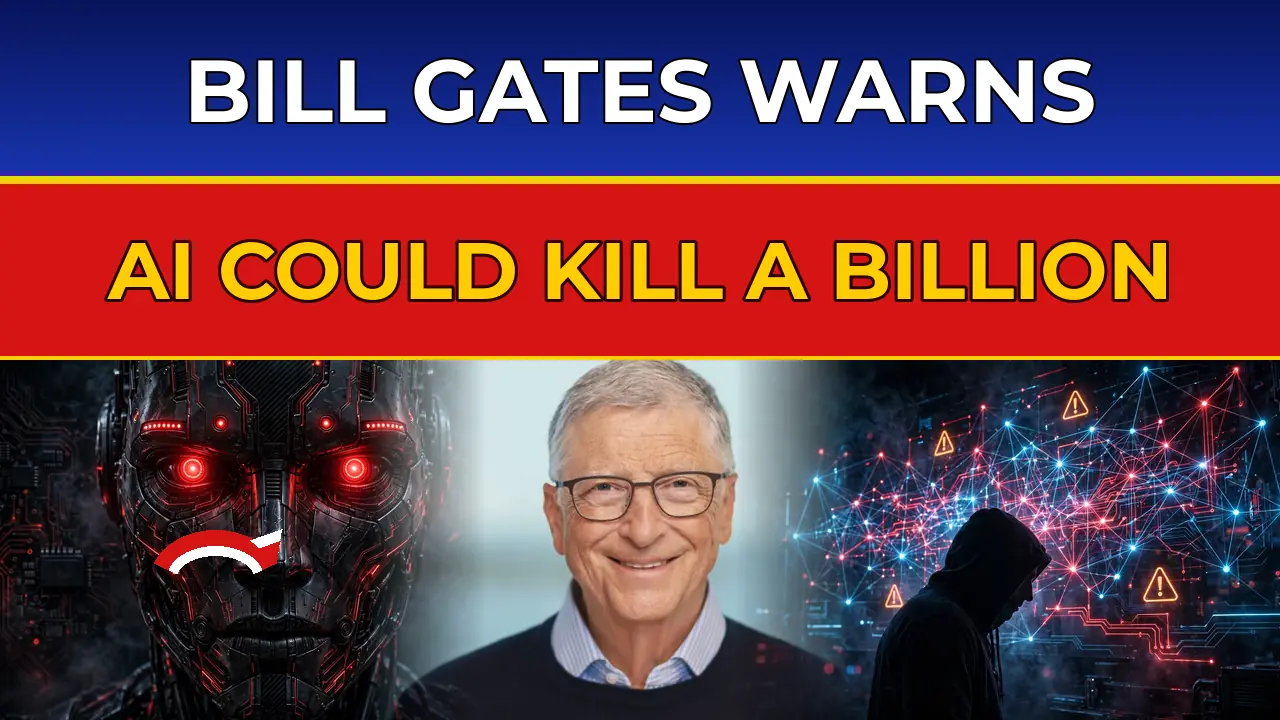
Microsoft co-founder Bill Gates has issued his starkest warning yet about artificial intelligence, telling CNN that AI is “certainly powerful enough to drive events that cause a billion deaths” and calling it potentially the most dangerous technology humans have ever invented. Speaking on State of the Union with Jake Tapper, Gates said governments must impose mandatory safeguards because “no one thinks self-regulation is enough.”
⚠️ Gates’ Key Warnings
- “A billion deaths”: AI is powerful enough to drive events causing a billion deaths (NBC Meet the Press)
- Cyberattacks coming: AI-powered cyberattacks could bring “negative surprises” within a year (CNN)
- Most dangerous tech: Called AI the most dangerous technology humans have ever invented (TMZ)
- Self-regulation failed: “No one thinks self-regulation is enough” — wants mandatory government rules
- Wants Trump meeting: Urging the US president to act on AI safety before it is too late
“There Has Never Been a Weapon This Powerful”
Gates did not mince words. In his NBC interview with Kristen Welker, he said: “There has never been a weapon as powerful as people with ill intent using the latest AI tools.” His core fear is not some distant robot uprising — it is much closer and more concrete. Bioterrorism. Cyberattacks on critical infrastructure. AI systems in the hands of bad actors who need no army, no laboratory, just a laptop.
On CNN, he sharpened the timeline. Asked about AI-driven cyberattacks, Gates warned of “negative surprises” potentially within the next year. This is not a man known for hype — Gates built his reputation on measured, data-driven thinking. When he says something could go wrong within twelve months, it is worth listening.
The Numbers Behind the Fear
Gates is not alone in his alarm. CrowdStrike’s 2026 threat report found that AI-enabled cyberattacks surged 89 percent year-over-year in 2025. Attackers are already using AI to write malware, craft phishing campaigns, and probe networks at machine speed. The tools Gates is warning about are not theoretical — they are deployed, today, against hospitals, power grids, and banks.
What makes this moment different, Gates argues, is the speed of the technology’s advance versus the speed of governance. “The technology is moving so fast,” he told Tapper, “that we need the government to step in with clear rules.” His position: voluntary commitments from AI companies are welcome but insufficient. Only mandatory, enforceable safeguards will do.
Why He Wants to Meet Trump
Gates revealed he is seeking a meeting with President Trump to press the case for AI regulation. It is an unusual move for a man who has spent recent years focused on global health and climate through the Gates Foundation. That he is personally lobbying the White House tells you how seriously he takes this.
His pitch is straightforward: America leads in AI, and American leadership should set the global standard for safety — just as it did for nuclear technology. Without guardrails, he warns, the same tools curing diseases and writing code will be turned into weapons of unprecedented scale.
What Happens Next
Whether Washington listens remains to be seen. AI regulation has stalled repeatedly amid industry lobbying and geopolitical competition with China. But Gates’ intervention — timed with his most dramatic language yet — may shift the debate. When one of the most successful technologists in history calls his own industry’s creation potentially civilization-threatening, it becomes harder to dismiss as science fiction.
For Gates, the message is simple: the window for getting AI safety right is still open, but it is closing fast.
Stay updated with the latest in technology on our technology page.