Pakistan Beat Sri Lanka by 37 Runs in Tri-Series Opener
Pakistan defeated Sri Lanka by 37 runs in the opening match of the ODI tri-series at Rawalpindi Cricket Stadium on October 18, 2026, taking a winning start to the three-nation tournament. Salman Ali Agha’s brilliant 107 off 90 balls lifted Pakistan to 305 all out, before captain Shaheen Afridi (3 for 55) led a disciplined…
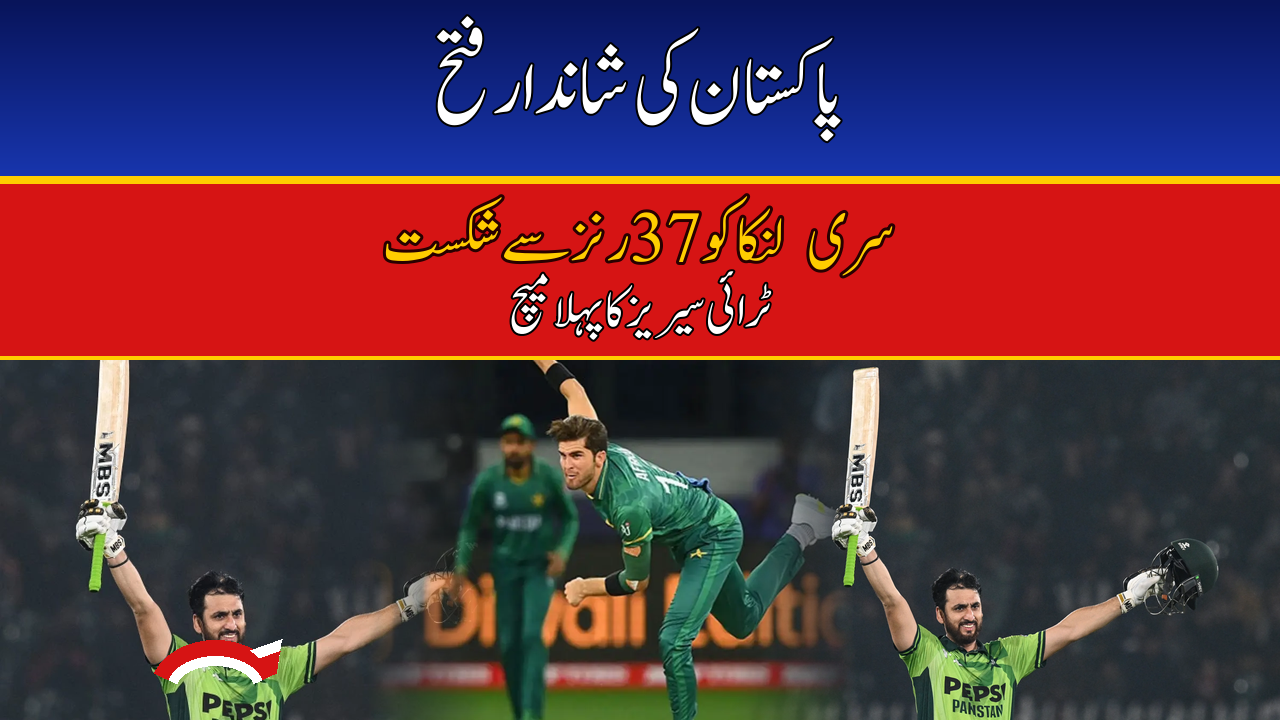
Pakistan defeated Sri Lanka by 37 runs in the opening match of the ODI tri-series at Rawalpindi Cricket Stadium on October 18, 2026, taking a winning start to the three-nation tournament. Salman Ali Agha’s brilliant 107 off 90 balls lifted Pakistan to 305 all out, before captain Shaheen Afridi (3 for 55) led a disciplined bowling effort to dismiss Sri Lanka for 268 in 48.1 overs.
⚡ Match at a Glance
| Match | Pakistan vs Sri Lanka, 1st Match — ODI Tri-Series 2026 |
| Venue | Rawalpindi Cricket Stadium |
| Date | October 18, 2026 |
| Pakistan | 305/10 (49.5 overs) — Salman Ali Agha 107 (90), Babar Azam 45 (57) |
| Sri Lanka | 268/10 (48.1 overs) — Pavan Rathnayake 79 (74), Janith Liyanage 60 (74) |
| Result | Pakistan won by 37 runs |
| Series | Tri-series featuring Pakistan, Sri Lanka and England, October 18–31 |
| Toss | Sri Lanka won and chose to bowl first |
Salman Ali Agha Rescues Pakistan With Fourth ODI Century
If you only watched one innings from this game, you know which one it was. Salman Ali Agha walked in with Pakistan wobbling at 118 for 4 — the innings half-gone and the middle order exposed — and simply took the game by the scruff of the neck.
His 107 came off just 90 deliveries, decorated with ten fours and one six, and it never felt slow. This was his fourth hundred in one-day internationals, and arguably the most complete of the lot: controlled against spin, punishing anything loose, and ruthless once Sri Lanka’s seamers tired. The strike rate of 118.89 tells its own story — when Salman decides to accelerate, few grounds in Pakistan are big enough to hold him.
The rescue job was built on two partnerships that Sri Lanka will be replaying with regret. First, a 97-run fifth-wicket stand with Hasan Nawaz, who played the perfect supporting hand with 37 off 49 balls. Then, after Asitha Fernando broke that stand at 215, Salman added another 64 for the sixth wicket with Arafat Minhas (18). By the time Salman finally fell, Pakistan had crossed 280 — and the 300 mark suddenly looked inevitable rather than hopeful.
How Pakistan’s Innings Unfolded
It had started badly. Sri Lanka won the toss and elected to field, and left-arm seamer Dilshan Madushanka made the decision pay inside six overs. Saim Ayub was caught at mid-off for 7 in the third over, and Fakhar Zaman followed for 16 — both undone by Madushanka’s early swing. Pakistan were 32 for 2, and the Rawalpindi crowd had gone quiet.
Then came the one partnership that steadied everything. Babar Azam, walking in at No. 3, and 21-year-old debutant wicketkeeper Saad Baig added 74 for the third wicket. Baig, handed his ODI debut by captain Shaheen Afridi at the toss, looked anything but overawed — 39 off 40 balls with three fours and two sixes before Eshan Malinga got him. Babar’s 45 off 57 balls included six boundaries and, notably, took him past 16,000 international runs — only the fifth Pakistani to reach the landmark.
But Malinga was Sri Lanka’s best bowler on the night and he struck twice in quick succession to remove both set batters, leaving Pakistan 118 for 4. At that point, 270 looked like a stretch. Salman Ali Agha had other ideas.
Malinga finished with 4 for 46 from 9.5 overs — genuinely excellent figures — while Asitha Fernando claimed three wickets. Pakistan were bowled out for 305 in 49.5 overs, with Shaheen Afridi unbeaten on 13 at the end. At the toss, Shaheen had said the pitch looked fresh and that Pakistan would have batted first anyway. The openers made him sweat for a while, but the total vindicated the call.
Sri Lanka’s Chase: A 119-Run Stand and a Late Collapse
Chasing 306 was always going to need something special, and for a while Sri Lanka had it. Naseem Shah removed Avishka Fernando for 5 in the sixth over after a 30-run opening stand with Kamindu Mendis. When Faheem Ashraf dismissed skipper Kusal Mendis for 18, the visitors were 66 for 2.
Shaheen Afridi then produced the captain’s spell the home crowd demanded. He removed the dangerous Kamindu Mendis for 44 off 50 balls and struck again to dismiss Sahan Arachchige for 3. At 91 for 4, Sri Lanka were sinking.
What followed was the partnership of the chase. Pavan Rathnayake, playing a fearless counter-attacking knock, and Janith Liyanage put on 119 runs for the fifth wicket — and suddenly Pakistan were the ones feeling the pressure. Rathnayake raced to a maiden ODI half-century and kept going to 79 off 74 balls, with six fours and two sixes. Liyanage, meanwhile, was the calm head: 60 off 74 balls, his eighth ODI fifty, built on five boundaries.
Faheem Ashraf finally broke the stand with Rathnayake gone at 210 for 5. Liyanage and Dasun Shanaka still added 43 for the sixth wicket, and at 253 for 5, Sri Lanka were briefly favourites. Then Pakistan’s pace battery slammed the door shut. Haris Rauf removed Liyanage for 60, Shaheen knocked over Shanaka for 28, Naseem Shah dismissed Sachindu Colombage for 1, and Haris wrapped things up by removing Asitha Fernando for 7. From 253 for 5, Sri Lanka lost their last five wickets for just 15 runs — all out for 268 in 48.1 overs.
Shaheen Afridi Leads From the Front
It is easy to forget that Shaheen Afridi is still relatively new as captain, but he bowled like a man who has done it forever. His 3 for 55 in 10 overs broke the back of Sri Lanka’s top order and then returned at the death to finish the job. Naseem Shah, Haris Rauf and Faheem Ashraf each took two wickets — a genuinely shared bowling effort, which is exactly what Pakistan will want to see with a World Cup on the horizon.
Pakistan’s White-Ball Momentum in 2026
This was not a win out of nowhere. Pakistan came into the tri-series with genuine one-day momentum, having recently beaten Australia 2-1 in an ODI series — a low-scoring affair dominated by Pakistan’s bowlers. That series also introduced the country to Arafat Minhas, the young left-arm spinner whose seven wickets at 12.28 earned him the Player of the Series award, and who was in the XI again in Rawalpindi.
Sri Lanka, by contrast, are still searching for a settled formula. Their 2026 record makes grim reading: 22 defeats against 10 wins. Their one bright spot this past week was a dead-rubber T20I win over Pakistan — Kusal Mendis carrying them with an unbeaten 87 off 48 balls — but translating that into 50-over cricket against Pakistan’s pace attack proved beyond them.
The bigger picture is the World Cup, now less than twelve months away. Every one of these tri-series games is an audition: combinations to test, roles to settle, and nerves to harden. On this evidence, Pakistan’s middle order and death bowling look increasingly like settled strengths rather than experiments.
What This Win Means for Pakistan
A 37-run win in the series opener is the start Pakistan wanted, but the context makes it bigger. This tri-series — also featuring England, running October 18 to 31 across Rawalpindi and Lahore with six league matches and a final — is one of the last serious white-ball auditions before next year’s World Cup.
Pakistan arrived with momentum, having recently won an ODI series against Australia 2-1, and this performance had the hallmarks of a team that knows how to close games out. Sri Lanka, by contrast, continue to search for consistency — they have won just 10 of 32 matches in 2026, though their dead-rubber T20I win over Pakistan last week showed they are dangerous on their day.
The middle-order steel shown by Salman Ali Agha, the composed debut of Saad Baig, and a pace attack that held its nerve when a 119-run partnership threatened to steal the game — there is plenty here for the team management to feel good about. The next test comes soon: the PCB has already announced that the Pakistan-England ODI on October 25 will be dedicated to breast cancer awareness.
For more cricket coverage, check our sports section for the latest Pakistan and international cricket updates.
Frequently Asked Questions
By Imran Javed, Sports Desk — Updated October 18, 2026