Bank of England Raises Interest Rates to 4% — First Hike Since 2023
The Bank of England has raised interest rates to 4%, its first increase in over three years. The Bank’s Monetary Policy Committee voted 8-1 on Thursday, November 5, 2026, to lift Bank Rate by a quarter of a percentage point from 3.75%, warning that at least one more rise is likely if the US-Iran conflict…
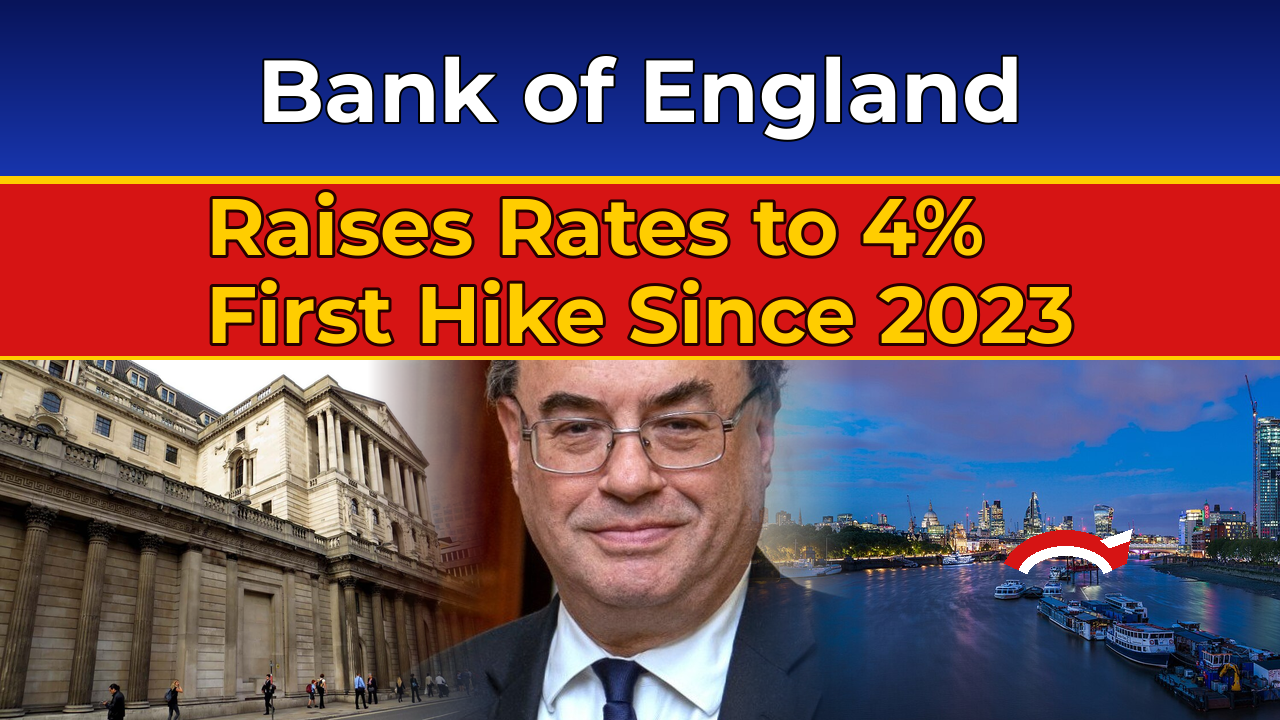
The Bank of England has raised interest rates to 4%, its first increase in over three years. The Bank’s Monetary Policy Committee voted 8-1 on Thursday, November 5, 2026, to lift Bank Rate by a quarter of a percentage point from 3.75%, warning that at least one more rise is likely if the US-Iran conflict in the Middle East keeps energy prices high.
It is a sharp change of direction. Until now, the Bank had held back while the US Federal Reserve, the European Central Bank and other major central banks raised rates to fight inflation driven by the war. Governor Andrew Bailey said months of high energy prices had built up so much inflationary pressure in the pipeline that the Bank could no longer sit on its hands.
| Bank of England Rate Rise — Key Facts | |
|---|---|
| New Bank Rate | 4%, up from 3.75% |
| Size of the rise | 0.25 percentage points |
| Decision date | Thursday, November 5, 2026 |
| MPC vote | 8-1 in favour of 4% |
| Dissenting member | Catherine Mann — voted for a bigger rise to 4.25% |
| Last rate rise before this | 2023 — first increase in over three years |
| UK inflation (September 2026) | 3.5% (CPI) |
| Inflation forecast | Around 5% by mid-2027, against a 2% target |
| Next MPC decision | December 17, 2026 |
The Vote: 8-1, With the Dissent Wanting More
The vote tells the story of a committee that has moved together, and fast. Eight members — Governor Andrew Bailey, Sarah Breeden, Swati Dhingra, Megan Greene, Clare Lombardelli, Huw Pill, Dave Ramsden and Alan Taylor — voted to raise Bank Rate to 4%. The single dissenter, Catherine Mann, did not want rates held. She wanted a bigger move: a half-point rise to 4.25%.
Mann had said last month that the Bank had been slow to reassure markets that it had a grip on inflation, and in the November minutes she warned of “non-linear inflation risks” after consumer price inflation reached 3.5% in September — a potential trigger, in her view, for a loss of confidence in the central bank.
Just two months ago the picture looked very different. In September, the committee held rates at 3.75% by 6-3, with three members already wanting a rise to 4%. By November, nobody on the committee wanted to hold at all. The argument inside the Bank is no longer whether to raise rates, but how fast.
Why Now? The Energy Shock From the Middle East
The reason is energy. The conflict in the Middle East is in its ninth month, and the Bank says the pressure on prices building up from months of high energy costs is now enough to justify a rise. There is still little evidence of faster inflation outside the sectors directly hit by higher energy costs, but the Bank decided the inflation coming down the road was too large to ignore.
The numbers are stark. UK inflation was 3.5% in September, and the Bank now expects it to reach around 5% in the middle of next year — more than double its 2% target. Its central forecast puts the peak at an average of 4.8% in the second quarter of 2027. In a worse scenario, where oil peaks at around $130 a barrel compared with around $100 now, inflation would hit 6.2% in the third quarter of 2027. Under the central forecast, inflation is not expected to return to 2% until the third quarter of 2028, six months later than the Bank predicted in July.
The energy shock is rippling through global markets, and Pakistan is buying energy in the same expensive market — Islamabad has gone to the spot market for winter gas, as covered in our report on Pakistan’s spot LNG tender for two winter cargoes. For Britain, the immediate problem is domestic: after inflation and taxes, British households’ income from work is set to fall both this year and next, according to the Bank.
“Not the First in an Inevitable Sequence — But Not Likely the Last”
Governor Bailey was careful to frame the decision as a measured step, not the start of an aggressive cycle. “Today’s increase should not be seen as the first in an inevitable long sequence of hikes. That is not inevitable. But unless the conflict in the Middle East is resolved, neither does it seem likely to be the last increase,” he said at the press conference.
His colleagues were more direct in the minutes. Deputy Governor Clare Lombardelli said a further hike was likely to be needed in the near term. Megan Greene and Chief Economist Huw Pill — both of whom, like Mann, had voted for a rise in September — spoke of a need for “further tightening” and “additional hikes”. Swati Dhingra and Alan Taylor, who had previously been reluctant to raise rates, said they would need stronger evidence of second-round effects — companies raising prices and workers seeking higher pay — before backing more tightening.
Financial markets are already pricing in more, with investors expecting three quarter-point rises for 2027 — more than most economists think likely.
What It Means for Borrowers, Savers and Markets
For anyone with a mortgage in Britain, the pain started before the Bank even moved. Two-year fixed mortgage rates have already risen by nearly 50 basis points since early September, because lenders price off market expectations rather than the day’s decision. Borrowers coming off cheaper fixed deals will feel the rise most. Savers, on the other hand, will gain a little, and sterling found support from higher rates: the pound strengthened against the US dollar after the decision, and two-year British government bond yields rose by a relatively sizeable 4 basis points.
The Bank also raised its growth forecasts, expecting the UK economy to grow 1.6% this year and 1.3% next — notably stronger than the government’s Office for Budget Responsibility predicted last week — helped by spending on artificial intelligence and a small, temporary boost from Finance Minister John Healey’s annual budget.
Global markets have been volatile around the same pressures. US stocks were hit hard on the same day by a sharp sell-off in AI and chip shares, as reported in our coverage of the Nasdaq plunge on November 5. A major central bank raising rates because of an energy shock is a reminder that the inflation problem has not gone away anywhere.
What Happens Next
The next decision comes on December 17, 2026, and four things will shape it: energy prices, the October and November inflation figures, pay data, and how quickly mortgage rates adjust. A sustained fall in Brent crude and gas prices from their October averages would weaken the case for another rise. Oil has already eased in recent sessions on hopes of de-escalation.
But the Governor also warned that the dip would not stop him from moving again. “There is already a significant amount of inflationary pressure in the pipeline,” he said. “Without news which softens the risks to inflationary pressures, I can see the argument for a further increase in rates,” he added in the policy minutes. The Bank stresses that policy is not on a preset path: decisions will be made meeting by meeting, depending on how energy prices and second-round effects develop.
What is the Bank of England interest rate now?
Bank Rate is 4%, after the Bank of England raised it by 0.25 percentage points from 3.75% on November 5, 2026. It is the first rate rise in over three years.
Why did the Bank of England raise interest rates?
Energy prices driven by the Middle East conflict, now in its ninth month, are pushing UK inflation higher. Inflation was 3.5% in September and the Bank expects it to reach around 5% by mid-2027, more than double its 2% target.
Who voted against the Bank of England’s decision?
The Monetary Policy Committee voted 8-1 for the rise. The only dissenter was Catherine Mann, who wanted a bigger half-point increase to 4.25%, not a hold.
Will the Bank of England raise rates again?
Probably, if the US-Iran conflict continues. Governor Andrew Bailey said another increase was likely unless the conflict is resolved, and markets have priced in further rises in 2027. The next decision is on December 17, 2026.
What does the rate rise mean for mortgages and savers?
Two-year fixed mortgage rates had already risen by nearly 50 basis points since early September, before the decision, because lenders price in expectations. Borrowers coming off cheap fixed deals will feel it most, while savers will gain a little.
When was the last Bank of England rate rise before this one?
The last rise was in 2023. The November 2026 decision is the first increase since then — the first in over three years.